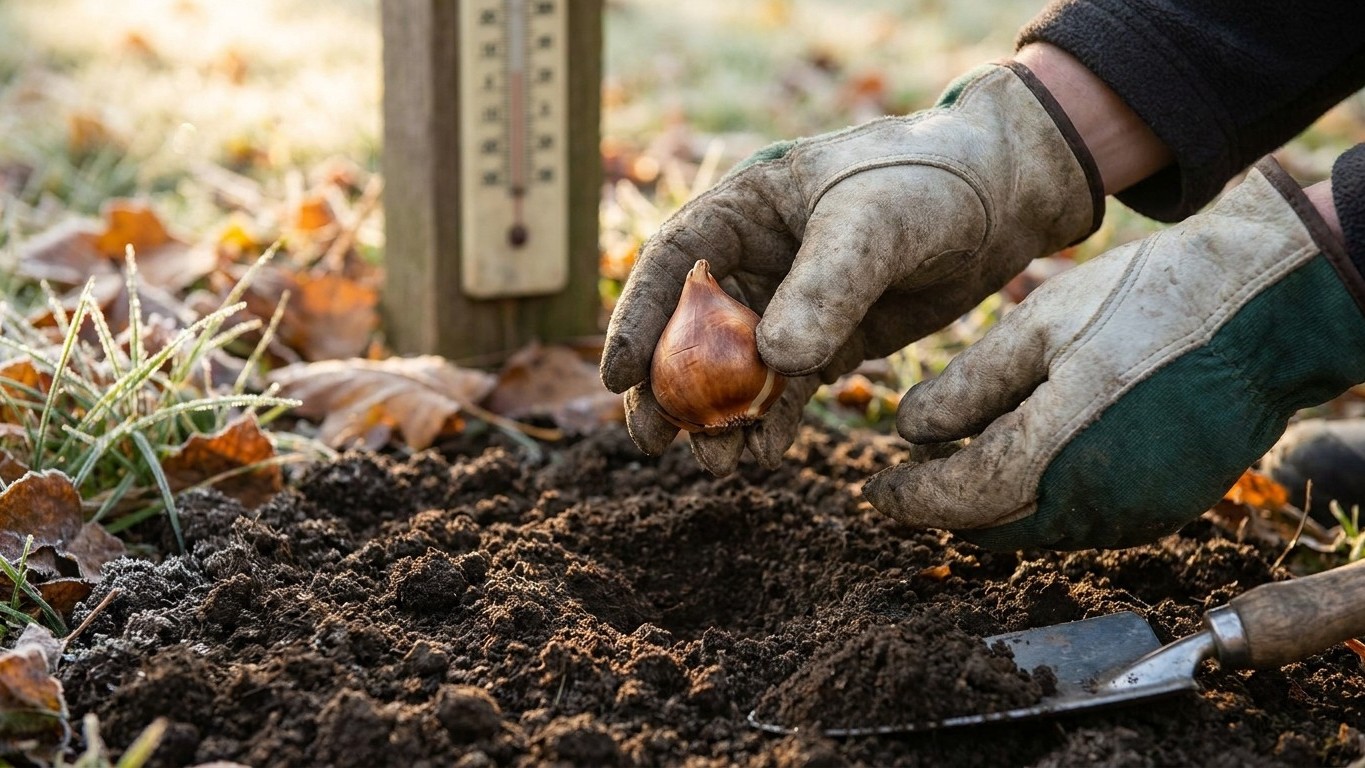

According to almanac tradition, spring bulbs go in during the third quarter of the Moon, between the full moon and the last quarter, on a day when the Moon is in a fruitful or semi-fruitful sign. For this fall, the traditional days are October 26-27 (Moon in Taurus), October 30-31 (Moon in Cancer) and November 26-27 (Moon in Cancer). No effect of the Moon on bulbs is proven, and your state’s calendar comes first.
What the tradition says about planting spring bulbs

Gardening almanacs sort crops into three types: leaf, fruit and root. Spring bulbs belong to the root type, a group that also holds root crops and perennials. The almanac rule is to plant that group in the third quarter, the stretch from the full moon to the last quarter. Gardeners who plant by the Moon also call this stretch the waning moon, and our page on planting in a waning moon covers it in more detail. The broader custom is explained in our guide to planting by the moon.
| Crop type | Quarter in the almanac rule | Crops listed |
|---|---|---|
| Leaf | First quarter (new moon to first quarter) | Lettuce, spinach, cabbage, broccoli, celery |
| Fruit and seed | Second quarter (first quarter to full moon) | Tomatoes, peppers, beans, squash, corn |
| Root, bulbs, perennials (spring bulbs) | Third quarter (full moon to last quarter) | Potatoes, carrots, garlic, onions, beets |
The fourth quarter, from the last quarter to the new moon, is left out of the table because the almanacs treat it as a rest period. They reserve it for weeding, pruning, turning the soil and composting.
This is tradition and nothing more. No effect of the Moon on spring bulbs is proven. The Moon’s tidal pull at the Earth’s surface works out to about 1.1 millionths of a meter per second squared, roughly one ten-millionth of gravity at its strongest. That is far too small to move anything as small as a seed or a root. If you follow the custom, you follow it as a habit, not as a mechanism.
Quarters are only half of the rule. Many almanacs add a second filter, the zodiac sign the Moon is passing through. This convention labels Cancer, Scorpio and Pisces fruitful, and Taurus, Libra and Capricorn semi-fruitful. The other six signs are labeled barren. The Moon’s phase cycle runs 29.53 days, while one orbit against the stars takes 27.32 days. Because those two clocks do not match, the third quarter lands on a different sign each month, and the days that satisfy both conditions are few. In the windows below, the Moon is in Taurus or Cancer.
Traditional spring bulbs planting days, 2026 and 2027
The table lists each month with its Traditional Days for the root type, along with the Moon sign. For more detail on a single month, see the October 2026 moon calendar and the November 2026 moon calendar.
| Month | Traditional days (Eastern time) and Moon sign |
|---|---|
| October 2026 | October 26-27 (Moon in Taurus), October 30-31 (Moon in Cancer) |
| November 2026 | November 26-27 (Moon in Cancer) |
| September 2027 | September 19-20 (Moon in Taurus) |
| October 2027 | October 16-17 (Moon in Taurus), October 20-22 (Moon in Cancer) |
| November 2027 | November 14 (Moon in Taurus), November 17-18 (Moon in Cancer) |
The months shown are those when gardeners in much of the country plant spring bulbs. Your state may start earlier or finish later, so only the rows that fall inside your own state’s window count. A row outside that window is simply not available to you, whatever the Moon is doing.
Each day is read at noon Eastern time, and the Moon changes sign partway through the day. Treat the first and last day of every run as soft edges. A day listed as “October 26-27” does not mean the Moon is in Taurus for the whole of both dates. If you plant on an edge day, you may be planting on the border between two signs.
Two small habits make the table easier to use. If you live west of the Eastern time zone, the Moon’s sign may change at a different hour on your clock, so edge days deserve extra caution. And if a listed day does not suit your schedule, the almanac custom does not offer a substitute. The next listed window is the next option.
Check your state first: when to plant spring bulbs where you live
The order of decisions matters. Start with your state’s planting calendar for spring bulbs. That calendar sets the span of dates when bulbs can go in the ground where you live. Then, only if you want to, look at the Moon and pick among the days that calendar already allows. The Moon never overrides the calendar of the place. Frost dates and soil temperature decide whether bulbs can be planted. If you follow the custom, it only chooses among days that are already open.
Our page on when to plant spring bulbs where you live holds the dates and conditions for each part of the country. This page deliberately leaves out any planting date, soil temperature or frost date, because those belong to that guide and to your own state’s planting guide. If your state’s window and the table above do not overlap, the table has nothing to offer you this year.
When the two do overlap, the practical step is small. Find your state’s window, then circle the rows of the table that fall inside it. If a traditional day falls just inside the start or the end of your window, remember the soft edges described above. You may prefer a day in the middle of a run, where the Moon’s sign is less likely to be changing.
For gardeners who find the two layers confusing, it helps to think of them as two filters, not two rules. The state guide gives you a calendar. The almanac gives you a shorter list drawn from it. You can ignore the second filter entirely and lose nothing the first one provides.
A fair way to try it
A gardener who wants to know whether the custom means anything on their own plot can test it without much effort. The method is simple and keeps the comparison honest.
- Split the bulbs into two equal batches of the same variety, from the same package or the same supplier.
- Plant one batch on a traditional day from the table and the other on an ordinary day inside the same week, in similar soil and at the same depth.
- Label both batches with plant markers that show the date and which batch is which.
- Keep notes in spring on the date shoots first appear and the date the first flower opens, for each batch.
Be honest about what one season can tell you. A single spring will not settle anything. Weather, a wet corner of the bed or a hungry squirrel can swamp any small difference between the two batches. Even several seasons on one plot would only describe that plot, not the Moon in general.
Still, this is the only way a home gardener can judge the custom for their own garden. Reading claims, for or against, tells you what other people believe. Two labeled batches and a notebook tell you what happened in your soil.
Questions about planting spring bulbs by the moon
Does the tradition say to plant spring bulbs in a waxing or a waning moon?
According to almanac tradition, spring bulbs belong to the root type, which is planted in the third quarter. That quarter runs from the full moon to the last quarter, so it falls in the waning half of the cycle. The waxing half, from the new moon to the full moon, is assigned to leaf and fruit crops. This is the almanac rule, and no effect of the phase on bulbs is proven.
What if a traditional day falls on a frost?
The calendar of the place wins. Frost dates and soil temperature decide whether bulbs can go in the ground, and the Moon never overrides them. If a traditional day lands outside your state’s planting window, skip it. The almanac tradition offers no exception, and you can wait for the next listed window or plant on an ordinary day inside your state’s dates.
Do I need to follow the Moon sign as well?
Not if you are following only the quarter rule. The sign is a second layer that many almanacs add, and the table above applies both. A gardener who plants by the phase alone has more days to choose from. Be aware that the sign systems do not agree with one another. The convention used here labels Cancer fruitful and Taurus semi-fruitful, and sources differ on Virgo, Sagittarius and Aquarius. The biodynamic system of Maria Thun sorts days differently, into root days (Taurus, Virgo, Capricorn), flower days (Gemini, Libra, Aquarius), leaf days (Cancer, Scorpio, Pisces) and fruit days (Aries, Leo, Sagittarius). Under that system, Taurus is a root day and Cancer is a leaf day.