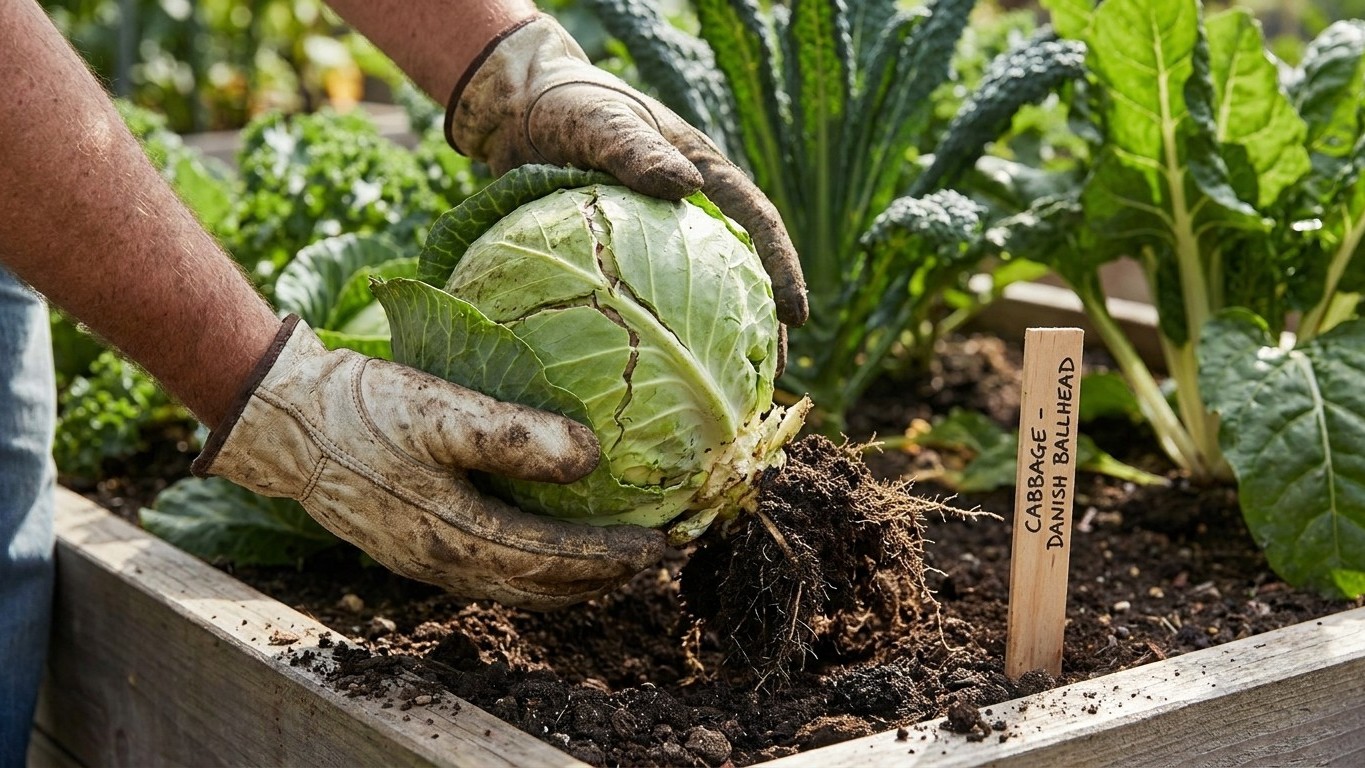

Split cabbage heads come from too much water moving into a head that’s already full, and the fix isn’t complicated. Utah State University Extension’s guide Cabbage in the Garden recommends grabbing the head and pulling it upward to break some of the side roots, which physically limits how much water the plant can push into that head. It’s a five-second job that can save a head you’d otherwise lose right before harvest.
The short answer
When a cabbage head splits, the cause is almost always a sudden shift in soil moisture right as the head is filling out. Utah State University Extension puts it plainly: “Moisture fluctuations during heading will cause maturing heads to split open.” A stretch of dry soil followed by a heavy watering or a soaking rain sends a rush of water into roots that are still fully functional and still pulling hard. The head, which has already reached the size its outer leaves can structurally contain, has nowhere for that extra volume to go except outward, and the leaves crack.
The remedy Utah State University Extension recommends targets the root system directly rather than the watering schedule. Pull the cabbage head up out of the soil to break some of the side roots. With fewer intact roots, the plant physically cannot move as much water upward, so the pressure inside the head drops and splitting stops even if the weather keeps swinging between dry and wet.
There’s a second contributor that has nothing to do with rain or irrigation timing: nitrogen. Utah State University Extension advises against applying additional nitrogen after heads begin to form, because high nitrogen levels at this stage cause loose heads and splitting to occur. So a split head in late season can be a fertility mistake made weeks earlier, not just a watering mishap that happened yesterday.
The timing question that matters most isn’t when splitting happens, it’s when to stop worrying about it. Utah State University Extension’s harvest guidance is straightforward: pick the heads when they reach full size and are firm and compact, before they have the chance to split. Waiting for “just a little bigger” is the single most common reason a gardener loses a head that was otherwise fine. Firm and compact is the signal, not a date on the calendar.
What actually decides it

Splitting is a plumbing problem, not a nutrition or disease problem, and treating it as anything else wastes effort.
Water pressure, not water shortage
A cabbage plant’s roots are constantly moving water upward as long as the soil has moisture available. When the head is small, the surrounding leaves have plenty of slack to accommodate whatever water arrives. Once the head reaches full size, that slack disappears. The leaf layers are packed tight, and any additional water arriving through the roots has to force its way in. If the soil has been dry for a stretch and then gets soaked, either from irrigation catching up or from rain, the roots suddenly resume pulling water at full volume into a head with zero spare capacity. The head splits because the inside expands faster than the outer leaves can stretch. Adding more water on a regular schedule doesn’t solve this. The problem isn’t a shortage of water at any single point, it’s the swing between low and high supply. Steady moisture, not more moisture, is what prevents the pressure spike.
Nitrogen timing changes the structure, not just the size
Nitrogen applied while the head is forming pushes rapid, soft leaf growth at the exact moment the plant should be tightening and firming its layers. Utah State University Extension’s warning is specific to this stage: nitrogen after heading begins causes loose heads and splitting. A loosely packed head has more internal space for water to accumulate unevenly, and looser leaf tissue is simply less resistant to cracking under pressure. This is why the fix isn’t to feed the plant less overall, it’s to stop feeding nitrogen at the point when the head starts forming and let the plant firm up on what’s already available in the soil.
Why “pulling more water in” never fixes it
A tempting instinct is to keep the soil evenly damp by watering more often, assuming that consistency will prevent the swings. But if the root system is large and healthy, it will still transport whatever water is available directly into an already-full head the moment conditions allow it. The transport capacity is the issue, not the total water supplied over the week. That’s precisely why Utah State University Extension’s fix works on the roots themselves rather than on the irrigation can.
How to do it
- Watch for firm, compact heads. Once a head feels solid all the way through when squeezed, and has stopped visibly increasing in size week to week, it’s at the stage where splitting risk rises fast. This is the moment to start checking heads every day or two rather than every week.
- Check soil moisture history before acting. If the plant just went through a dry spell and the soil was recently watered heavily, or a hard rain just fell, that’s the exact combination that triggers splitting. Recognizing this pattern tells you which heads need the root-breaking treatment first.
- Grasp the head firmly at the base and pull upward. The goal, per Utah State University Extension, is to pull the cabbage head up out of the soil in order to break some of the side roots. You’re not trying to uproot the plant entirely, just lift it enough that a portion of the shallow side roots snap.
- Let the plant settle back down. After the tug, the head will usually resettle into the soil somewhat, still anchored by its deeper roots and remaining side roots. That’s enough. The mechanism at work is straightforward: fewer intact roots means less capacity to transport water upward, so excess water stops being pushed into a head that’s already full, which is what stops the splitting.
- Harvest promptly once heads are firm and compact. Don’t hold out for extra size. Utah State University Extension’s guidance is to harvest at the firm, compact stage specifically because waiting past that point is when splitting becomes likely regardless of any root-pulling you’ve done.
- Count backward from your last frost date for next season’s planting, not this season’s fix. Cabbage is transplanted into the garden Before the Last Frost date, unlike warm-season crops that wait for frost to pass. Knowing your own last frost date lets you count backward the number of weeks a variety needs, using days-to-maturity figures like Golden Acre at 65 days or Danish Ball Head at 100 days, so heads reach that firm, compact stage before late-season moisture swings become more common.
What goes wrong

- Watering on a fixed schedule instead of watching the soil. A rigid every-few-days watering routine can still create the dry-then-soaked swing that triggers splitting, especially if rain falls between scheduled waterings. Check actual soil moisture before adding water rather than watering by the calendar, and keep moisture as level as possible through the heading stage.
- Feeding nitrogen after heads start forming. A gardener trying to “push” heads to finish bigger by adding fertilizer late is doing the opposite of what the head needs. Utah State University Extension is direct on this: stop nitrogen once heading begins, since it causes loose heads and splitting. Feed earlier in the season instead, before heads start forming.
- Waiting too long to harvest a firm head. Once a head is firm and compact, every extra week is added risk with no real reward in size or flavor. Harvest at that firm stage rather than gambling on a bit more growth.
- Confusing broccoli’s care with cabbage’s. The two crops share a family but not a heat tolerance profile: cabbage tops out around 80°F and tolerates cold down to 25°F, while broccoli’s thresholds are different, at 75°F and 28°F. Applying broccoli’s Temperature assumptions to cabbage can lead to mistimed watering and stress during heading, indirectly raising the odds of a moisture swing that splits the head.
- Ignoring the roots when a head is already showing early splitting. Once the first crack appears, it’s tempting to assume the head is a lost cause. Pulling the head to break some side roots can still slow further splitting on a head that’s just starting to crack, buying enough time to harvest it before the damage spreads.
Common questions
Does pulling the cabbage head hurt the plant permanently?
No. The technique only breaks some of the shallow side roots, not the main root system. The plant continues drawing enough water and nutrients through its remaining roots to finish maturing normally, while the reduced root capacity is exactly what stops excess water from reaching an already-full head.
Can I prevent splitting without pulling on the head at all?
Keeping soil moisture level through the heading stage and avoiding nitrogen applications once heads begin forming addresses the two root causes Utah State University Extension identifies. The root-pulling technique is a targeted fix for when a moisture swing has already happened or is about to, not a substitute for steady watering.
How do I know a head is firm and compact enough to harvest?
Squeeze it. A head that’s ready feels solid all the way through, with no give when pressed, and has stopped noticeably increasing in size over recent days. That firmness is the exact signal Utah State University Extension recommends using to time harvest before splitting risk climbs.
Is splitting the same issue in every cabbage variety?
The mechanism, water pressure against a full head, is the same across varieties, but time to reach that firm, mature stage differs. Golden Acre matures in 65 days, Ruby Ball in 55 days, Savoy Ace in 80 days, and Danish Ball Head in 100 days, so a longer-season variety spends more calendar time at risk of a moisture swing during heading than a fast-maturing one does.