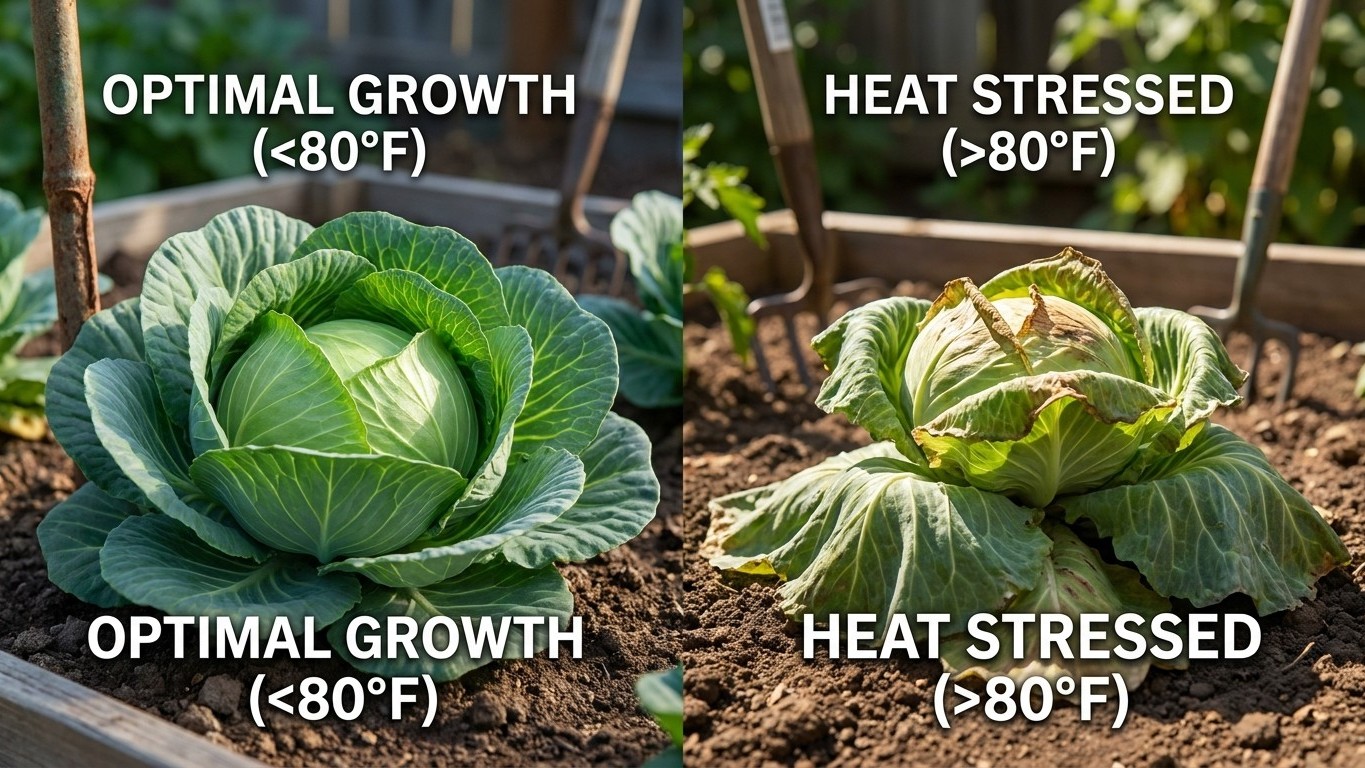

Eighty degrees Fahrenheit. That’s the line cabbage won’t cross without paying for it. Below that mark, plants keep building tight, heavy heads. Above it, growth slows, quality drops, and the crop starts working against itself. Utah State University Extension puts it plainly in its guide Cabbage in the Garden: cabbage grows best when Temperatures do not exceed 80 F, and it shrugs off cold down to 25 F without serious damage.
The short answer
Utah State University Extension names 80 F as the ceiling for cabbage and 25 F as the floor it can absorb without real harm. Read those two numbers side by side and something jumps out: 55 degrees of buffer on the cold end, zero buffer on the hot end. That’s not a rounding error. It’s the whole personality of the crop. Cabbage descends from a coastal, cool-season plant, and its biology never fully adjusted to summer.
The Extension’s language matters here too. It doesn’t say cabbage merely tolerates temperatures up to 80 F. It says the plant grows best below that point, which frames 80 F not as a survival cutoff but as a performance cutoff. A cabbage plant sitting at 85 F for a stretch of days isn’t dying. It’s simply doing a worse job of being a cabbage. Growth rate drops. The plant reallocates energy away from head formation. And the source is direct about the consequence: high temperatures reduce growth, decrease quality, and may cause internal tipburn to form.
That last phrase, internal tipburn, is worth sitting with because it explains why gardeners sometimes cut open a head that looked fine from the outside and find brown, papery edges on the Inner Leaves. It’s not rot. It’s not a pest. It’s a heat-triggered failure that happens on the inside of the head, invisible until harvest.
Compare that to the cold side of the ledger. A cabbage transplant that gets caught by a late frost at 28 F, or even down near 25 F, generally shakes it off. The outer leaves may look rough for a day or two, but the plant keeps going. That asymmetry is the reason cabbage behaves so differently from a warm-season crop like tomatoes in the early garden calendar. Gardeners who plant cabbage with a tomato mindset, waiting for all frost risk to clear before putting Transplants in the ground, are working against the plant’s actual tolerance. Cabbage doesn’t need that wait. It needs the opposite kind of caution: protection from heat, not from cold.
What actually decides it

The growth ceiling itself
Temperature above 80 F doesn’t act like a switch that flips a healthy plant into a damaged one overnight. It works more like a tax. Every degree above that line pulls a little more efficiency out of the plant’s metabolism. Enzymes involved in photosynthesis and growth have temperature ranges where they work fastest, and for cabbage that range tops out right around 80 F. Push past it and those processes slow down even while the plant is still, technically, alive and green. That’s why the Extension’s wording separates “reduce growth” from “may cause tipburn.” Slower growth happens first and happens gradually. Tipburn is the more dramatic failure that can follow if heat persists.
Internal tipburn: a transport problem, not a shortage
Tipburn inside a cabbage head looks like a calcium deficiency, and for decades gardeners have reached for calcium sprays or extra lime to fix it. That instinct misreads the problem. Calcium moves through a plant almost entirely through the water stream in the xylem, driven by transpiration, the process where leaves lose water vapor and pull more water (and dissolved calcium) up from the roots to replace it. Outer leaves, exposed to air movement and sunlight, transpire freely and get their calcium supply easily. Inner leaves, wrapped tightly inside a forming head, are shielded from air movement and barely transpire at all. Under heat stress, that gap widens: the plant’s water demand shifts toward the fast-transpiring outer leaves, and the inner leaves get starved of calcium even when the soil underneath has plenty of it. Adding more calcium to the soil doesn’t reach the tissue that needs it, because the bottleneck isn’t supply. It’s transport. Fixing tipburn means addressing the conditions that disrupt water movement inside the head, principally heat, not the mineral content of the soil.
Why the cold side stays forgiving
The 25 F cold tolerance isn’t an accident either. Cool-season brassicas concentrate sugars in their leaf tissue under cold stress, which lowers the freezing point of the cell fluid and helps cells survive brief exposure to sub-freezing air. That’s a built-in mechanism heat exposure simply doesn’t have an equivalent for. There’s no comparable defense the plant can mount against 85 F afternoons, which is exactly why the Extension’s advice for hot weather is mulch and moisture management rather than any wait-it-out approach.
How to do it
- Get transplants into the ground before your last frost date, not after it. Since cabbage tolerates cold down to 25 F, there’s no reason to hold transplants back the way you would for a frost-tender crop. Count backward from your area’s average last frost date and set transplants out ahead of it, the same approach used for broccoli, so the plants finish their cool-weather growth phase before summer heat starts pushing past 80 F.
- Pick a cultivar based on how fast it needs to finish. Days to maturity determine how much of the growing season a head spends in the cool zone versus the hot zone. Utah State University Extension lists four examples with distinct maturity windows:
Cultivar Days to maturity Ruby Ball 55 days Golden Acre 65 days Savoy Ace 80 days Danish Ball Head 100 days A faster cultivar like Ruby Ball spends less total time in the garden, which narrows the window during which heat above 80 F can interfere with head formation.
- Track soil and air temperature through the season, not just the forecast high. A single hot afternoon matters less than a stretch of days where readings sit consistently above 80 F. That’s the trigger point the Extension identifies for taking action.
- Apply organic mulch once temperatures increase above 80 F. Spread a layer of straw, shredded leaves, or another organic material around the base of the plants. The gesture is simple, but the mechanism behind it is what matters: mulch blocks direct sun from heating the soil surface, slows heat conduction into the root zone, and reduces evaporation, keeping the soil several degrees cooler than bare, exposed ground would be. Cooler soil means roots keep functioning normally even while air temperature climbs.
- Keep watering consistent during hot stretches. Steady soil moisture supports the transpiration stream that carries calcium to inner leaves, directly countering the transport failure behind internal tipburn.
What goes wrong

- Internal tipburn shows up despite plenty of soil calcium. This is a transport failure caused by heat interrupting water movement to inner leaves, not a soil deficiency. Adding calcium fertilizer won’t fix it. Mulching to keep soil cooler and watering consistently through hot spells addresses the actual cause.
- Heads stay small or growth stalls during a hot stretch. Temperatures above 80 F slow the plant’s growth processes directly. Since air temperature can’t be controlled, focus on the soil: an organic mulch layer keeps root-zone temperature lower even when the air above it is well past the ceiling.
- Transplants go in late, on a tomato-style schedule. Waiting for all frost danger to pass before transplanting wastes cabbage’s real advantage, its tolerance down to 25 F. Set transplants Out Before the Last Frost date instead, giving the plant more cool-weather growing time before heat becomes the limiting factor.
- Quality declines but the head still looks harvestable. Heat damage isn’t always visible from outside a head. If a hot stretch has pushed well past 80 F for several days running, don’t assume the crop is fine just because it looks intact. Cut a test head open before assuming the rest of the row is unaffected.
Common questions
Does cabbage need shade cloth once summer heat sets in?
Utah State University Extension’s specific recommendation for temperatures above 80 F is organic mulch to cool the soil, not shade cloth. Mulch addresses the root zone directly, which is where the plant’s heat sensitivity does the most damage.
Can a cabbage transplant survive a frost after it’s already in the ground?
Yes. The Extension states cabbage is not seriously damaged by temperatures down to 25 F, which is why transplanting Before the Last Frost date is the recommended approach rather than waiting for frost risk to end.
Is internal tipburn a sign the soil is low on calcium?
No. Tipburn results from a transport problem, heat disrupting the water flow that carries calcium to inner leaves, rather than a shortage of calcium in the soil itself. Adding more calcium to the soil doesn’t correct it.
Which cultivar finishes fastest if summer heat is a concern?
Among the cultivars named by Utah State University Extension, Ruby Ball matures in 55 days, the shortest window of the four, which limits how much of the growing season the head spends exposed to temperatures above the 80 F ceiling.