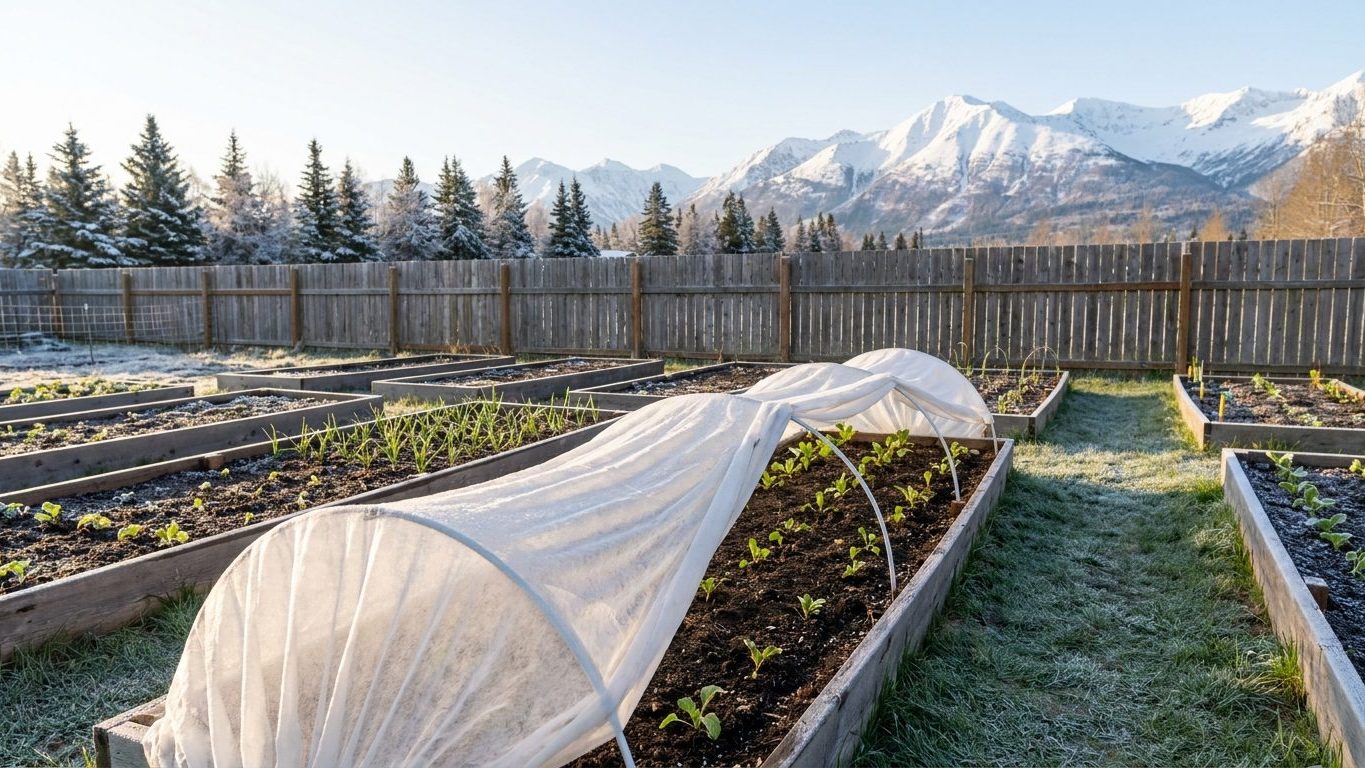

Cover your Iowa garden on any night the forecast shows a low near 32°F. In practice that means spring nights from mid-April until the last freeze has passed, and fall nights starting in the first half of October, sometimes earlier. The calendar gets you to the right week. The overnight forecast gets you to the right night.
The short answer for Iowa
Cover when the overnight low is forecast at or near 32°F, and keep doing it until the last spring freeze has passed and again once the first fall freeze arrives. For Des Moines, the NOAA 1991-2020 Climate Normals put the last spring freeze between April 12 and April 24. The first fall freeze falls between October 14 and October 25.
Those ranges are probabilities of a 32°F freeze, taken from the 30% to 70% band. They are not dates when frost politely stops or starts. Inside the spring window, a freeze is still a live possibility in a good share of years, and the same logic runs in reverse in fall. The Des Moines airport station also sits at the optimistic end. Iowa State Extension county figures (1950-2021) run about 4 days later in spring and 10 days earlier in fall. Shrink the season at both ends before you plan around it.
Spring: covering after transplanting
Tomatoes, peppers, squash, cucumbers and melons are the crops that need cover, and they need it on the nights right after they go in the ground. Hardy crops such as peas, spinach, lettuce and radishes go in earlier and usually need cover only when a hard freeze is forecast. The mechanism is simple: soil and plants soak up heat all day and release it overnight, and fabric slows that escape. Expect a gain of a few degrees, not a different climate.
Put the cover on at dusk, before the air cools, and take it off in the morning once temperatures climb. Hoops or stakes keep the fabric from resting on leaves, where cold can pass straight through. For which materials suit which job, see Which Season Extenders Work in Iowa. The wider picture of stretching the season at both ends lives in Extending the Growing Season in Iowa.
Fall: a night-by-night call
In fall, the first freeze is rarely the last good night of the year. A light freeze is often followed by milder days, so a cover that carries tomatoes and peppers past one cold night can buy more ripening time. Start watching the forecast about ten days before the airport dates, because the Extension county numbers say the first freeze can come that much sooner. Then cover on the nights that matter and uncover on the mild days between.
What will not work here
Planting tender crops on April 12 and trusting the airport date is the most common failure. That date is the early edge of a probability band, and county figures run about 4 days later in spring. A garden planted on the optimistic number and left uncovered is betting on a coin that is closer to even than it looks.
Overwintering under fabric
Winter is the other wall. The mean daily minimum of Des Moines’ coldest month is 13.8°F, and that is an average, so some nights run colder. A single layer of row cover adds only a few degrees, nowhere near enough to hold tender crops through an Iowa January. Fabric can extend harvest of hardy greens and roots into late fall. It will not turn the garden into a year-round one. The state’s USDA hardiness range, 4b to 6a, tells the same story for perennials: the cold here is real, and plants rated for milder places will not make it.
Slow crops and the wrong habits
Iowa’s season, roughly six months between the spring and fall freeze windows, is generous for most vegetables and tight for the slowest. A crop that needs a long run of warm nights, started late and then asked to ripen before an October freeze that may arrive 10 days earlier than the airport says, will run out of time. A cover can rescue one cold night. It cannot add the weeks that a late planting needed.
A few habits also backfire in Iowa specifically:
- Leaving unvented plastic closed on a sunny spring day. Iowa springs swing hard between cold mornings and warm afternoons, and the plants underneath can cook.
- Leaving fabric on squash, cucumbers or melons once flowers open. Bees cannot reach covered blooms.
- Keeping covers on through humid summer weather. Trapped moisture invites disease, and the season-extension job is finished by then.
- Skipping anchors on open ground. Prairie wind will pull loose fabric off a bed by morning, often right on the coldest night.
What changes across Iowa
Iowa is not one garden. The USDA Plant Hardiness Zone Map (2023, built on 1991-2020 data) puts the state in a range from 4b to 6a, four half-zones apart. That map is built on one variable, the average annual extreme minimum temperature, so it describes winter survival, not frost dates. There is no single answer for the whole state, and the dates on this page belong to Des Moines specifically.
Des Moines sits at 41.53 degrees north. A reader in the north should shift the whole calendar later in spring and earlier in fall, which means more cover nights at both ends and a shorter window for slow crops. A reader in the south gets the reverse. Iowa has no mountains, so elevation matters less here than latitude and local terrain: a river valley or low field collects cold air on still nights, while a south-facing wall or a spot near a house stays milder.
Latitude also matters for a reason that has nothing to do with frost. Onions decide when to stop making leaves and start forming a bulb based on day length, not warmth. A gardener near the northern or southern edge of the state should check their own latitude rather than assume Des Moines’ figure applies.
Which zone you are in is a lookup, not a guess. Use the USDA Plant Hardiness Zone Map and enter your ZIP code. Then treat the result as a winter-survival guide only, and keep using frost forecasts for the cover decision.
Where to check this for your own county
Your state extension service holds the county-level data this page lacks. For Iowa, that is Iowa State University Extension. Start by finding your county office and look for two things: the local planting calendar, and the vegetable varieties trialled in your county.
The calendar matters because Extension’s county figures, built from 1950 to 2021 records, run about 4 days later in spring and 10 days earlier in fall than the airport numbers here. If a calendar is organized by crop, as many are, pick the one for the crop you are actually growing instead of a general one. The variety trials matter because a tomato that ripens in a research plot near you tells you more than any catalog description.
A county recommendation beats a state one, every time. This page is the state one. It rests on a single airport station, so it cannot see the cold hollow behind your barn or the warm corner by your south fence. If Extension gives you a frost date that conflicts with a number here, trust Extension, and trust your own garden over both.
Checking this against your own garden
Every date on this page is an average. Your garden is a specific place, and it will tell you things no table can. Three signs are worth watching, and none requires equipment.
- Soil warmth by feel. Push your bare hand a couple of inches into the bed in the morning. Soil that feels cold and clammy is behind the calendar, and warm-season seedlings will sulk there. Compare a sunny bed with a shaded one and you have mapped your microclimate.
- The first male flowers. Squash and cucumber plants produce a flush of male blooms before the female flowers that make fruit. When they open early in one bed and late in another, you are seeing which spot warms first.
- The first true leaves. The first pair of leaves on a seedling are seed leaves. The second set, the true leaves, show the plant is growing on its own. A bed where seedlings reach that stage days ahead of the rest is your early bed, and the best place for the earliest planting.
Write down what you see for a season or two. A few notes on which corner warms first and which hollow frosts first will outrank any airport figure.
Common questions
Is 32°F the right temperature to cover for?
It is the usual trigger, since it is the freeze threshold used in the NOAA data. Clear, calm nights can still produce frost when the forecast reads a few degrees above freezing, particularly in low spots, so cover when the forecast is close.
Can I plant tender crops on April 12 in Iowa?
April 12 is the early end of the airport range for the last 32°F freeze, not a guarantee. County figures from Iowa State Extension run about 4 days later in spring, so treat it as the optimistic case and keep covers ready.
Do I need to cover plants in winter?
Perennials rely on hardiness, not covers, and the state’s USDA range is 4b to 6a. Des Moines’ coldest-month mean daily minimum is 13.8°F, which is too cold for a single layer of fabric to protect tender plants.
Should covers stay on during the day?
Usually not. Take them off or vent them on warm days, and always uncover flowering squash, cucumbers and melons so pollinators can work. The 13.8°F figure above is an average of nightly lows, so individual nights run colder, and that is one more reason to watch the actual forecast.