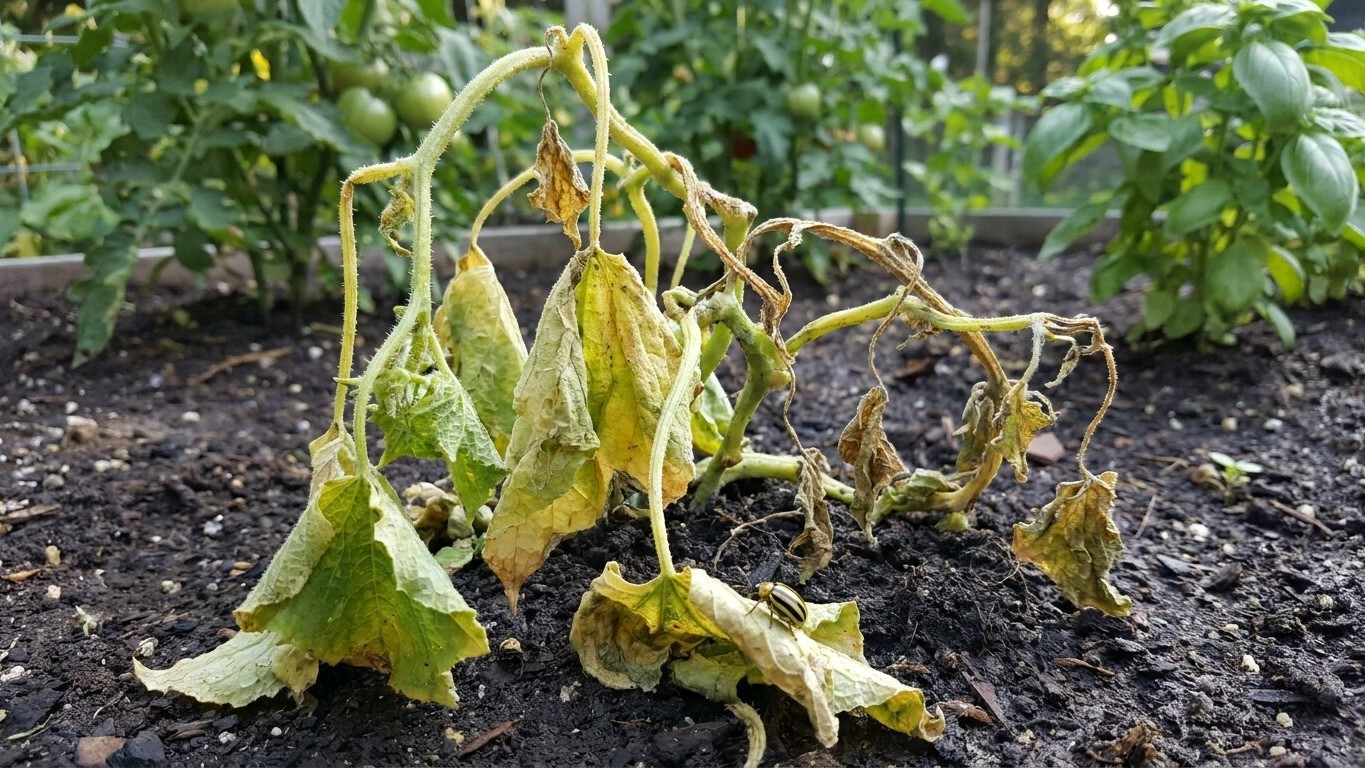

A cucumber vine that droops by afternoon and perks back up after dark is dealing with heat or dry soil. One that stays collapsed morning after morning, no matter how much water goes down, almost always has bacterial wilt, a disease carried into the plant by feeding cucumber beetles. There is no spray that cures it once symptoms show. The only real leverage is catching the beetles early, because the bacteria move from bite to bite, vine to vine.
What is actually going on

The thing to understand here is blockage. The bacteria responsible, Erwinia tracheiphila, don’t attack the leaves or roots directly the way a fungus might. They get inside the xylem, the plumbing that carries water up from the roots, and multiply there until the tissue is packed solid with bacterial cells and the sticky residue they produce. The plant isn’t short on water in the soil. It’s short on water it can actually move through its own stem.
That distinction explains why watering harder never helps. A drought-stressed vine wilts because the soil is dry; give it a good soak and turgor returns within hours. A vine with a clogged xylem can be standing in mud and still collapse, because the pipe itself is obstructed. Once enough vascular tissue is blocked, wilting becomes one-way. Leaves that go down stay down, and the collapse spreads from one leaf to the next runner over a matter of days rather than reversing overnight.
How the bacteria get in
Striped and spotted cucumber beetles pick up the bacteria while feeding on an infected plant, carry it in their gut, and deposit it in the wounds they leave on the next plant they chew. A single beetle can remain infectious for a good part of the season, which is why one early arrival on a young seedling can seed problems across an entire bed within a couple of weeks. Beetles tend to concentrate on new growth and open blossoms, so the youngest, most tender part of the vine is usually the first exposed.
Susceptibility isn’t identical across every cucumber. University trials over the years have found meaningful differences between types, with some pickling and slicing selections showing more tolerance than others, and some burpless or parthenocarpic types bred with reduced susceptibility as a side benefit of other traits. None of that is universal, and it changes from trial to trial and region to region, so rather than chase a specific variety name, the more useful move is checking your state extension service’s current variety trial results for what has actually held up locally. Bush and vining habits don’t appear to matter much on their own; exposure to beetles matters more than growth form.
In the garden
The fastest way to tell bacterial wilt apart from ordinary heat stress is a simple cut-stem test, and it takes less time than walking to the hose. Cut a wilted stem near the soil line, press the two cut ends back together for a second, then pull them apart slowly. If a thin, sticky strand of sap stretches between the two surfaces like a spider’s thread, that’s the diagnostic sign of bacterial wilt. A clean, dry break with no strand points toward drought, heat, or a root problem instead.
| What to check | If it’s bacterial wilt | If it isn’t |
|---|---|---|
| Timing of wilting | Never fully recovers overnight; gets a little worse each day | Perks back up after evening cooldown or a deep watering |
| Pattern across the plant | One runner can wilt while a neighboring one still stands, then spreads leaf by leaf | Whole plant tends to wilt evenly, front to back |
| Cut-stem sap test | Sticky strand of sap stretches between the pulled-apart cut ends | Clean, dry break, no strand |
| Cucumber beetles on leaves or blossoms | Usually present, or feeding scars are visible on leaves | May be present or absent; not the deciding factor for other causes like fusarium wilt |
Once that sap strand confirms bacterial wilt, there’s no soil drench or foliar treatment that reaches the bacteria sitting inside the vascular tissue. Nothing applied to the leaves or the roots gets to where the blockage actually is. That’s the part gardeners find hardest to accept, because everything else in the vegetable garden responds to some intervention, and this one doesn’t.
The practical response shifts from treating the sick vine to protecting the healthy ones around it. Pull the confirmed vine out, roots and all, and discard it away from the compost pile, since the bacteria can persist in plant debris rather than breaking down harmlessly. Then turn attention to the beetles themselves: floating row covers over young seedlings until flowering keeps beetles off the most vulnerable growth stage, yellow sticky traps give an early read on when beetles are active in a particular yard, and daily hand-picking during the first few weeks after transplant catches the population before it builds. None of that fixes the vine already lost, but it slows the next infection.
What it depends on where you are
How much of this risk shows up in a given garden has a lot to do with things this page simply can’t know from here: how long the growing season runs, how warm the soil gets in spring, and how much rain falls once the vines are established. Cucumber beetles overwinter in plant debris and soil, and they emerge once the ground warms to a certain point, so a region with an early, warm spring gives beetles a longer window to build numbers before cucumber vines even get going. A region with a short, cool season may see less pressure simply because the beetle and the plant are less in sync.
Rainfall matters too, though not in a straightforward way. Wet springs can knock back some early beetle activity in certain areas, while other regions see the opposite effect depending on how the local beetle population overwinters. Longer, hotter summers in some parts of the country can also support more beetle generations in a single season, which means more chances for the bacteria to move from an infected vine to a healthy one before the season ends.
None of this is something a single article can pin down responsibly for every reader, and guessing at it would do more harm than good. The state-level pages in this cucumber guide series look at these regional patterns in more detail, and the most current, locally accurate information will always come from a state’s own cooperative extension service, which tracks beetle emergence and local variety performance year to year rather than relying on a national average that may not apply to any one backyard.
The mistake that costs the most
The single costliest mistake is treating the first wilted vine like a watering problem and waiting to see if it bounces back. That delay feels reasonable, since most wilting in a vegetable garden really is about moisture, and pulling a plant that might just be thirsty seems premature. But every extra day that infected vine sits there is another day cucumber beetles keep visiting it, feeding, and then carrying the bacteria straight to the healthy vines nearby. What looks like one sick plant on Monday can look like three or four by the following weekend, not because the disease jumped on its own, but because the delay gave the beetles time to do the spreading.
The better move is running the cut-stem sap test the same day the wilting is noticed, rather than after a week of extra watering to see if it helps. If the test confirms bacterial wilt, pull the vine promptly and get it away from the bed instead of composting it. From there, the energy that would have gone into trying to save the lost plant is better spent on the vines still standing: covering young transplants, checking for beetles daily, and keeping an eye on which types in the bed seem to be holding up better than others, information worth passing along to a state extension office if trial data on locally resistant types is something they track.
Bacterial wilt isn’t a failure of watering technique or fertilizer timing, and no amount of extra care after the fact reverses what’s already blocked inside the stem. Acting fast on the diagnosis, not on the wilting itself, is What Actually Limits the damage.