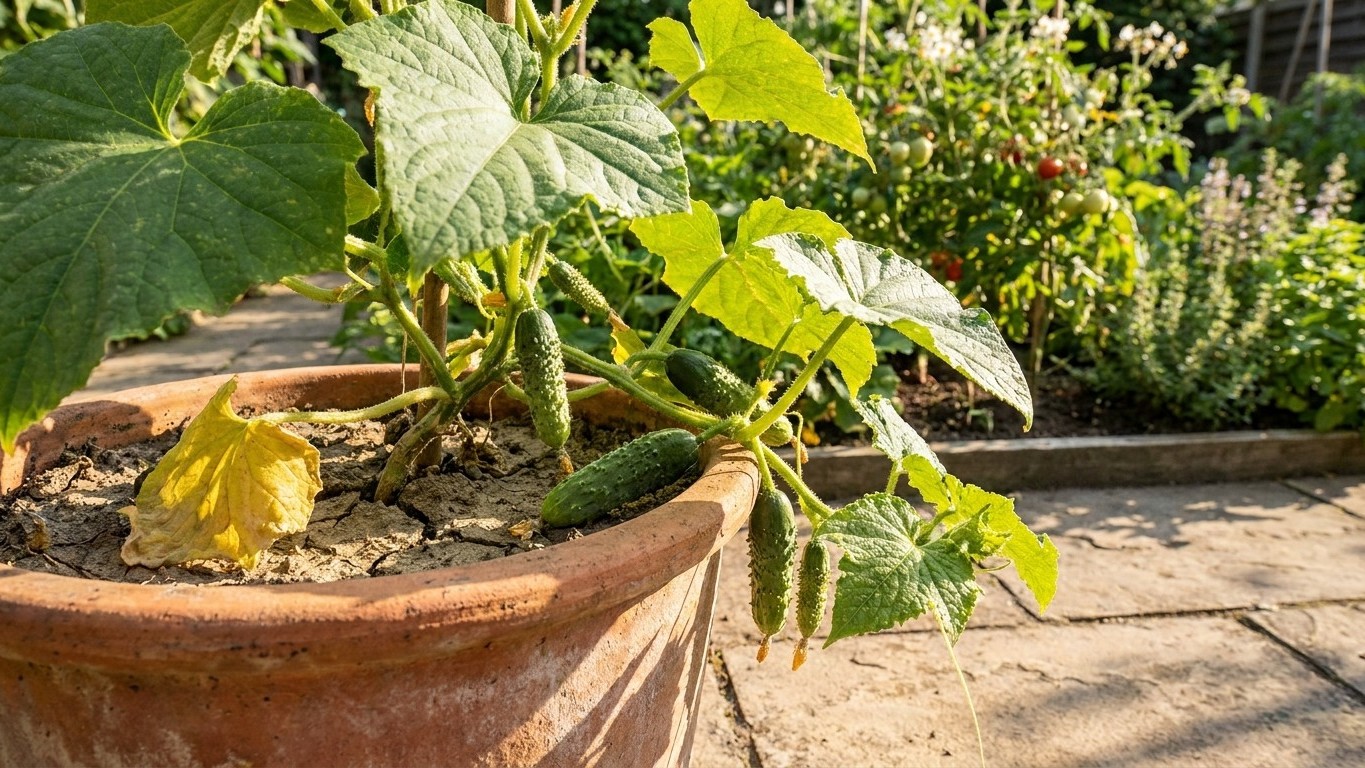

A cucumber in a container can produce just as heavily as one in open ground, but only if the water supply never runs dry between waterings. The pot itself isn’t the ceiling on yield. What’s actually capping production, almost every time, is a gap between how much water a fruiting vine pulls and how much a container can hold in reserve.
What is actually going on

Root room gets blamed constantly, but it’s rarely the real limit. Cucumber roots are shallow and spread wide more than deep, which is exactly why they adapt to container life better than, say, a tomato with a taproot habit. The thing to understand here is water: a container holds a fixed reserve, and a fruiting cucumber can empty it inside a day in summer heat. That’s the mechanism behind almost every container cucumber problem people report, from stunted growth to bitter fruit to a vine that just stops setting.
Here’s why the math works against a pot. A cucumber plant loses water constantly through its leaves, a process called transpiration, and that rate climbs sharply once fruit starts forming and temperatures rise. In open ground, roots can chase moisture sideways and down, tapping reserves the plant never sees in a pot. A container has none of that. Its soil volume is fixed the day you fill it, and once that volume dries past a certain point, the plant doesn’t wait politely. It shuts down fruit development, drops blossoms, or produces cucumbers that taste bitter because growth was interrupted and restarted in stress.
This is also why type matters more than most people think when choosing what to grow in a pot. Vining types keep extending and keep demanding more water and nutrients as they climb, which works fine with a trellis and a generous container, but it raises the daily water bill. Bush types, bred to stay compact, ask for less total leaf area to support, which means a smaller daily water swing and more forgiveness if you miss a day. Parthenocarpic types, the ones that set Fruit Without Pollination, tend to be bred for greenhouse and container production and often handle the confined root zone better than open-pollinated field types. None of that is a brand recommendation. It’s a category difference, and your state extension service will have trial data on which types perform in your specific climate, which is worth checking before you buy seed.
The other piece of the mechanism is nutrient flushing. Every time you water a container heavily enough to see runoff, and you should, you’re also washing nutrients out the drainage holes. A garden bed replenishes itself slowly through soil biology; a pot doesn’t. So the same water constraint that limits fruiting also drives a faster need for supplemental feeding than an in-ground planting, and the two problems compound each other if you’re not watching for it.
In the garden
Once you accept that water reserve is the real constraint, the practical choices fall into place. Container size, plant type, and watering rhythm all exist to solve the same problem: keeping the root zone from swinging between soaked and bone-dry.
Matching container and type
| Container size | Best suited type | What goes wrong if mismatched |
|---|---|---|
| Small pot (roughly 1-gallon range) | Not recommended for fruiting cucumbers | Reserve empties too fast; plant wilts daily and aborts blossoms even with attentive watering |
| Medium pot (5-gallon range) | Bush type, no trellis needed | Vining type planted here outgrows the water supply within weeks and stalls production |
| Large container (10-gallon range or bigger) | Vining or parthenocarpic type, trellised | Underfilling with lightweight potting mix reduces actual water-holding capacity, defeating the point of the bigger pot |
The watering rhythm a pot imposes
Ground plantings tolerate an irregular watering schedule because soil below the root zone acts as a buffer. Containers don’t have that buffer, so the rhythm has to be closer to daily during fruiting, and sometimes twice a day in extended heat. Skip a day here and there and nothing dramatic happens at first. Skip it repeatedly during fruit set and you’ll see the classic signs: leaves that look fine in the morning and droop by afternoon, blossoms that yellow and drop before opening, and fruit that develops a bitter edge at the stem end.
Mulching the container surface, something gardeners do reflexively in beds and often skip in pots, slows evaporation enough to stretch that watering window. A one-inch layer of straw or shredded bark on top of the potting mix measurably reduces how fast the surface dries, which buys you margin on the days you can’t check the plant twice.
Feeding follows the same logic as watering. Because heavy watering flushes nutrients out the drainage holes, container cucumbers need supplemental feeding on a shorter cycle than the same plant would need in a bed. The practice that matters is regular, diluted feeding timed to the plant’s fruiting stage, not a single application at planting and then nothing. What product and what dose depends on your soil test and your local extension recommendations, but the principle holds everywhere: a container feeds itself worse than a bed does, and you have to compensate.
What it depends on where you are
Everything above is mechanical and holds true whether the container sits on a patio in the desert Southwest or a deck in New England. What changes by location is how often the water reserve gets stressed and for how long.
Season length decides how many weeks you’re managing this problem at all. A short growing season means fewer weeks of peak demand, but it also means less margin for a slow start, so timing when you move a container cucumber outdoors matters more in a short-season climate than in a long one. Summer heat decides how fast that container reserve depletes on a daily basis; a 95-degree afternoon with low humidity pulls water out of a pot at a rate a mild coastal summer never approaches. And summer rainfall decides how much of the watering job gets done for you versus how much falls entirely on you to manage by hand, since a container under an open sky in a rainy climate still needs monitoring, but one in an arid region needs a watering plan you can’t skip.
None of that is something a national guide can specify accurately, because it varies not just by state but by microclimate within a state, coastal versus inland, elevation, even which side of a house a container sits on. This site’s state-level pages cover regional timing and heat patterns in more detail, and your state’s Cooperative Extension Service publishes trial data on cucumber types suited to local conditions, along with region-specific advice on when to start plants and how to manage them through peak summer stress. That’s the resource worth checking before assuming a general timeline applies to your yard.
The mistake that costs the most
The single costliest mistake with container cucumbers is treating watering as a daily chore to fit into a routine rather than a response to what the plant and the weather are actually doing that day. A gardener who waters every morning at the same time, rain or shine, heat wave or mild spell, will eventually hit a stretch of hot, dry days where that fixed schedule under-delivers, and the plant pays for it in dropped blossoms and bitter fruit before the gardener even notices anything wrong.
What costs the most isn’t one missed watering. It’s the pattern of letting the container swing between too dry and then overcorrecting with a flood, which stresses the plant twice in one cycle instead of once. Blossom end rot, often blamed on a calcium deficiency, is frequently a watering consistency problem instead, since inconsistent moisture disrupts how the plant moves calcium to developing fruit even when calcium levels in the soil are adequate.
The fix isn’t a stricter schedule. It’s checking the container directly, by pushing a finger an inch or two into the mix, rather than trusting a calendar. On a mild day that might mean skipping a watering; on a 95-degree day with a fruiting vine, it might mean checking twice. This is also where container and type choice from earlier pays off: a bush type in a properly sized pot with mulch on the surface gives you a wider margin for error than a vining type crammed into an undersized container, because the water demand is lower to begin with. Get the sizing and type right, then let the plant’s actual condition, not the clock, decide when the watering can comes out.