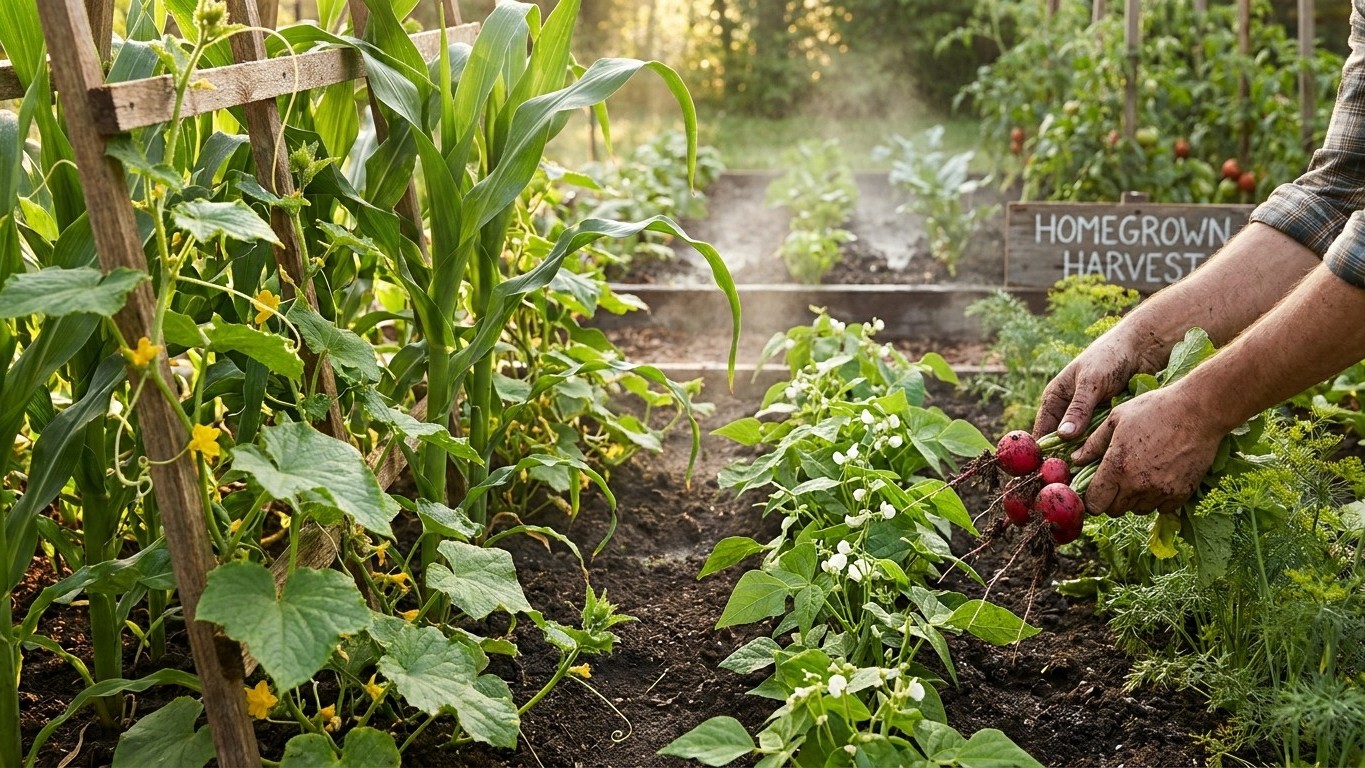

The short answer: pair cucumbers with plants that fix nitrogen, repel specific pests, or share a trellis without competing for root space, like bush beans, corn, radishes, and dill. Skip potatoes, aromatic herbs, and other vining cucurbits. The reasoning matters more than the list, because it tells you when to break the rule.
What is actually going on

Most companion planting charts read like folklore passed down from gardener to gardener, and a lot of it is exactly that. The thing to understand here is that the pairings with real evidence behind them come down to four mechanisms: shade, airflow, root competition, and shared disease pressure. Everything else is anecdote.
Shade is the easiest to picture. Cucumber vines have shallow, wide-spreading roots and broad leaves that shade the soil around them once they mature. A plant like corn, tall and narrow at the base, can share that space without blocking light the cucumber needs, while also giving a vining type something to climb if you let it wander. That’s a physical fit, not a mystical one.
Airflow is the second lever, and it’s the one most home gardeners underrate. Cucumbers are prone to powdery mildew and downy mildew, both of which spread faster in still, humid air. Planting something bushy and dense right next to a vining cucumber, especially on the side that blocks prevailing wind, traps moisture against the leaves. That’s why the useful companions tend to be upright or low-growing rather than sprawling and leafy at the same height as the cucumber canopy.
Root competition explains most of the bad pairings. Potatoes are the classic example: both potatoes and cucumbers are heavy feeders that pull nitrogen and potassium from the same soil layer, and both are vulnerable to overlapping fungal issues in wet soil. Put them close together and you’re not creating synergy, you’re creating a fight over the same resources at the same depth.
Shared disease is the mechanism nobody wants to hear about, because it means some “bad companions” aren’t bad because of the plant itself but because of what it hosts. Squash, melons, pumpkins, and cucumbers are all cucurbits, and cucurbits share pest pressure from cucumber beetles and squash bugs, along with susceptibility to bacterial wilt spread by those same beetles. Planting several cucurbit types in one block doesn’t cause a new problem, it just concentrates an existing one in a smaller footprint, which makes an outbreak worse once it starts.
None of this requires a specific variety. Whether you’re growing a pickling type for a small harvest window, a slicing type on a trellis, a burpless type for easier digestion, or a parthenocarpic type that sets Fruit Without Pollination in a greenhouse or high tunnel, the mechanisms above apply the same way. What changes by variety is trellising habit and fruit set timing, not which plants make good neighbors. For variety performance specific to your area, your state’s cooperative extension service runs trial data most seed catalogs don’t.
In the garden
Here’s where the mechanisms turn into actual planting decisions, along with what tends to go wrong when the pairing is mistimed or mis-spaced rather than simply wrong.
| Pairing | Why it works | What goes wrong if you get it wrong |
|---|---|---|
| Bush beans | Fix nitrogen in the soil that cucumbers, as heavy feeders, use readily; low growth habit doesn’t compete for light | Planted too close, beans get shaded out once cucumber vines spread, and the nitrogen benefit doesn’t offset lost bean yield |
| Corn | Tall, narrow footprint gives a vining cucumber a natural climbing structure and doesn’t block afternoon sun | If corn is planted too dense, it competes for water hard enough that both crops come up short during dry spells |
| Radishes | Fast-growing and shallow-rooted, some gardeners use them as a trap crop for cucumber beetles, drawing pests away from emerging cucumber seedlings | Left in the ground too long after cucumbers establish, radishes just compete for the same topsoil moisture with no remaining trap-crop benefit |
| Dill | Attracts predatory wasps and other beneficial insects that prey on cucumber pests, especially once it flowers | Dill left to go to seed everywhere can become a weed problem in the same bed next season |
| Marigolds | Some varieties suppress root-knot nematodes in soil over a full growing season, and the strong scent can mask cucumber plants from egg-laying pests | The nematode effect takes a season of dense planting to show up, not a few marigolds scattered around the bed’s edge |
| Nasturtiums | Act as a sacrificial trap crop for aphids, which strongly prefer nasturtium foliage when both are available | If aphids overwhelm the nasturtiums, they migrate to the cucumbers anyway, so this only works if you’re monitoring, not ignoring, the trap crop |
On the other side of the ledger, potatoes top the list of plants to keep away from cucumbers, for the root competition and shared fungal pressure already described. Aromatic herbs like sage and rosemary are a subtler miss: they prefer drier soil and less frequent watering than cucumbers do, so the two end up fighting over irrigation timing rather than benefiting from any pest-repelling scent, which is the reason usually given for planting them together.
Other cucurbits, squash, melons, pumpkins, and zucchini, are the pairing gardeners get wrong most often, usually because the advice to “grow your vining crops together” sounds efficient. It isn’t. Cucumber beetles and the bacterial wilt they spread move easily between cucurbit species, and a bed that mixes several of them turns one infected plant into a fast-moving problem across the whole block. If space is tight, separate cucurbit types by as much distance as the bed allows, or stagger planting dates so they’re not all vulnerable at the same growth stage at once.
What it depends on where you are
Everything above is the part of this answer that holds true nationally, because it’s about mechanism, not climate. What changes by region is timing, disease pressure, and which pest actually shows up first in a given season, and this page has no way of knowing which of those applies to your yard.
Season length changes when companion plants need to go in relative to cucumbers. In a short growing season, a fast crop like radishes needs to be timed so it’s finished or removed before cucumber vines need that same soil space, while in a long season there’s more room to stagger a second round of a trap crop later in summer. Corn planted as a living trellis needs enough weeks ahead of cucumber transplanting to reach a height that’s actually useful for climbing, and that timing window differs by region far more than most planting charts admit.
Summer heat changes which companion plants hold up at all. Some herbs and greens that work as understory plants in a moderate summer will bolt or die back in extended high heat, at which point they stop providing any shade or pest benefit and just become dead space in the bed. In regions with intense, sustained summer heat, the shade-providing role that a companion plant offers matters more, not less, because cucumber roots overheat faster in exposed soil.
Summer rainfall and humidity change the disease side of this equation more than anything else. In wetter regions, the airflow mechanism becomes the priority, and the case for avoiding dense, moisture-trapping neighbors gets stronger. In drier regions, powdery mildew still shows up but downy mildew is less of a threat, which changes how much spacing actually matters.
Pest pressure itself varies enough that a trap crop useful in one state may not be the local pest’s actual preference in another. Cucumber beetle species, aphid populations, and squash bug pressure all differ regionally in timing and severity. Your state’s cooperative extension service tracks this locally, often with specific guidance on trap crops and monitoring windows for your area, and it’s a far better source for that detail than a national companion planting list. Check this site’s state-level cucumber guides for the specifics that apply to your growing region.
The mistake that costs the most
The single costliest error isn’t picking a bad companion. It’s crowding a good one. A gardener reads that beans, corn, and radishes are all beneficial, plants all three tight around a cucumber hill, and ends up with a root competition problem worse than anything a genuinely poor pairing would have caused.
Companion planting benefits are not additive. Nitrogen fixed by bush beans doesn’t stack with the pest-trapping value of radishes to create some multiplied benefit if all three are jammed into the same square foot of soil. Each companion plant still needs enough root room and light access to do its job, and cucumbers, whether a compact bush type in a container or a vining type sprawling across a trellis, still need their own share of both. Pile too many companions in too little space and you’ve recreated the exact root competition problem this page just spent several paragraphs explaining how to avoid, just with more species involved.
What to do instead is treat spacing as the first decision, not an afterthought once you’ve picked which plants sound good together. Decide how much room the cucumber itself needs based on whether it’s a bush or vining habit, plan the trellis or ground space accordingly, and only then look at what fits in the remaining margin without shading the cucumber’s leaf canopy or competing in the same root zone. One well-placed companion that gets enough space to actually do its job, whether that’s fixing nitrogen, drawing off aphids, or luring cucumber beetles elsewhere, beats three companions stacked in too tight to do any of it. If the bed is small, that often means choosing one companion function to prioritize, disease-related airflow, pest trapping, or nitrogen, rather than trying to solve all three problems in the same few square feet.