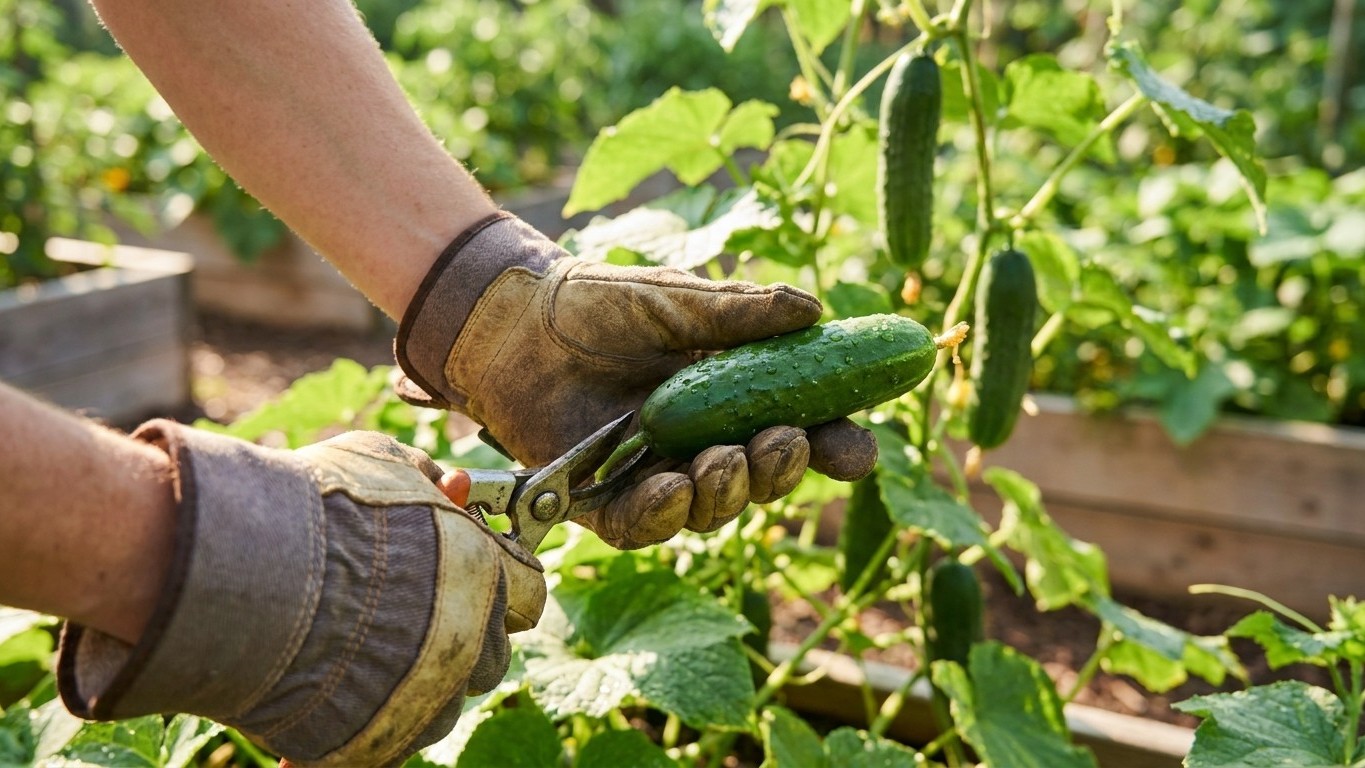

Pick cucumbers small and pick them often, ideally every day or two, before the skin dulls or the fruit starts to swell past its type’s normal harvest size. That single habit, more than fertilizer or watering schedule, determines whether a vine keeps producing through summer or shuts down after three weeks.
What is actually going on

The thing to understand here is that a cucumber vine doesn’t count harvest baskets. It counts seeds. Once a fruit is left on the vine long enough to start maturing, the seeds inside begin to develop and the plant reads that as mission accomplished. It shifts resources away from flowering and new fruit set toward ripening that one cucumber into a seed-bearing structure. One overlooked cucumber, hidden under a leaf for a week, can cost the whole plant a week of new growth. Multiply that across a dozen missed fruit over a season and the yield gap becomes obvious.
This is a hormonal signal, not a nutrient shortage. Mature seeds inside a ripening fruit produce plant hormones that travel back through the vine and suppress the formation of new female flowers nearby. Gardeners who check the row daily are essentially interrupting that message before it gets sent. Gardeners who check twice a week, especially during a hot stretch when fruit can go from finger-sized to oversized in 48 hours, are letting the signal through again and again without realizing it.
Fruit type changes how forgiving this is. Pickling types are bred to be picked young and often, sometimes multiple times a week, because their whole value is in small, dense fruit with thin skin. Slicing types tolerate a slightly longer window since the target size is bigger to begin with. Burpless and parthenocarpic types, the seedless or near-seedless varieties often grown on trellises or in greenhouses, still follow the same rule even though they don’t need Pollination to set fruit: an oversized fruit still tells the plant to stand down, seeds or no seeds. Bush types tend to ripen in a shorter, more concentrated window than vining types, which spread production out but also hide fruit more easily under sprawling foliage.
None of this is about a fixed number of days from planting. Maturity windows vary by type and by the specific variety a gardener is growing, and inventing a days-to-maturity figure here would be guesswork. What stays constant is the mechanism: size and color are the signal to pick, not the calendar. A state extension service or the seed packet for the specific variety in the ground is the right source for how big is too big for that particular plant.
In the garden
Picking correctly is less about strength and more about angle. Cucumbers don’t pull cleanly off the vine the way a ripe tomato does. Yanking tears the stem, and a torn stem is an open wound that invites rot and lets in vine borers and other pests looking for an easy entry point. The fix is a clean cut, made with a small knife, garden snips, or even a thumbnail pressed against the stem just above the fruit, leaving a short stub attached to the cucumber rather than tearing into the vine itself.
| Step | What to do | What happens if skipped |
|---|---|---|
| Check the whole plant, not just the visible top | Lift leaves and look under the canopy, since fruit hides against the soil and behind foliage | Fruit balloons unseen for a week and suppresses new flowering before anyone notices it’s there |
| Cut, don’t pull | Snip the stem with a blade or shears, leaving a short stub on the fruit | The vine tears, the wound scars over slowly, and the plant becomes an easier target for stem borers and fungal rot |
| Harvest on a schedule, not by mood | Walk the row every one to two days during peak season, more often in hot weather | Fruit crosses from ideal size to oversized between visits, and the plant reads that as a stop signal |
| Handle fruit gently after picking | Set cucumbers in a shaded container rather than tossing them in a pile | Bruised skin softens fast and the fruit turns soft and off-flavor within a day or two |
| Deal with oversized fruit immediately | Remove any yellowed or swollen cucumber from the vine even if it’s not wanted for eating | Leaving it as compost-in-place keeps sending the shutdown signal even though nobody plans to harvest it |
That last row matters more than it looks. An oversized cucumber, one that’s gone soft, yellow, or seedy, isn’t garbage. It’s still useful in the kitchen for relishes, pickled spears cut from the firmer outer flesh, or grated into slaws once the seedy core is scooped out. But the reason to remove it from the vine has nothing to do with whether it’s edible. It’s about stopping the hormonal brake before it stalls the rest of the plant’s production. Treat overgrown fruit as a harvest task even on the days there’s no intention of eating it.
One more practical note on cutting versus pulling: this is especially true for parthenocarpic and burpless types often grown vertically on a trellis, where the vine is under more tension and a torn stem can destabilize a section of the whole plant rather than just one fruit’s connection point.
What it depends on where you are
The mechanism, mature fruit suppressing new flowers, is universal. It happens the same way in a raised bed in the Pacific Northwest as it does in a row crop in the Southeast. What isn’t universal is how fast a cucumber gets from perfect to oversized, and that’s entirely a function of local heat and season length.
In a stretch of intense summer heat, fruit can size up dramatically faster than it does during a cooler, cloudier week, which means the safe interval between harvests shrinks exactly when a gardener is least likely to want to walk the row twice a day. Humidity and rainfall patterns also affect disease pressure on wounded stems and on fruit sitting in wet foliage, which changes how much care matters in the cutting step described above. A short growing season changes the math differently: gardeners working with a compressed window before first frost often let harvest intervals slip because every fruit still on the vine near season’s end feels like it might be the last one, when in fact picking it promptly is what buys a few more weeks of production before frost actually arrives.
None of that can be answered generically. A safe harvest interval in one state’s July isn’t the same as another state’s July, and a gardener in a short-season northern climate is managing a completely different calendar than one in a long, hot southern growing season. This site’s state-level cucumber pages cover those regional differences directly, and for anything more specific, a state extension service or land-grant university’s horticulture program has trial data and localized guidance that a general gardening article simply can’t replicate. That’s not a cop-out. It’s the honest answer: the picking rule is national, the timing math underneath it is local.
The mistake that costs the most
The single most expensive mistake is letting a “just one more day” mindset apply to cucumbers the way it might apply to a tomato slowly turning red on the vine. Tomatoes reward patience. Cucumbers punish it. A gardener who waits an extra day or two hoping a slicing-type fruit gets a little bigger isn’t gaining much size, since most of the growth that matters happens fast once a cucumber starts sizing up, but they are absolutely triggering the shutdown signal that slows down every flower that plant would have opened over the following week.
The fix isn’t complicated, but it does require treating cucumber harvest as a routine rather than a reaction. Walking the row on a set schedule, checking under the leaves and along the soil line where fruit likes to hide, and cutting rather than pulling every single time, does more for total season yield than almost any other single practice, including fertilizing schedules or pest treatments. It costs nothing but a few minutes a day.
The version of this mistake that trips up even experienced gardeners is the vacation gap. A week away in peak season, with nobody checking the vines, is often enough to let several fruit go from ideal to oversized, and the plant responds by slowing production right when the gardener gets back expecting a bumper harvest waiting for them. Arranging for a neighbor or family member to pick, even without eating anything, during any absence longer than a couple of days protects the plant’s output far more than it protects the actual fruit picked. The cucumbers removed during that stopgap harvest matter less than the fact that removing them keeps the vine’s signal system clear.