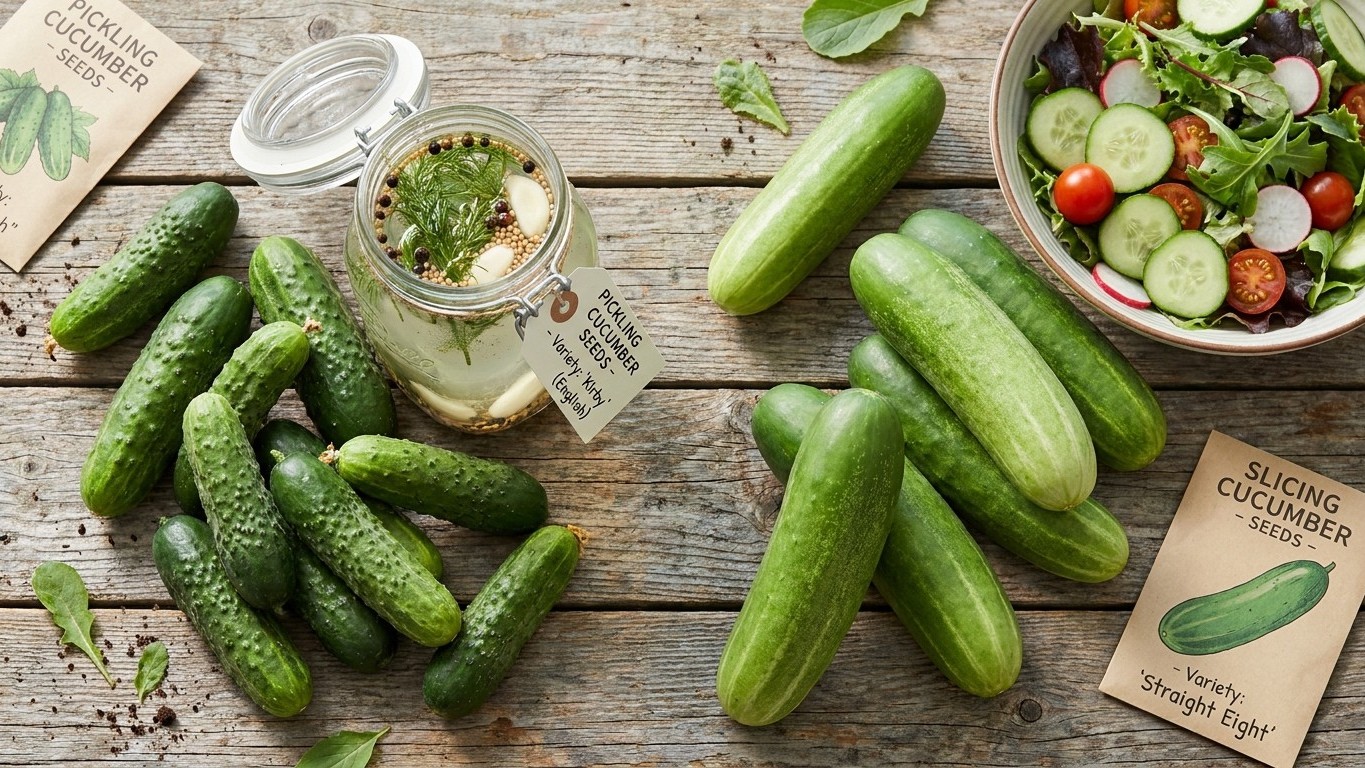

Pickling cucumbers and slicing cucumbers are genetically different plants bred for opposite outcomes: dense, thin-skinned flesh built to hold up in brine, versus thick-skinned, high-water flesh built for fresh eating. You make that choice when you buy the seed packet, not later at the cutting board. Swap the two and the jar, or the salad, will tell you immediately.
What is actually going on

The thing to understand here is skin and seed cavity. A pickling cucumber has thin, often bumpy or spiny skin and a small, tight seed cavity packed with dense flesh. That density matters once the cucumber hits a brine bath: salt and vinegar need to move evenly through the flesh, and a compact interior with fewer air pockets lets that happen without turning mushy. Thin skin also helps, since it lets liquid in without acting as a barrier the way a thicker rind would.
A slicing cucumber is built for the opposite job. Its skin is thicker and usually smoother, partly because that skin has to survive time on a grocery shelf or a kitchen counter without shriveling. The flesh inside carries more water and a looser structure, which is exactly what makes it pleasant raw, cool, crisp, easy to bite through, but that same looseness is a liability in a jar. Add brine to a slicer and the cell walls collapse under the salt and acid instead of firming up, which is why home-canned slicers so often turn out soft.
Seed size and placement follow the same logic. Pickling types are typically harvested small and immature, before the seeds inside have hardened, which keeps the texture uniform end to end. Slicing types are left to grow larger and are harvested with the expectation that the seeds will be bigger and more noticeable, since nobody is asking that fruit to hold a crunch after fermenting.
Beyond the two basic camps
Within both groups you will find further distinctions worth knowing about, even if this page will not tell you which named variety to buy. Burpless types, bred for a milder flavor and easier digestion, exist in both pickling and slicing forms. Parthenocarpic varieties, which set fruit without pollination and are common in greenhouse and high tunnel production, also come in both types. Growth habit varies too: some plants are bred bush-style, more compact and suited to containers or small beds, while others are vining and need a trellis or a lot of ground space.
None of these traits override the core split between pickling and slicing. A burpless bush cucumber is still either a pickler or a slicer underneath, and that underlying identity is what a state extension service trial list will confirm for the varieties that actually perform in a given region’s soil and season.
In the garden
The confusion usually starts at harvest, when a gardener looks at a small, young slicing cucumber and assumes it will behave like a pickler just because it is small. Size at picking is not the same as type. Here is what actually happens when the wrong type gets pressed into the wrong job.
| Scenario | What happens | Why |
|---|---|---|
| Slicing cucumber picked young, used for pickles | Soft, sometimes slippery pickles that don’t hold a snap | Higher water content and looser cell structure collapse once salt and acid draw moisture out |
| Pickling cucumber left to grow large, eaten fresh | Tough skin, hard seeds, bitter undertone in some fruit | Bred for dense flesh and small size; oversized fruit turns woody and the seed cavity hardens |
| Pickling cucumber used for fresh slicing at proper small size | Actually works reasonably well | Thin skin and firm flesh are pleasant raw too, just less watery than a dedicated slicer |
| Slicing cucumber fermented or lacto-pickled instead of vinegar-brined | Slightly better result than vinegar pickling, still softer than a true pickler | Fermentation is gentler on cell walls than a hot vinegar brine, but doesn’t fix the underlying water content |
The lesson in that table is that the failure runs one direction more than the other. A pickling cucumber eaten fresh is a minor disappointment. A slicing cucumber brined for pickles is often a wasted harvest and a wasted jar, since soft pickles cannot be fixed after the fact by more processing time or more salt.
Harvest timing compounds the problem. Pickling varieties are meant to be checked daily once they start producing, because the window between a good small pickling size and an overgrown, seedy fruit is short. Gardeners who grow picklers on a once-a-week harvest schedule, the way they might manage a slicing patch, often end up with fruit too large for anything but relish.
Trellising choice matters for both types but for different reasons. Vining plants trained upward tend to produce straighter fruit with more even color, which matters cosmetically for slicers headed to a salad bowl, and matters practically for picklers since straight fruit packs into a jar with less wasted space. Bush varieties, left to sprawl on the ground, are more prone to fruit resting in damp soil, which invites rot and disfigured shape in either type. None of this changes what the plant fundamentally is, but it does change how usable the harvest turns out to be.
What it depends on where you are
The pickling-versus-slicing choice is universal. Everything around it, season length, summer heat, and how much rain a region gets during fruit set, is local, and this page has no way of knowing which conditions apply to a specific reader’s yard.
Cucumbers of both types are heat-loving and frost-sensitive, but how much of the growing season they get to work with varies enormously across the country. A short-season northern garden and a long, hot Gulf Coast growing season are not managing the same plant the same way, even if the seed packet says the same thing. Humidity plays its own role separate from heat, since damp, still air raises the risk of foliar disease regardless of whether the crop is destined for a jar or a salad.
Soil moisture consistency affects pickling and slicing cucumbers differently in practice. Picklers are usually harvested young and often, so a garden that dries out unevenly can produce fruit with a bitter edge or an odd shape sooner than a slicing patch would show the same stress, simply because pickling fruit is checked and picked so much more frequently that the problem gets noticed faster. That is not proof pickling types are more sensitive, only that their harvest rhythm surfaces problems on a shorter timeline.
Because season length and summer conditions genuinely change which varieties perform, and which planting dates make sense, the honest answer is to check both a state-level guide and an official source. The USDA Plant Hardiness Zone Map is the starting point for understanding a region’s frost dates and growing window, and a state’s land-grant university extension service will have trial data on which pickling and slicing varieties actually hold up locally. This site’s own cucumber growing guide and state-specific planting pages go into that regional detail further than a single national page reasonably can.
The mistake that costs the most
The single costliest mistake is buying cucumber seed by size or by habit, bush versus vining, without checking whether the packet says pickling or slicing at all. Gardeners plan a whole season around a crop, then discover in the second week of harvest that the fruit they are pulling off the vine cannot do the job they had in mind for it. By that point the plant is already committed. There is no fixing a slicing cucumber into a pickler mid-season.
This mistake is easy to make because seed racks and catalogs often organize by growth habit or by novelty trait, burpless, mini, container-friendly, before they organize by pickling or slicing intent. A shopper scanning for a compact plant for a small raised bed can walk away with a bush slicer when what they actually wanted, without realizing it, was a bush pickler for a batch of refrigerator dills come August.
The fix is simple and happens entirely at the seed rack or the online checkout, before a single seed goes in the ground. Read the packet’s stated use, not just its size or habit, and match it to the actual plan for the harvest. Someone who wants both fresh salad cucumbers and a batch of jarred pickles from the same garden should plant both types deliberately, in labeled rows or separate sections, rather than assuming one all-purpose plant can cover both jobs. If there is doubt about which named varieties of either type are proven performers in a given climate, a state extension service’s cucumber variety trial list settles it with regional data instead of guesswork.
Labeling matters more than it seems once midsummer arrives and several cucumber vines look nearly identical. A garden marker at the base of each row, noting pickling or slicing plainly, prevents the exact confusion this page keeps returning to: a harvest that looks fine in the hand and disappoints in the jar.