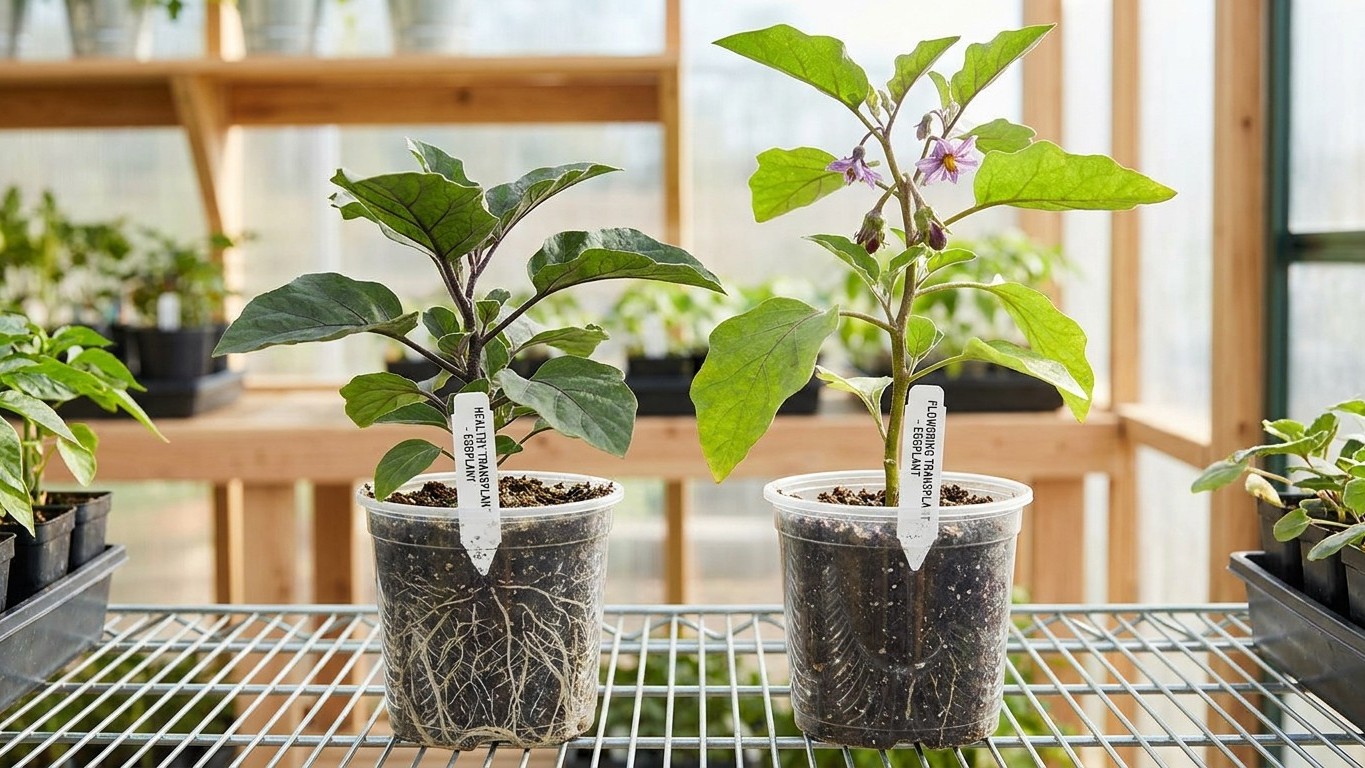

The one already in flower is the eggplant to leave on the bench. Utah State University Extension is blunt about it: plants with blossoms or fruit establish slowly and yield poorly once they hit the ground. What you want instead is a stocky, dark green transplant with 6 to 9 leaves and a root system that’s ready to work, not one that’s already spent its early energy trying to make fruit in a six-inch pot.
The short answer
Skip the eggplant with buds or blossoms showing, and skip anything with a fruit already forming, even a small one. According to Utah State University Extension’s guide to growing eggplant in the garden, the transplants that grow fastest and settle in best are stocky, dark green, carry 6 to 9 leaves, and stand 5 to 8 inches tall. That’s the checklist. Nothing about flower color, nothing about pot size, nothing about how “advanced” the plant looks on the shelf.
It sounds backwards at first. A shopper walking a greenhouse aisle sees a six-pack with a purple flower already open and assumes it’s ahead of the game, closer to harvest, a head start worth paying for. Utah State’s research says the opposite. A transplant that’s already blooming has diverted its resources toward reproduction before it’s even left the container. It hasn’t built the root mass it needs to survive the shock of transplanting, and it pays for that later with stunted growth and a thinner harvest all season.
The extension’s language is direct on this point: eggplant grows best when transplanted at 6 to 9 leaves with a well-developed root system, and transplants at that stage mature earlier and yield more. That’s not a minor edge. It’s the difference between a plant that recovers from transplant shock in a matter of days and one that sulks for weeks, dropping leaves, refusing to push new growth, and eventually producing a handful of undersized fruit instead of a full-season crop.
There’s a second piece to the short answer, and it’s just as easy to get wrong at the store: even a perfect, leafy, non-flowering transplant is a bad buy if you bring it home too early. Eggplant is a warm-season crop through and through. Utah State University Extension specifies that transplanting should wait until soils reach 60 degrees Fahrenheit or until all danger of frost has passed, whichever comes later at your location. Eggplants, the extension notes, are very sensitive to cool temperatures. So the “one not to buy” question has two layers: don’t buy the plant that’s flowering, and don’t buy into the idea that eggplant can go in the ground on the same early schedule as cabbage or lettuce. It can’t.
What actually decides it
The blossom-on-the-shelf problem and the cold-soil problem aren’t two separate rules to memorize. They’re the same underlying issue showing up twice: eggplant’s root system is slow to establish, and anything that adds stress on top of that slowness compounds the damage.
Why a flowering transplant stalls
A young eggplant plant has a limited amount of stored energy and a root system that’s still developing inside the container. When that plant sets a blossom or a fruit, it redirects carbohydrates and water toward reproduction instead of toward expanding roots. Then it gets pulled from its pot, its roots get disturbed, and it’s asked to rebuild that root system in native soil, at exactly the moment it has the least reserve left to do it with. The plant that was “ahead” in the greenhouse ends up behind in the garden, because it spent its head start on a flower instead of on the roots it needed to survive the move. Utah State’s finding that blossoming plants establish slowly and yield poorly is the direct result of that trade-off, not a separate, unrelated fact.
Why cold soil makes it worse
Layer cold soil on top of that weak root system and the problem compounds. Eggplant roots are already working overtime to recover from transplant shock; asking them to do that in soil below 60 degrees Fahrenheit slows nutrient uptake and water movement even further. A plant that was already struggling because it flowered too early in the pot now struggles doubly, because the roots it’s trying to rebuild are working in soil that won’t cooperate. This is why the extension frames the 60-degree soil threshold and the frost-free requirement as firm conditions, not flexible suggestions. A gardener who buys the right plant (vegetative, leafy, no blossoms) but sets it out too early has simply traded one root-stress problem for another.
Put the two together and the mechanism is simple: eggplant yield depends almost entirely on how well the root system establishes in the first two to three weeks after transplanting, and both a premature blossom and premature cold soil attack that same window from different directions.
How to do it
- Choose the transplant at the point of sale. Look for stocky, dark green plants with 6 to 9 leaves and a height of 5 to 8 inches. Skip any six-pack or pot showing a blossom, a bud about to open, or a small fruit already forming, no matter how full or established the plant looks otherwise.
- Check the root system before buying if you can. A well-developed root system is part of what Utah State University Extension lists as the mark of a transplant that matures earlier and yields more. Roots that fill the container without circling tightly are the goal.
- Wait for your own last frost date to fully pass. Eggplant is not planted ahead of frost the way hardier crops are. Count from your local last frost date and don’t move the plant outdoors until that date is behind you and nighttime lows are no longer dipping to frost.
- Confirm the soil temperature separately from the frost date. Even after frost danger ends, the soil itself needs to reach 60 degrees Fahrenheit at planting depth. Use a soil thermometer rather than guessing from air temperature, since soil warms more slowly than air.
- Space plants 24 inches apart in the row, with rows 24 inches apart. This spacing gives each plant room for the root system and canopy it will need through the season, and it matches the exact spacing Utah State University Extension recommends for eggplant.
- Water in immediately after transplanting. A thorough watering at planting helps settle soil around the disturbed root system and reduces the added stress of transplant shock on top of the temperature requirements already met.
What goes wrong
- Buying a transplant that’s already blooming or fruiting. This is the single most common mistake at the point of sale. The plant looks further along, but Utah State University Extension found these transplants establish slowly and yield poorly. The remedy is simple: pass over any six-pack showing flowers or fruit and choose the leafier, shorter, non-blooming plant instead.
- Transplanting before the soil has warmed. Eggplant set out in soil below 60 degrees Fahrenheit, even after the last frost date, stalls because the crop is very sensitive to cool temperatures. The remedy is to check soil temperature directly with a thermometer rather than relying on the calendar or on air temperature alone.
- Verticillium wilt. This is one failure with no varietal fix. Utah State University Extension does not list any resistant variety for eggplant against verticillium wilt. The only measures given are crop rotation, so eggplant and related crops aren’t replanted in the same soil year after year, and soil solarization to reduce the pathogen’s presence before planting. There is no variety to switch to that sidesteps this problem.
- Crowding plants closer than recommended. Setting transplants tighter than 24 inches apart in the row, or rows closer than 24 inches apart, competes root systems against each other and reduces air movement around the canopy. The remedy is to hold the line on spacing even when it seems like a waste of space between small young plants.
Common questions
Is it ever fine to buy an eggplant transplant with a single flower on it if the rest of the plant looks strong?
Utah State University Extension’s guidance doesn’t carve out an exception for an otherwise strong-looking plant. The finding is specifically that plants with blossoms or fruit establish slowly and yield poorly, so the presence of even one flower is the disqualifying sign, regardless of how the rest of the foliage looks.
What if my soil hits 60 degrees Fahrenheit before my last frost date has passed?
Both conditions matter, and the extension frames the requirement as transplanting when soils are 60 degrees Fahrenheit or after all frost danger has passed. In practice, that means waiting for whichever milestone comes later at your location, since a warm soil reading doesn’t protect a young eggplant from a late frost event.
Does starting with a taller transplant, say one already over 8 inches, give a head start?
No. The extension specifies 5 to 8 inches tall alongside 6 to 9 leaves as the marks of a transplant that grows most rapidly. A plant that’s grown taller than that in the container, especially if it’s stretched or leggy, isn’t described as an advantage in this guidance.
Can I rotate in a different eggplant variety to avoid verticillium wilt?
Not according to this source. Utah State University Extension lists thirteen eggplant varieties without attaching any resistance rating to verticillium wilt for any of them. The measures given for managing this disease are crop rotation and soil solarization, not variety selection.