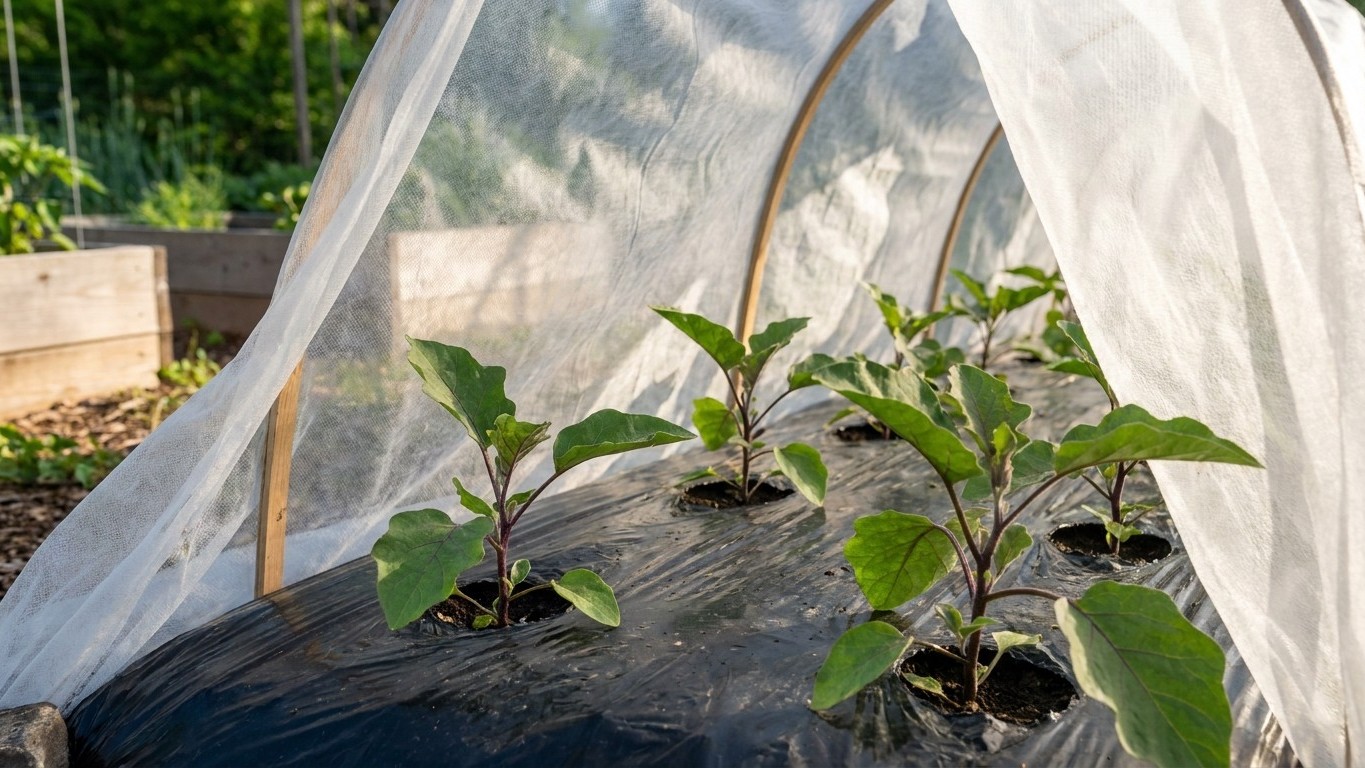

Eggplant hates cold soil, and no amount of babying in seed trays changes what happens once the plant meets open ground. Utah State University Extension has documented one system that reliably buys a gardener extra time: black plastic mulch laid down first, then row covers over the Transplants. Together, the two let plants go into the ground several weeks earlier than they otherwise could. Skip either piece and that advantage doesn’t happen. Here’s the mechanism behind it, the steps in order, and where the whole plan falls apart.
The short answer
According to Utah State University Extension’s guide Eggplant in the Garden, black plastic mulch warms the soil, holds moisture, and suppresses weeds, and when it’s paired with row covers over the plants, transplants can go into the ground several weeks Before the Last Frost date. That’s the whole trick, and it’s a pair, not a single tool. Plastic alone warms the bed but leaves the young plant exposed to cold air at night. A row cover alone traps some warmth around the foliage but does nothing for the roots sitting in cold dirt below. Neither one, used by itself, produces the early start described in the source.
This matters more for eggplant than for most vegetables in the garden, because eggplant is strictly a warm-season crop. Cabbage, broccoli, and lettuce tolerate a light frost and often go out ahead of the last frost date as a matter of course. Eggplant doesn’t work that way. Under normal conditions, transplants wait until all danger of frost has passed and the soil itself has warmed to 60°F. That’s the baseline rule, full stop, with no protection involved.
The black plastic and row cover combination is the documented exception to that baseline, and only that combination. It doesn’t mean frost risk stops mattering. It means the plastic has already been banking heat in the soil for days or weeks before the transplant goes in, and the row cover holds that warmth around the young plant once it’s there, so the bed reaches a safe condition sooner than an uncovered plot would on its own. The gain is measured against an unprotected planting schedule, not against ignoring frost risk altogether. Anyone skipping the plastic, or skipping the cover, is back to the standard timeline: wait for frost danger to clear, confirm the soil has reached 60°F, and only then set plants out. There’s no shortcut around that soil Temperature check, protection or not.
What actually decides it
Soil temperature drives everything else
Eggplant roots simply stop functioning well in cold soil, and a plant with sluggish roots can’t support the top growth it’s been given, no matter how warm the air feels above it. Black plastic works by absorbing solar radiation and transferring that heat downward into the root zone, raising soil temperature faster than bare ground would warm on its own. That’s the first link in the chain: warmer soil means active roots, and active roots mean a transplant that can actually use the nutrients and water available to it instead of sitting stalled.
The row cover closes the gap plastic can’t
Plastic warms what’s underground, but the air just above the soil surface is a different problem, and a cold snap at night can still stunt or kill a transplant even with warm dirt beneath it. The row cover traps a layer of warmer air right around the plant, which is why the two tools work as a pair rather than substitutes for each other. But that same trapping effect turns into a liability once daytime Temperatures climb. Utah State University Extension specifies that eggplant grown under row covers requires ventilation when air temperatures exceed 80°F. Skip that step and the cover stops protecting the plant and starts cooking it, since the same enclosed air that held in nighttime warmth now holds in daytime heat with nowhere to escape.
Mulch timing can undo the whole system
Gardeners who reach for straw or grass clippings out of habit, the same materials that work well later in the season, can quietly cancel the benefit of the plastic. Organic mulches insulate the soil from the sun and keep it cooler, which is exactly the opposite of what black plastic is doing. That’s why the source is specific that organic mulch shouldn’t go down until soil temperatures are warmer than 75°F. Put it down too early, over or instead of the plastic, and the soil-warming effect that made the early transplant possible gets undone by the very material meant to help the plant later on.
How to do it
- Find your own last frost date for your area, since every step that follows is timed against that date rather than a calendar month.
- Lay black plastic mulch over the bed several weeks ahead of that date, giving the soil time to absorb heat before any transplant goes in.
- Check soil temperature under the plastic before transplanting. Even with protection in place, don’t set plants out until the soil reads 60°F.
- Cut slits or holes in the plastic and set transplants through it once that soil temperature is reached.
- Cover the transplants with row covers immediately after planting, anchoring the edges so cold air can’t slip in underneath.
- Watch daytime air temperature under the cover. Ventilate or remove it once temperatures exceed 80°F, since the enclosed air that helped at night becomes a hazard by day.
- Side dress with about 1/2 tablespoon of fertilizer per plant at 4 weeks after planting, and repeat the same amount at 8 weeks. Heavier feeding pushes leaf growth at the expense of flowering and fruit.
- Hold off on organic mulch until the soil is warmer than 75°F, since applying it earlier works against the warming the black plastic already accomplished.
What goes wrong
- Organic mulch goes down too soon. Straw or grass clippings applied while soil is still cool insulate the ground from the sun and cancel out the black plastic’s warming effect. The fix is simple timing discipline: no organic mulch until the soil reads warmer than 75°F.
- Row covers stay on past 80°F. The same trapped air that protects against a cold night turns into heat stress once daytime temperatures climb past that mark. Vent or remove the cover as soon as air temperature crosses 80°F rather than waiting to see if the plant shows stress first.
- Transplants go in before the soil actually hits 60°F. Growers sometimes trust the plastic to have done its job and skip checking, only to set plants into soil that’s still too cold underneath the surface. Always confirm the temperature directly rather than assuming.
- Fertilizer gets applied too heavily or too often. Over-fertilization encourages excessive leaf growth and delays both flowering and fruit maturity. Stick to the light side-dress schedule, roughly 1/2 tablespoon per plant at 4 and 8 weeks after planting, and resist adding more out of impatience.
- Verticillium wilt shows up regardless of variety chosen. There’s no varietal resistance to this disease in eggplant, so picking a different variety won’t prevent it. The only measures that help are crop rotation and soil solarization; once the plant is infected, there isn’t a resistant option to fall back on.
Common questions
Can row covers alone gain the same weeks without black plastic underneath?
No. The early-start effect described by Utah State University Extension comes from the two tools working together. A row cover without plastic still leaves the soil cold, and cold roots stall the plant regardless of what’s happening in the air above it.
What soil temperature has to be reached before transplanting, even with protection in place?
60°F. That threshold doesn’t change whether or not black plastic and row covers are being used; it’s the minimum condition for setting eggplant transplants out at all.
When is it safe to switch from black plastic to organic mulch?
Once the soil is warmer than 75°F. Before that point, organic mulches like straw or grass clippings cool the soil rather than warming it, working against the purpose the black plastic served.
Does a resistant variety protect against verticillium wilt?
No such variety exists for this disease. Utah State University Extension names rotation and soil solarization as the only measures available, with no varietal resistance to rely on instead.