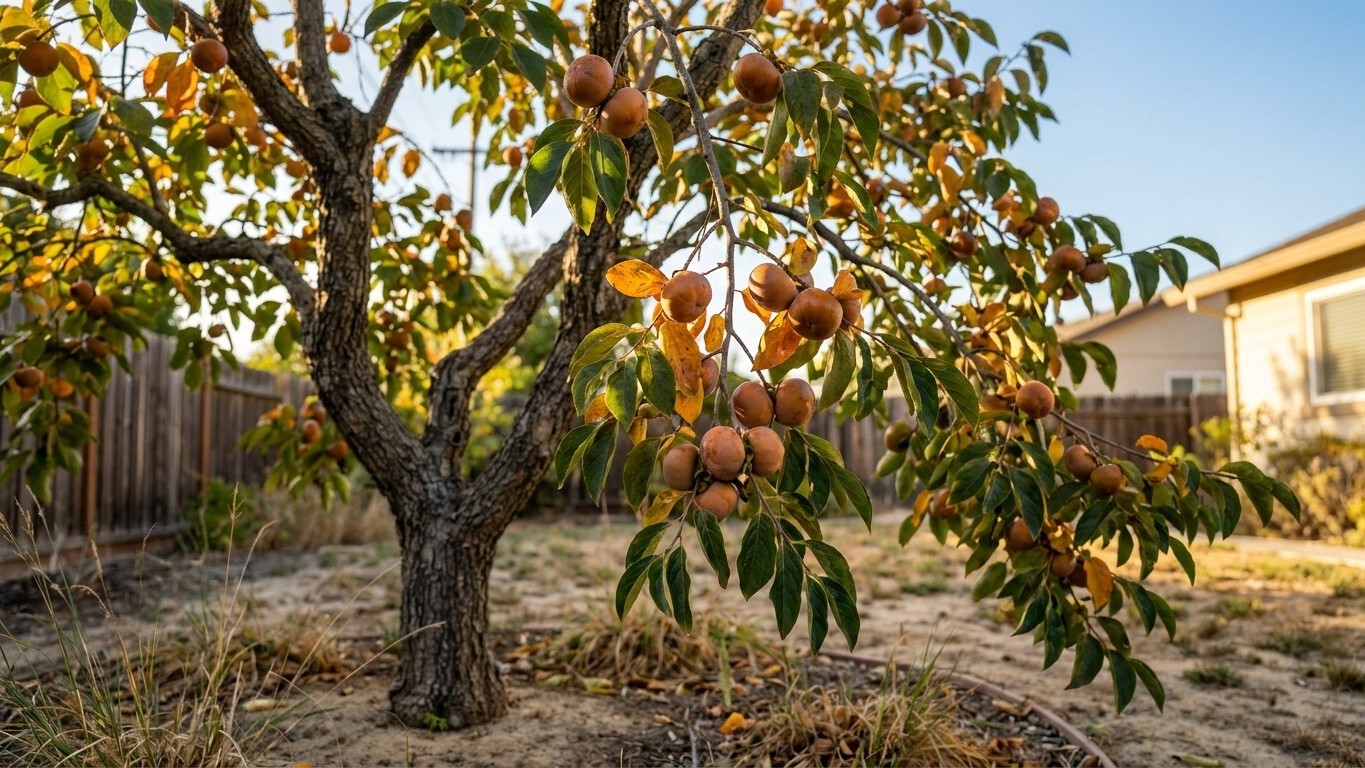

American persimmon (Diospyros virginiana) survives across USDA hardiness zones 4a-9b, tolerates sand, loam or clay, and grows slowly into a tree needing anywhere from 24 to more than 60 feet of space at maturity. But surviving and cropping are two different questions. Site, sun exposure, and whether a second tree is needed all shape whether a planted tree ever produces fruit worth picking.
Where it will and will not survive
The USDA hardiness range for Diospyros virginiana is 4a-9b. That number is the deciding fact for anyone weighing whether to plant one, and the most useful way to read it is backward: this tree is not rated to survive winters colder than zone 4a, and it is not rated to survive conditions above zone 9b. Those two edges matter more than anything in the middle, because a range like this describes the boundary of survival, not a recommendation.
Being hardy to 9b is not the same as being comfortable in a 9b summer. A plant rated to the warm end of a range can still struggle there, showing stress, slower growth, or a shorter productive life, even while technically surviving. The same caution runs in the other direction near 4a: a tree that lives through the winter is not necessarily a tree that thrives there. Hardiness zones describe what a plant can endure, not what conditions suit it best.
Find your own zone before you plant
None of this tells a reader what zone they are actually in, and guessing is how a young tree ends up planted a zone too cold or too hot. The right move is to check a hardiness zone map for the specific state and county in question, since zone boundaries shift with elevation, latitude, and even local microclimate in ways a national map glosses over. This site’s own hardiness zone guide breaks that down state by state, which is the better starting point than assuming a zone from a general sense of climate. Once that number is confirmed, it is a simple matter of checking it against 4a-9b: below the bottom of that range, this tree is not expected to survive; above the top of it, the same applies.
One more note worth carrying into that comparison: the data behind this hardiness range comes from the North Carolina Extension Gardener Plant Toolbox. The USDA zone figure itself is a national standard and applies everywhere. Any regional planting advice tied specifically to North Carolina’s coastal, piedmont, or mountain regions belongs to that state and should not be applied to a garden elsewhere, even if the source happens to mention it in passing.
What it is called, and why that matters here
This tree goes by a long list of common names: American Persimmon, Common Persimmon, Date Plum, Eastern Persimmon, Jove’s Fruit, Persimmon, Possum Apples, Possumwood, Simmon, and Winter Plum. That list comes straight from the source, given alphabetically, and none of the ten is flagged as the official or preferred name. That is exactly why this page is titled by the botanical name, Diospyros virginiana, rather than picking one common name to lead with. An alphabetical list has no opinion about which name is correct, and neither does this page.
Some of these names are worth pausing on, because they carry real potential for confusion. “Persimmon” on its own is the name most shoppers know, but it is also used loosely for Asian persimmon, a different species entirely, sold fresh in many grocery stores. Someone asking a nursery for “a persimmon tree” without specifying American or Asian could easily end up with the wrong one for their taste, their climate, or their intended use. “Date Plum,” too, is a name more commonly attached elsewhere to a related but distinct Asian persimmon species, which means using it by itself, without the botanical name alongside it, risks buying or discussing the wrong plant.
Names like “Possum Apples” and “Possumwood” point to the same tree from a different angle, a nod to wildlife that feed on the fallen fruit, and “Winter Plum” and “Simmon” are regional shorthand more than botanical description. None of these are wrong exactly. They are just imprecise on their own, which is the practical argument for using Diospyros virginiana when buying, searching, or asking a supplier a specific question, and treating the common names as the conversational shorthand they are.
The site it needs to actually crop
The source lists a fairly wide tolerance for light, soil, and drainage, which is good news for anyone without a perfect garden. Here is what it allows for, laid out plainly:
| Condition | What the source lists as tolerated |
|---|---|
| Light | Full sun (6+ hours direct) or partial shade (2-6 hours direct) |
| Soil texture | Clay, loam (silt), or sand |
| Soil pH | Acid (below 6.0), neutral (6.0-8.0), or alkaline (above 8.0) |
| Drainage | Good drainage, moist, or occasionally dry |
That range across soil texture, pH, and drainage reads as a survival tolerance: this is a tree that will take root and grow in a wide range of ordinary garden conditions, from sandy to clay-heavy ground, acid to alkaline, and reasonably dry stretches as well as consistently moist soil. What the facts do not spell out is whether cropping performance shifts across that same range. Light is the one factor conventionally tied to fruit set in trees like this, and here the source lists both full sun and partial shade as tolerated for the plant itself, meaning survival in partial shade should not be in question. Whether that same tree crops as reliably in partial shade as it would in full sun is not something these facts settle, and it would be a mistake to assume either way without confirming it locally.
Space at maturity: the costliest number here
The figure most likely to cause regret later is space at maturity, listed here as 24 to 60 feet, or more than 60 feet. That is a wide spread, reflecting real variation in mature size, and it means this is not a tree for a spot ten feet from a fence line or a foundation. Growth rate is listed as slow, so the size problem builds gradually rather than announcing itself in year one, which is precisely how a tree ends up planted too close to a structure: the mistake doesn’t show up until it is expensive to fix. A tree that reaches 60 feet or beyond also puts fruit high up on female trees, something worth factoring in for anyone planning to actually harvest rather than just enjoy the tree as shade or habitat.
When it crops, and whether it needs a partner
Bloom time is listed as spring and summer, a season rather than a fixed date, and that spread matters more than it might seem. A tree that blooms strictly early in spring is the one most exposed to a late frost wiping out that year’s flowers before fruit ever sets. A bloom period that extends into summer suggests more flexibility, with some flowering happening later once the frost risk has usually passed, though exactly how that plays out depends on latitude and the particular season, and it will shift year to year regardless of what the calendar says on average.
One detail buried in the fruit description matters here directly: fruit forms “on female trees” in fall, which tells us plainly that this is a species with separate sexes on separate plants. That is useful and it is also where this page needs to stop rather than guess further. Whether a male tree is required nearby to pollinate a female tree, and how close it would need to be, is not something covered in these facts. Neither is how many years a newly planted tree takes before it produces its first crop, information that varies a great deal even within a single genus.
Two questions to ask before buying
Rather than guess at either of these, and risk planting a single tree that waits years for fruit that never comes because there is no compatible partner nearby, the practical move is to ask a nursery or supplier two direct questions before buying:
- Does this tree need a second, compatible plant nearby to set fruit, and if so, how close does it need to be?
- How many years should I expect before this tree bears its first crop?
Getting answers to those two questions up front costs nothing and saves years of confusion later, especially since some plants in the same genus are self-fertile while others are not, and there is no safe way to guess which applies here from the plant type alone.
What the fruit is, and what it is for
The source describes the fruit plainly: a globular berry, 1 to 1½ inches long, yellowish to orange or pale peach in color with a waxy bloom on the surface, appearing on female trees from September through December. It is, by the source’s own description, astringent unless overripe, which lines up with the separate edibility note stating the fruit is astringent when green but turns sweet once soft and fully ripe.
That timing matters enormously for anyone eating one. A green or firm American persimmon carries a sharp, mouth-puckering tannic bite, the kind of astringency that coats the tongue unpleasantly and is genuinely unpalatable underripe. Left on the tree until it softens fully, sometimes past the point where it looks appealing at all, that same fruit turns sweet, soft, and almost custard-like in texture, closer to eating a spoonful of dense, honeyed fruit pulp than biting into a firm apple or plum. The gap between underripe and ripe is not subtle here, and it is the single most important thing to know before tasting one.
The source lists the fruit as edible and states it is used raw, and worked into syrups, jellies, ice cream, and pies once fully ripe. That spread of uses, from eating out of hand to baking into a pie filling, fits the fruit’s soft, pulpy ripe texture better than it would a firmer fruit, and it tracks with why overripe persimmons rather than firm ones are the ones cooks reach for. Beyond that description, the source makes no nutrition or health claims about the fruit, and none should be assumed here.
What it resists, and what it does not
Resistance in a plant listing means a tendency to hold up under a particular stress, not immunity from it. A tree listed as resistant to wind can still lose a branch in a severe storm; it is simply less likely to suffer the kind of damage that would affect a more brittle or shallow-rooted species under the same conditions. With that in mind, here is what the source lists for this tree:
| Challenge | What resistance means here | What a reader would likely see |
|---|---|---|
| Wind | A general tendency to withstand wind stress, degree unspecified | Fewer broken branches or toppled limbs than a more wind-sensitive species in the same storm |
| Poor soil | A general tendency to tolerate low-fertility or difficult ground, degree unspecified | Continued growth in soil too poor for many other fruiting trees, rather than the tree faltering or failing outright |
| Storm damage | A general tendency to withstand storm conditions broadly, degree unspecified | Less structural damage after severe weather compared with a more vulnerable species |
The source does not attach a specific degree to any of these three, which is why the table describes them as general tendencies rather than guarantees. It is also worth being clear about what this list does not cover. It speaks to the tree itself, its wood, its structure, its tolerance for difficult soil and weather. It says nothing about pests or diseases that attack the fruit specifically, and these facts carry none of that information. Anyone planning to harvest and eat the fruit, rather than simply grow the tree, is dealing with an open question this page cannot answer and should not guess at.
Common questions
Does American persimmon need a pollinator to produce fruit?
The fruit description confirms it forms on female trees, which tells us the species has separate sexes on separate plants. Whether a male tree is needed nearby to pollinate a female one is not covered in these facts, and it is a question to put directly to a nursery or supplier before buying.
How long before a newly planted tree bears fruit?
There’s no figure for this in the available data, and it varies enough within the genus that guessing would be irresponsible. Ask a supplier directly rather than assuming a timeline.
Can American persimmon grow in shade?
The source lists partial shade (2 to 6 hours of direct sun) as tolerated alongside full sun, which suggests the tree should survive in partial shade. Whether it fruits as reliably there as it would in full sun isn’t addressed in these facts.
Is the fruit safe to eat straight off the tree?
Only once it’s fully soft and ripe. The source describes the fruit as astringent when green and sweet only once soft and overripe, and eating one before that point delivers an unpleasant, mouth-puckering tannic bite rather than anything resembling the sweet ripe version.