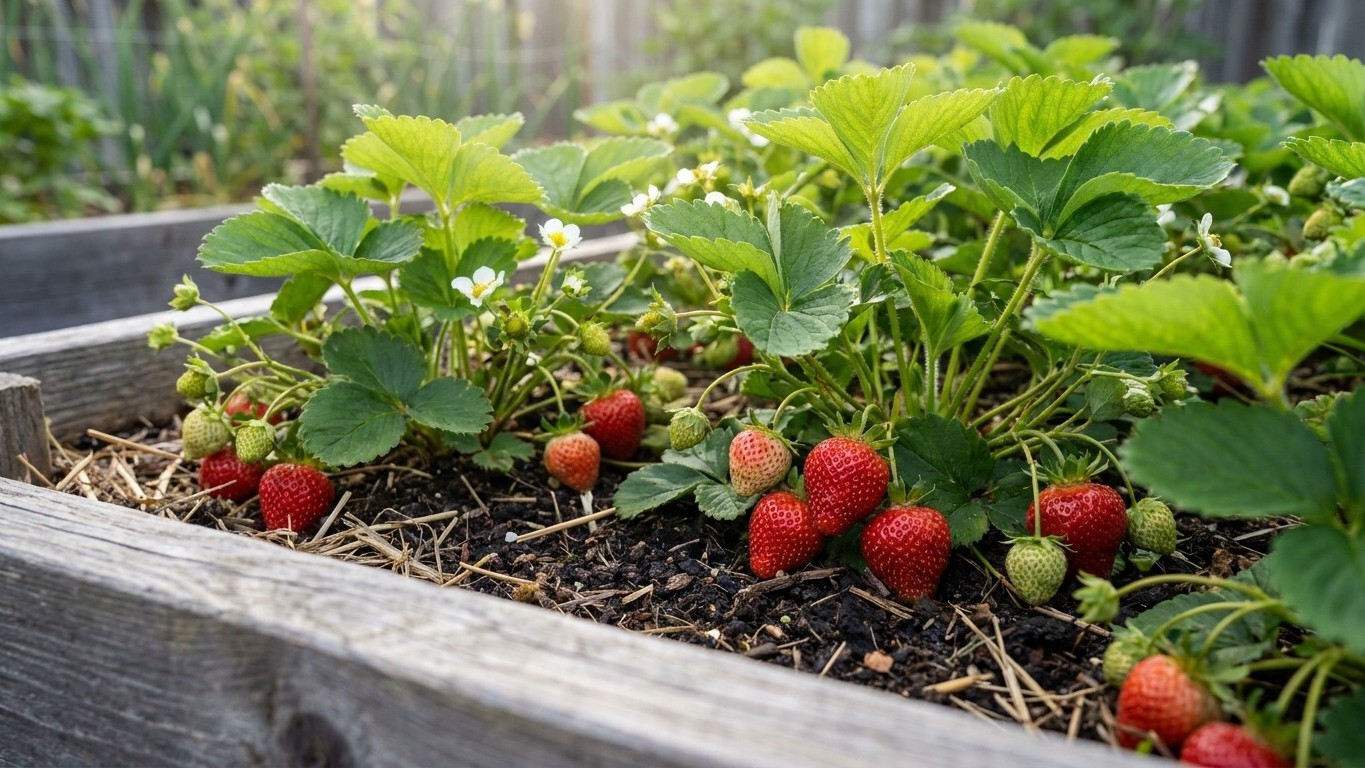

Fragaria x ananassa is the botanical name for the garden strawberry, the fruiting ground cover found in raised beds, rows, and containers across the country. It survives across USDA hardiness zones 5a to 9b, spreads by a clumping habit, and needs full sun or partial shade, moist soil rich in organic matter, and good drainage to actually fruit. It blooms in spring and produces a red, fleshy fruit studded with true seeds called achenes. Here’s what decides whether it lives where you garden, and what it takes to get from flower to fruit.
Where it will and will not survive
The USDA hardiness range for Fragaria x ananassa is 5a-9b, per the North Carolina Extension Gardener Plant Toolbox. That figure matters most for what it rules out: below the bottom of this range, winter cold kills the plant over time; above the top of it, heat and a shortened dormant season push past what it can reliably handle.
A range like this describes survival, not comfort. A strawberry rated hardy to 9b can live through winter there without necessarily thriving through 9b summers, and one at the cool edge, 5a, survives cold without being at its best in a short growing season.
This brief carries no state-by-state breakdown, and none should be guessed here. Zone maps shift by county and even by microclimate within one. Check your own zone directly rather than assume it, using this site’s hardiness zone guide, which breaks the data down county by county. The North Carolina Extension source also offers regional advice, Coastal, Piedmont, Mountains, but that guidance is local to North Carolina and doesn’t transfer elsewhere; the USDA range itself is the part that applies wherever you’re reading this.
What it is called, and why that matters here
The source lists two common names for Fragaria x ananassa: Strawberries and Strawberry. Both point to the same plant, one plural and one singular, without the real conflict that shows up elsewhere in this kind of data, where one common name gets recycled across genuinely unrelated plants.
That’s worth flagging anyway, because it’s exactly the failure mode this naming system can produce. The source lists common names alphabetically, not by how widely used or “correct” they are, and designates none of them as primary. For plants with several distinct common names, that method can leave a reader guessing which name belongs to what’s in front of them. Here the ambiguity is mild: Strawberry and Strawberries are the same word in two forms.
The underlying reason this page is titled by the botanical name still holds. The genus Fragaria includes other strawberry species too, some grown as wild groundcovers rather than fruit crops, and “strawberry” alone doesn’t distinguish between them the way Fragaria x ananassa does. Neither common name is wrong, they’re what nearly everyone actually says, but at the point of buying a specific plant, the botanical name is the one that won’t get confused with a look-alike on the same nursery bench.
The site it needs to actually crop
Survival and fruiting aren’t the same test, and the conditions the source lists split fairly cleanly between the two.
| Condition | What the source lists | Mainly about |
|---|---|---|
| Light | Full sun (6+ hrs) or partial shade (2-6 hrs) | Yield, the source doesn’t say how much fruiting drops in partial shade |
| Soil texture | Clay, high organic matter, loam (silt) | Survival and root health |
| Drainage | Good drainage, moist | Survival, standing water is a common way to lose this plant |
| Growth rate | Medium | How fast it fills in |
| Maintenance | High | Ongoing care to keep it cropping |
No soil pH figure appears in the source, so none is given here. What is specified, high organic matter plus clay or silt loam, with drainage that’s both “good” and “moist”, is a narrower target than generic well-drained soil, which is likely why maintenance rates high.
On space at maturity, the source describes the habit as clumping rather than giving a spread figure in inches or feet. That habit still tells you something: a clumping groundcover spreads from a crown rather than throwing long runners, which is why it’s commonly grown in contained beds or rows where the fruit stays reachable. Confirm an exact spacing number with whoever supplies the plants, since this source doesn’t carry one.
When it crops, and whether it needs a partner
Fragaria x ananassa blooms in spring, a season rather than a fixed month, since timing shifts with latitude and elevation. Spring bloom also means relatively early bloom, and early flowers are the ones a late frost catches, wiping out that season’s fruit set even though the plant itself survives fine. Local frost dates, like hardiness zones, vary by county, so that risk is worth checking against your own conditions rather than a general rule.
What this brief doesn’t carry is whether Fragaria x ananassa needs a second, genetically different plant nearby to set fruit, or bears on its own. Fruiting plants split on exactly this question even within one genus, some self-fertile, some not, so it isn’t safe to guess from plant type. The source data notes the flowers attract pollinators and specialized bees, which confirms they’re built to be visited, but not whether visits within a single clump are enough to set fruit.
Age at first crop is missing too. Some fruiting plants bear the first year; others take several seasons. Nothing here settles that timeline for Fragaria x ananassa, and guessing risks a reader waiting years for fruit that was never coming, or giving up on a plant that simply hadn’t reached bearing age. Both questions, pollination partner and years to bearing, belong to the supplier, asked before buying.
What the fruit is, and what it is for
The source describes the strawberry in botanical terms: the red, fleshy part eaten is technically an “accessory fruit,” not the true fruit. The true fruits are the achenes, the small seed-like dots on the surface, each developed from a flower’s ovary, with the whole cluster hanging from long pedicels. Most of what fills your hand isn’t, strictly, the fruit at all, an odd fact that doesn’t change how it’s picked or eaten.
The source states the use plainly: edible fruits used raw or cooked, covering both the fruit eaten straight off the plant and the fruit cooked into jams, sauces, or baked fillings, without stretching to any preparation the source doesn’t mention.
On flavor: a ripe strawberry is sweet with a bright, tart edge, juicy rather than dry, and fragrant enough that ripeness often shows in smell before color confirms it. That sweetness-and-acidity balance is why the fruit works plain, sliced, or reduced with heat, where sugars concentrate and tartness mellows. That description won’t hold evenly across every cultivar sold under this name, since breeding for shipping or disease resistance shifts flavor cultivar to cultivar, and the source data here doesn’t break flavor out that way. No nutrition claim appears in the source either, so none is added.
What it resists, and what it does not
Resistance in plant data means a tendency to shrug off a pressure more often than not, not immunity. A resistant plant can still succumb under enough stress or bad luck.
The honest gap here: the source data behind Fragaria x ananassa on the North Carolina Extension Gardener Plant Toolbox doesn’t include a resistance list, no named pests, diseases, or deer and drought ratings attached to this page’s data. Rather than guess at plausible-sounding pests for a strawberry bed, this page names the absence directly. If that data exists elsewhere for this species, it isn’t part of what’s verified here, and it’s worth checking with a local extension office before relying on this plant to handle a known problem in your yard.
A second gap sits underneath the first. Even a full resistance rating on the plant itself says nothing about pests and diseases that attack the fruit rather than the foliage or roots, issues that can hit a healthy plant and still ruin the crop. That fruit-specific picture isn’t in this brief either, and it’s a separate question worth researching on its own before planting for a harvest.
Common questions
Is Fragaria x ananassa the same as a wild strawberry?
Not necessarily. It’s the hybrid garden strawberry behind most cultivated fruiting varieties. The genus Fragaria includes other species too, some grown as wild groundcovers rather than fruit crops, and this page’s data applies to Fragaria x ananassa specifically.
Does it need full sun to produce fruit?
The source lists full sun and partial shade as both tolerated, but doesn’t say how yield changes between them. Full sun is the safer bet for cropping; treat partial shade as a survival condition, not a proven yield match.
How far apart should it be planted?
The source describes a clumping habit but gives no spacing figure in inches or feet. Ask a supplier for exact spacing on the specific variety you’re buying.
Does it need a second plant nearby to fruit?
That’s unresolved by this data. Pollination requirements aren’t included, and self-fertility varies within the Fragaria genus, so ask directly before buying.