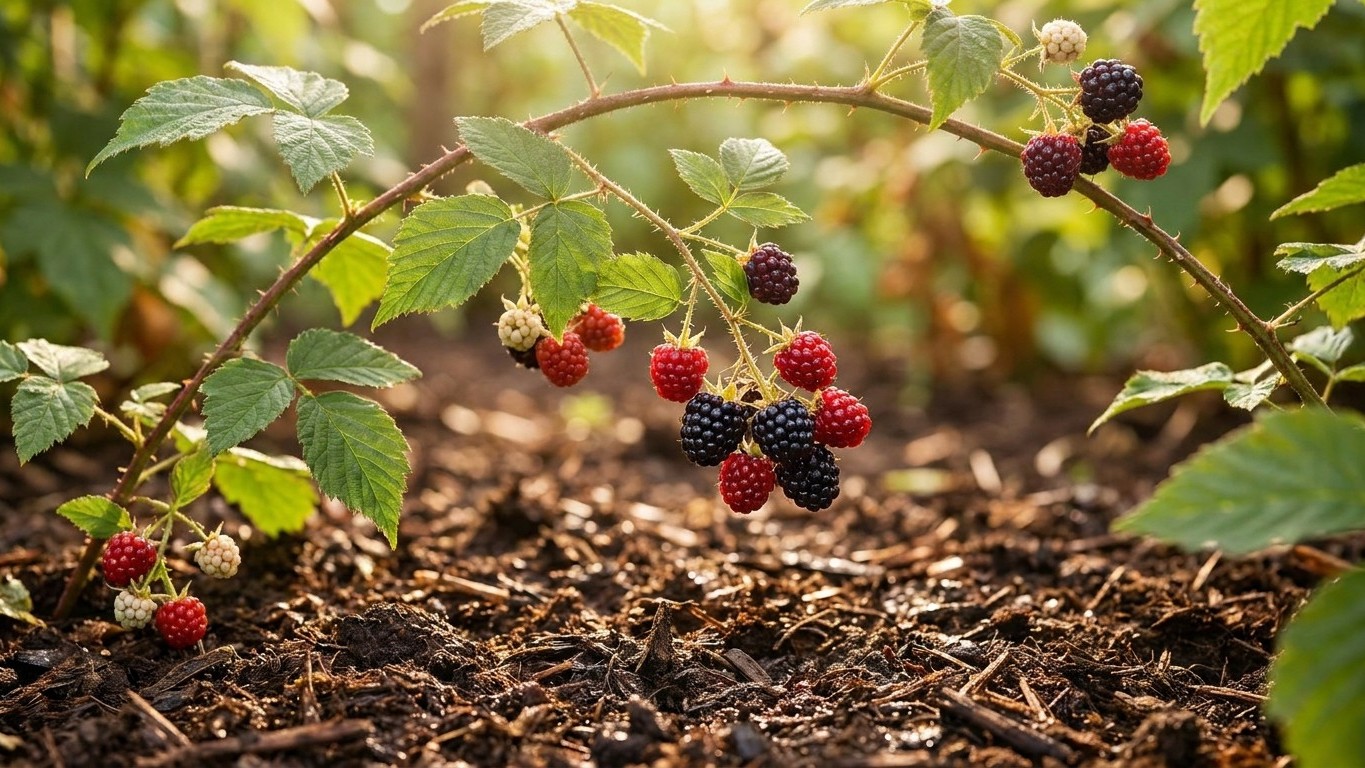

Rubus occidentalis, the black raspberry, survives across USDA hardiness zones 4a-8b, tolerates part shade to full sun, and needs moist, high-organic-matter soil to actually crop rather than just persist. It flowers in spring and summer, grows in an arching or erect habit, and produces a compound drupe that ripens from white to red to black-purple between June and July. Whether it fruits reliably in a given yard depends less on the plant’s hardiness than on light, soil, spacing, and a pollination question this page won’t guess at.
Where it will and will not survive
USDA hardiness zones 4a-8b is the span North Carolina State University’s Extension Gardener Plant Toolbox gives for Rubus occidentalis, and it works best read backward. Below the bottom of this range, winter cold routinely kills the canes or crown before the plant can leaf out again. Above the top, the plant may well live on, but living and thriving are two different claims, and nothing here says black raspberry performs well at the warm edge of its range, only that it has been recorded surviving there.
Treat the top of the range as a ceiling, not a recommendation. Heat, humidity, and the disease pressure that often rides along with both can wear down a plant that technically tolerates the winter minimum for that zone. At the cold end, zone 4a is genuinely severe, and a planting near that boundary should expect some winterkill in a hard year even if the shrub as a whole comes back season after season.
None of this tells you what zone your own property actually sits in, and guessing is exactly how a black raspberry ends up planted somewhere it was never going to make it through a normal winter. Zones shift with elevation, proximity to large water, and microclimate factors as small as a south-facing wall or a low spot where cold air settles. Look yours up rather than assume it, using this site’s hardiness zone guide.
One more caution: the 4a-8b figure is the USDA range, national and consistent no matter who cites it. It is not the same as regional planting notes that sometimes travel alongside it on a state extension site, calibrated to that state’s own coastal, piedmont, and mountain zones. Use the hardiness number; leave the regional commentary where it was written.
What it is called, and why that matters here
The North Carolina Extension Gardener Plant Toolbox lists four common names for Rubus occidentalis: Blackberry, Blackcap, Black Raspberry, and Dewberry. They’re listed alphabetically, and the source doesn’t mark any single one as official. That’s why this page is titled by the botanical name rather than picking a winner among the four.
The confusion is real. “Blackberry” is also the common name most people use for other Rubus species that are genuinely different plants, with a different fruit structure and often a different growth habit. “Dewberry” runs into the same problem, applied elsewhere in the genus to trailing species that aren’t Rubus occidentalis at all. Ask for either name at a plant sale and there’s a real chance the person across the table is picturing a different plant.
“Blackcap” maps most cleanly onto this specific species, describing how the ripe fruit sits like a small black cap once it detaches, but it’s a regional term. “Black Raspberry” is probably the name most likely to be understood correctly nationwide, since it distinguishes the plant from true blackberries by fruit structure: a raspberry-type fruit pulls away from a white core and leaves it behind, while a blackberry pulls away whole. Even so, the source lists it fourth alphabetically, with no signal that it outranks the other three.
The source’s classification is Edible, Native Plant, Perennial, Shrub. “Native Plant” here means native to the southeastern United States, since that’s the region this extension source describes plants for, not a claim that the species is native wherever it’s sold. This is common names doing what common names do; if buying by name alone, confirm with the seller that you’re both talking about the same plant before it goes in the ground.
The site it needs to actually crop
| Condition | What the source lists | What it mainly affects |
|---|---|---|
| Light | Full sun (6+ hours) or partial shade (2-6 hours) | Both are listed as tolerated; the source doesn’t separate which favors fruit set |
| Soil texture | High organic matter | Root health and vigor |
| Drainage | Moist, occasionally dry | Survival |
| Growth rate | Rapid | How fast it fills, and crowds, the space around it |
| Habit | Arching, erect | How and where new growth spreads |
The source lists two acceptable light levels without separating which is merely enough for survival and which is needed for a full crop. That’s a real gap: many caneberries hang on for years in partial shade while setting noticeably less fruit than the same plant in full sun. Treat partial shade as a placement that keeps the plant alive, not a guarantee of a heavy crop, until confirmed locally.
Rapid growth paired with an arching habit catches people off guard. The source doesn’t give a fixed mature spread, but “rapid” growth combined with canes that arch back toward the ground means the plant spreads sideways as much as it grows tall, often rooting wherever an arching tip touches soil. Plant it tight against a walkway or a smaller shrub and the issue a year or two later isn’t survival, it’s a tangle of new crowns where there used to be one. If a supplier can give an expected spread for the specific plant, that figure is worth more than any general guideline here.
Drainage listed as “moist, occasionally dry” describes a plant that wants consistent moisture but tolerates short dry spells once established, not one suited to a boggy corner or ground that bakes hard by August. High organic matter in the soil points the same direction: build the soil up with compost or leaf litter rather than planting into lean, sandy ground. Maintenance is rated low, and the plant is listed as attracting bees, butterflies, other pollinators, small mammals, and songbirds, worth factoring in if the goal is picking the fruit yourself before something else does.
When it crops, and whether it needs a partner
Bloom time for Rubus occidentalis is listed as spring and summer, a season rather than a calendar date, which shifts with latitude and elevation. What that season predicts matters: a plant flowering on the early side of its window is the one a late frost catches. Open blossoms exposed to a cold snap after winter has technically ended is one of the most common ways a fruiting shrub loses an entire season’s crop without the plant itself being damaged.
A bloom window spanning both spring and summer, rather than a single tight month, suggests some flexibility in exactly when flowering happens year to year, likely tracking how early or late the local season runs. That’s worth weighing against local frost records, since winter hardiness and bloom-time frost risk are answered by two entirely different pieces of information.
What this page does not have, and won’t guess at, is whether Rubus occidentalis needs a second, compatible plant nearby to set fruit, or how many years a newly planted specimen takes before producing a real crop. Both matter enormously for a fruiting shrub. Some plants in the wider Rubus genus are self-fertile; others need a compatible partner within reasonable distance, and getting that wrong means a reader ends up with a shrub that flowers every spring and summer and never produces a berry worth picking. Self-fertility varies within the same genus and even between cultivars of the same species.
Settle both questions before buying, not after planting. Ask directly whether the specific plant or cultivar needs a pollinator partner nearby, and ask how many years it typically takes to bear a usable crop under conditions like yours. A supplier selling a named cultivar should answer both without hesitation.
What the fruit is, and what it is for
The fruit is a compound drupe: what looks like a single berry is actually a cluster of small drupelets fused together, each containing its own seed. It changes color as it ripens, starting white, turning red, and finally black-purple once mature, and it’s available between June and July. A red berry on this plant isn’t ripe yet, it’s partway there.
On flavor and use, the source is direct: the fleshy fruits are sweet and slightly tart, they detach cleanly and easily from their receptacles, and the flavor is described as excellent. That clean detachment also separates a raspberry-type fruit from a true blackberry at a glance: a ripe black raspberry pulls away from its white core, leaving that core behind on the plant, while a blackberry pulls away core and all. The source explicitly confirms these fruits are used as food; edibility here isn’t inferred, it’s stated outright.
A fruit that’s sweet with a touch of tartness and releases this cleanly is the kind that eats well straight off the plant, and that same balance generally holds up when cooked down or baked into something, since the tartness keeps it from tasting flat once heat and sugar are involved. Fruit availability given as June-July is a narrower window than the spring-through-summer bloom period, which tracks: bloom happens first over an extended stretch, and the fruit that follows ripens on a tighter schedule once pollination and drupelet development are complete.
Worth flagging where the source’s language draws a firm line: it describes flavor and texture, and it makes no nutrition or health claims in this entry. Any such claim attributed to black raspberries elsewhere isn’t part of what this source says, and it isn’t repeated here.
What it resists, and what it does not
Resistance, on any plant label, describes a tendency rather than a guarantee. “Resistant to deer” means deer browse the plant less often than alternatives nearby, not that they’ll never touch it in a hard winter with nothing else available. “Resistant to drought” almost always describes an established plant with a developed root system, not one still settling in during its first season.
For this entry, the resistance data available from the source didn’t come through as a usable list of traits, so this page can’t responsibly assign Rubus occidentalis any particular tolerance to deer, drought, or disease pressure without guessing. Rather than fill that gap with traits that sound plausible for a bramble but aren’t confirmed here, it’s stated plainly instead.
| Question | What’s known from this source |
|---|---|
| Deer browsing | Not specified in the available data |
| Drought tolerance | Not specified beyond the general drainage note (moist, occasionally dry) |
| Disease resistance (plant tissue) | Not specified in the available data |
| Pests or disease affecting the fruit itself | Not covered by this source at all |
That last row deserves its own note. Even a complete resistance list, when one is available, almost always describes what happens to leaves, canes, and roots, not what happens to the fruit hanging on the plant. Caneberries generally face pressure from fruit-specific pests and diseases that a general plant resistance rating never touches, and this brief carries none of that information for Rubus occidentalis. Anyone growing it specifically to harvest berries should treat fruit-stage pest management as a separate question to research locally.
Common questions
Is Rubus occidentalis the same as a blackberry?
No, though the common name “Blackberry” is one of four listed for it in the source, alongside Blackcap, Black Raspberry, and Dewberry. Rubus occidentalis is a black raspberry: its ripe fruit pulls away from a white core and leaves the core on the plant, unlike a true blackberry, which detaches whole.
Does black raspberry need another plant nearby to produce fruit?
This isn’t answered here. Pollination requirements aren’t part of the available data for this plant, and self-fertility varies across the Rubus genus and even between cultivars of the same species. Ask a supplier directly before buying.
What USDA zone is too cold for Rubus occidentalis?
Anything below zone 4a falls outside the range the source gives for this plant, meaning winter cold there would likely kill it. Check your specific zone using a county-level guide rather than a regional assumption.
How big does a mature black raspberry plant get?
The source doesn’t give a fixed mature spread. It does list rapid growth and an arching, erect habit, meaning the plant spreads as canes arch and root at their tips, so it needs room beyond whatever a young plant’s size suggests at planting time.