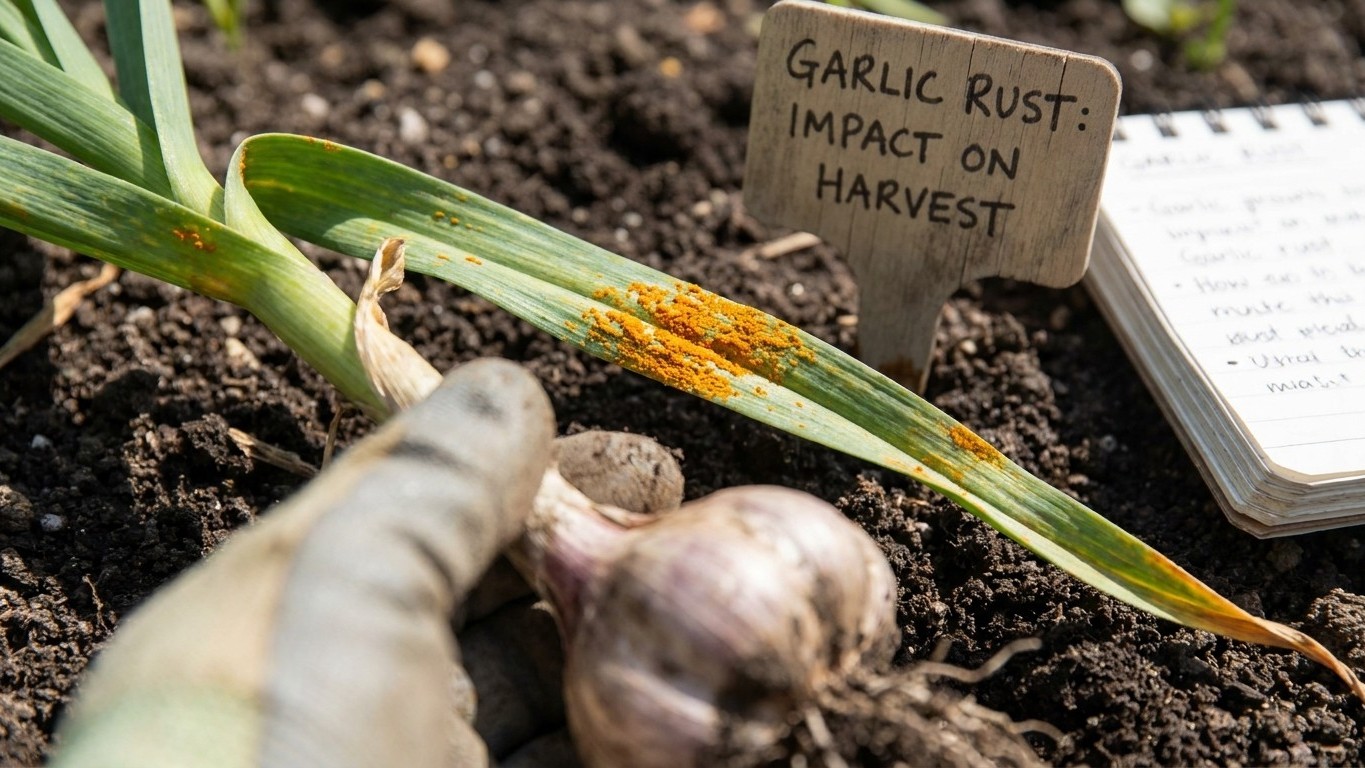

Those first pale flecks on a garlic leaf look harmless, the kind of thing you’d wipe off with a thumb and forget by lunchtime. Most gardeners do exactly that, since the bulb is underground and out of sight. But by the time those flecks have swelled into gritty reddish-orange pustules, the leaf feeding the bulb is already losing ground, and a plant that looks only lightly spotted can still finish the season with a noticeably smaller harvest.
What you are looking at

Rust starts small and easy to miss. The first sign is a scatter of pale flecks on the leaf surface, barely raised, that most gardeners walk past without a second look. Within a week or two those flecks develop into the diagnostic feature: oval to diamond-shaped pustules, reddish to dull orange, 0.12 to 0.2 inch long, as described in UC ANR Publication 3453. They sit slightly proud of the leaf surface and feel gritty rather than smooth.
On a lightly infected plant that might be the whole story: a leaf or two with scattered pustules, the rest of the plant green and upright. On a heavily infected plant the pustules multiply until much of the leaf surface is covered, and the tissue around them starts to yellow and then brown. Badly rusted leaves desiccate from the tip down, curling and drying while the rest of the plant is still growing.
The part that costs you is what happens underground while this is going on above it. Garlic bulbs size up almost entirely from the sugar the leaves make during the last weeks before harvest. A plant that has lost a third or more of its leaf area to rust has that much less capacity to fill out its cloves, and the published effect is reduced bulb size, not a rotted or discolored bulb. If you pull a rust-affected plant, expect a smaller bulb with normal-looking cloves, not the collapse you’d see with a basal rot.
What it is not
Yellowing garlic sends most gardeners straight to a disease diagnosis, and most of the time that’s the wrong turn. Garlic naturally yellows and dies back in the weeks before harvest as the plant redirects its remaining resources into the bulb. That dieback is even, starts from the leaf tips, and carries no raised spots of any color. Uneven water, whether too little or too much standing water around the roots, produces yellowing too, usually as a general pallor across the whole plant rather than a scatter of individual leaves.
Nitrogen deficiency looks similar to water stress: an overall pale, washed-out yellow-green, starting with the older leaves, with no texture change to the leaf surface at all. The one detail that separates true rust from all of these is texture. Rust pustules are raised and gritty, and they rub off orange on your fingertip. Ordinary yellowing, from nitrogen, water, or the natural end of the season, is flat and leaves nothing on your hand.
If the problem you’re seeing is at the base of the plant rather than on the leaves, root discoloration or a rotted plate, you’re looking at something else entirely. Rust stays on the foliage. Roots that have turned red or pink point to pink root instead, and a soft, rotted base at harvest is more consistent with fusarium basal rot.
Where it comes from and when it strikes
Garlic rust is caused by the fungus Puccinia allii. It arrives in a garden a few different ways: wind-blown spores from a neighboring planting, infected planting stock brought in without inspection, or spores that survive on volunteer garlic and onion plants left over from a previous season. Weedy Alliums growing along a fence line or in a compost pile serve as a year-round reservoir, feeding new spores back into the garlic bed once conditions turn favorable.
The temperature window that matters
UC IPM’s guidelines put the range for rust development at 57 to 75°F, with an optimum near 59°F, and this is worth reading carefully because it is a soil temperature, not an air temperature. A cool, wet spring where the air feels warm but the soil underneath the mulch stays cold and damp is exactly the kind of stretch that favors rust, even if the daytime high on the thermometer looks nothing like 59°F. Checking a soil thermometer pushed a few inches into the bed gives you a far better read on infection risk than checking the forecast.
Humidity and leaf wetness matter alongside temperature. Rust spores need moisture on the leaf surface to germinate, so a season of frequent rain, heavy dew, or overhead irrigation in the right temperature window is the setup that produces a bad outbreak. A dry spring in the same temperature range usually produces little rust at all, which is one reason the disease shows up as a bad-year problem rather than something you see every season regardless of weather.
What to do about it now
Once a leaf has visible pustules, there is no cure for that leaf. Nothing you spray or apply will make the tissue clean again. What you’re deciding at that point is whether to remove the leaf to slow the spread to the rest of the plant, or leave it and accept some loss of bulb size. For a home garden, the practical steps are:
- Cut off and remove the worst-affected leaves rather than letting them shed spores onto healthy foliage nearby.
- Do not compost rust-affected leaves in an open pile that won’t reach a sustained hot temperature. Bag them for trash or burn them if local rules allow it.
- Water at the base of the plant rather than overhead for the rest of the season, to cut down on leaf wetness.
- Harvest on schedule rather than delaying, since leaving infected plants in the ground longer only gives the disease more time to spread and the bulb less green leaf to size up on.
The commercial fungicide programs described in extension guidelines involve scheduled, banded sprays timed to the temperature window and reapplied on a fixed interval, which is a field practice built around large acreage and equipment most home gardeners don’t have. For a backyard bed, sanitation and timing do most of the practical work, and that’s a reasonable place to stop for this season.
Keeping it out of your garden
The controls that actually work start before you plant, not after you see a pustule. Start with clean seed garlic from a supplier who inspects for disease, or from your own stock only if last year’s crop was rust-free. Planting infected cloves is one of the most direct ways rust gets introduced to a bed that never had it before.
Rotation and isolation
UC IPM’s published guidance calls for rotating away from Allium crops, meaning no garlic, onion, leek, or shallot, for two to three years, and for keeping new plantings separated from older or previously infected fields. A home gardener can follow the rotation part directly: move garlic to a different bed or a different corner of the vegetable garden for a few seasons rather than replanting the same spot every year. Full field separation is less realistic on a small property, but even planting garlic as far as your layout allows from last year’s rust-affected bed reduces the odds that surviving spores reach the new crop on the wind.
The pathogen persists by overwintering on garlic and on volunteer Allium plants, and weedy Alliums act as an ongoing source of infection year after year. That means the rotation only works if you also pull every volunteer garlic and onion plant that sprouts from missed cloves or dropped bulbs, and clear any wild onion or garlic growing along fences, in gravel, or in unused corners of the property. A rotation plan undone by a patch of volunteer garlic left standing nearby is a common way this disease reappears in a bed that was supposedly rested.
Beyond sanitation and rotation, the broader picture of garlic health is worth reading in full: see Garlic Diseases for how rust fits alongside basal rot, pink root, and the other conditions that show up in the same crop, since several share early symptoms and the differences matter for what you do next.
Common questions
Can I still eat garlic bulbs from a plant that had rust on the leaves?
Yes. Rust stays on the foliage and does not rot or contaminate the bulb itself. The main effect is a smaller bulb from reduced leaf area, not a food safety issue.
Will rust spread to my onions if they’re planted nearby?
It can. Puccinia allii infects onions, leeks, and shallots as well as garlic, so a mixed Allium planting doesn’t give you any separation on its own. Keeping different Allium crops in separate parts of the garden helps more than keeping them apart by species alone.
Does rust on garlic mean I have to throw out my whole bed?
No. A few rusted leaves on scattered plants is common in a wet spring and rarely justifies pulling healthy-looking plants early. Reserve removal for leaves that are heavily covered and already yellowing, and let the rest of the plant continue to the normal harvest point.
Is orange rust on garlic the same thing as rust on other garden plants like beans or roses?
No. Rust fungi are highly specific to their host plants, and the species that infects garlic, Puccinia allii, does not cross over to unrelated crops. A rusted rose bush nearby is not a source of infection for your garlic bed.