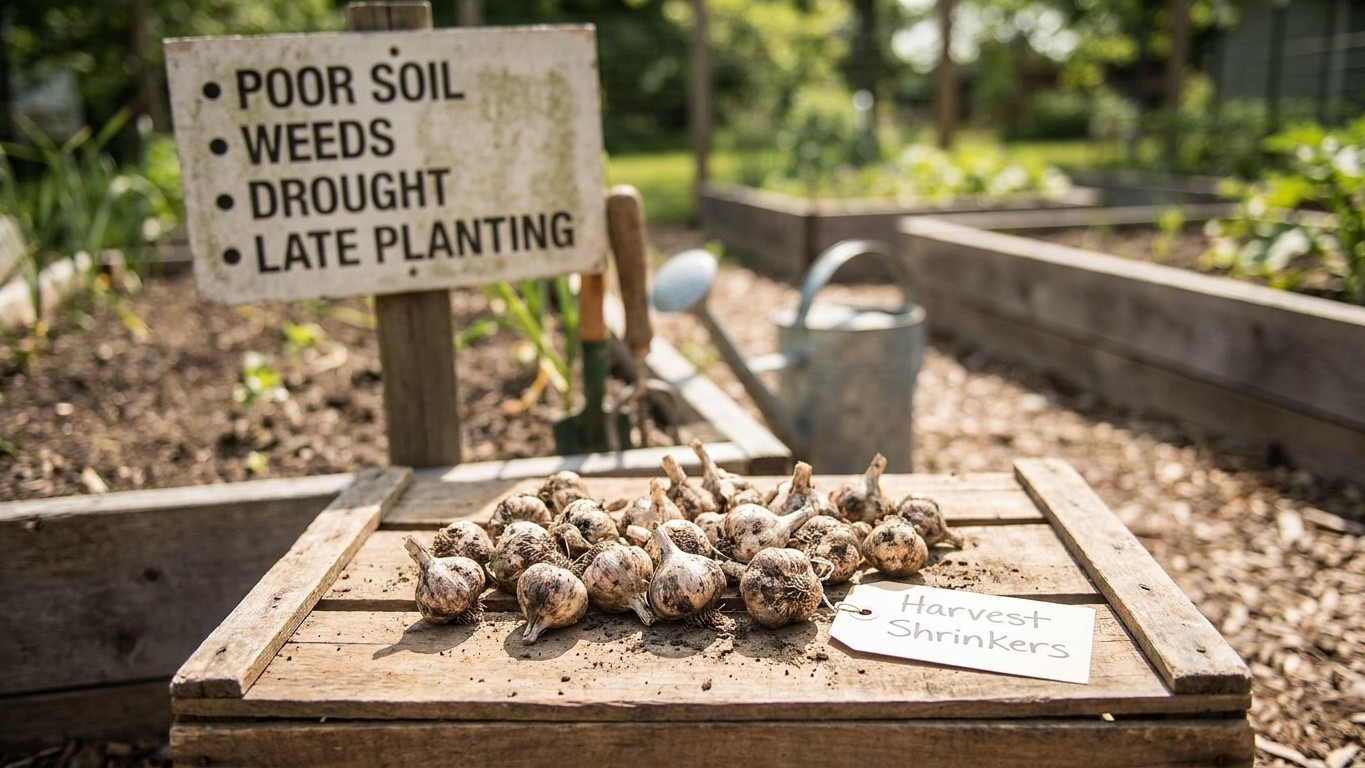

Small garlic bulbs usually trace back to four things: the clove size you planted, how much winter cold the crop got, how tightly it was spaced, and whether it had enough water during the final weeks of bulking. None of these can be fixed after the fact. Pull one bulb now and check whether it is small but firm, dry, and fully wrapped, or soft and discolored. That single check tells you whether you are dealing with a sizing problem or something else entirely, before you read another word.
What you are looking at

A small garlic bulb from a sizing problem looks like a miniature version of a normal one. The wrapper is intact and papery, the cloves (if it split into cloves at all) are firm and dry, and the neck is tight. Cut one in half. The clove tissue should be white or cream, with no brown streaking, no soft spots, and no smell. That combination, small but sound, rules out rot, root maggot damage, and the fungal diseases that also shrink bulbs but leave visible damage behind.
A separate look-alike is the “round,” a bulb that never divided into cloves at all and instead formed one solid, onion-like center. Rounds are common from small planting stock or from garlic planted very late in the season, and they are still perfectly good to eat, just not to plant.
Compare that to a bulb that is small and soft, streaked with pink or brown, or crumbling at the base plate. That is a disease problem, most often a soil fungus, and it calls for different action than anything in this article. If the leaves went yellow or collapsed early rather than ripening in order from the bottom up, check Yellow Leaves on Garlic: Normal Ripening or a Real Problem before assuming the bulb size is the whole story. And if the wrappers split open in the ground before you lifted the crop, that is its own issue, covered in Split Garlic Wrappers: Why Bulbs Burst Before You Lift Them.
What actually causes it
Garlic runs on a long cycle. It goes into the ground in autumn and doesn’t come out again until summer, so most of what shows up at harvest was decided months earlier, not in the last few weeks. Four separate decisions, made at four separate points in that cycle, each shrink the harvest on their own.
The four causes and when they acted
- Clove size at planting. Garlic is a clone of what you plant. A small clove has a smaller store of energy to push into a bulb, so it produces a smaller bulb almost every time. This was decided the day you planted, in autumn.
- Insufficient winter chill. Garlic needs a stretch of cold weather to trigger the clove inside from forming a single round into distinct cloves and to set the plant up to bulb properly in spring. A mild or short winter, or garlic planted too late to get enough cold before growth resumes, can mean the plant never divides cloves properly. This was decided over the whole winter, and there is no way to add missed cold back in later.
- Crowding. Garlic planted too close together competes for water, nutrients, and light below ground exactly during the weeks when the bulb is trying to size up. This was decided at planting, when the spacing was set, and it plays out gradually all season.
- Moisture stress during bulking. Garlic does most of its bulb sizing in the final weeks before the tops start to yellow. A dry stretch during that window, without supplemental water, caps bulb size even if everything else went right. This one acts late, in late spring and early summer, and is the only cause on this list with any timing overlap with harvest itself.
Because three of the four causes act months before you see the result, the honest answer to “What Went Wrong” is usually “something in autumn or winter,” not anything you did in the last few weeks of the season. For exact guidance on planting depth, spacing, and timing suited to your winters, your state’s land-grant university extension service is the right place to check, since chilling and planting windows vary by region.
What you can still do this season
If the bulbs are already out of the ground, the size is fixed. Nothing you do now changes it. What you can control is how you handle what you have. Cure the small bulbs the same way you would cure full-size ones: a few weeks in a warm, dry, airy spot out of direct sun, with the tops still attached, until the wrappers are papery and the necks are tight.
A small bulb is not a wasted bulb. It is perfectly edible, cooks the same as a full-size one, and often has a stronger, more concentrated flavor per clove because there was less water in the tissue to begin with. Use small bulbs first in the kitchen rather than saving them, since small bulbs and rounds tend to dry out and shrink in storage faster than well-sized ones.
If you have not yet harvested and the tops are still mostly green, check soil moisture now. Garlic in its final bulking weeks still benefits from even moisture, and a dry spell at this exact stage is the one cause on the list you can still influence this season. Everything else, clove size and winter chill and spacing, was locked in long before now.
What you should not do is set aside the smallest bulbs as next year’s seed stock out of habit. Save the largest, best-formed bulbs for planting instead, and eat the small ones. See Growing Garlic for how seed selection connects to the rest of the planting decisions you’ll make in autumn.
What does not work
Feeding the plants heavily after you notice small bulbs does nothing, because by the time you can see the problem, the growing season is essentially over and the plant has stopped taking up nutrients to build bulb tissue. A late dose of fertilizer, especially nitrogen, is more likely to push green growth than to fix a bulb that has already finished sizing.
Watering harder in the last week or two before harvest does not help either, and can actively hurt: it is a common reason for split wrappers and rot right at the point of lifting, not a fix for small bulbs. The window where water actually changes bulb size is weeks earlier, during active bulking, not at the very end.
Leaving undersized bulbs in the ground longer, hoping they will keep growing, does not work. Garlic bulbing has a defined end point tied to day length and temperature, not to how long you leave it in the soil. Bulbs left too long past that point are far more likely to split, rot, or get invaded by soil organisms than to gain any real size. And treating the crop for disease when the actual cause is clove size or winter chill wastes a spray and delays you noticing the real fix, which is a planting decision, not a treatment.
Getting it right next year
The fix for small bulbs happens at planting, not during the growing season, so the decision point is next autumn. Start with clove size: break your seed bulbs apart right before planting and use only the largest, outermost cloves. The small inner cloves go in the kitchen, not the ground.
Give the crop enough room. Crowding is one of the easier causes to fix, since it is purely a matter of spacing decided the day you plant, and standard garlic spacing guidance is widely published by university extension services and seed suppliers alike.
Matching cultivar to your winters
Hardneck types generally need a more reliable stretch of winter cold to divide cloves properly, and it is worth knowing which type you are growing before you decide anything else. Catalogue figures, always counted from planting or transplant and shifting by a week or two with the season, are a useful starting comparison:
| Cultivar | Type | Typical days to maturity |
|---|---|---|
| ‘Music’ | Porcelain hardneck | around 240 to 270 days from autumn planting |
| ‘German Red’ | Rocambole hardneck | around 240 to 270 days from autumn planting |
| ‘Inchelium Red’ | Softneck (artichoke) | around 210 to 240 days from autumn planting |
| ‘California Early’ | Softneck (artichoke) | around 210 to 240 days from autumn planting |
Because winter chill requirements and the safe autumn planting window both depend on where you garden, check your state land-grant university extension service or the USDA plant hardiness zone map for your area before choosing between hardneck and softneck types, and before setting an exact planting date. A cultivar picked for the wrong chill pattern will produce the same undersized, poorly divided bulbs described above, no matter how well you spaced or watered it.
Common questions
Is small garlic still safe to eat?
Yes, as long as the cloves are firm, dry, and free of soft spots or discoloration inside. Size has nothing to do with safety, only with how much you get per bulb.
Can I replant a small clove and get a bigger bulb next year?
Not reliably. Clove size is one of the strongest predictors of the next bulb’s size, so a small clove tends to produce another small bulb rather than catching up.
My garlic never split into cloves at all, is that the same problem?
It is related but not identical. A “round,” a bulb that stayed as one solid center instead of dividing, usually comes from very small seed stock or late planting rather than from crowding or drought, though insufficient winter chill can also cause it.
Should I pull my garlic early if I think the bulbs are small?
No. Pulling early almost always makes bulbs smaller, not bigger, since the last weeks before the tops yellow are when the bulb does most of its sizing. Wait for the normal ripening signs rather than guessing based on size alone.