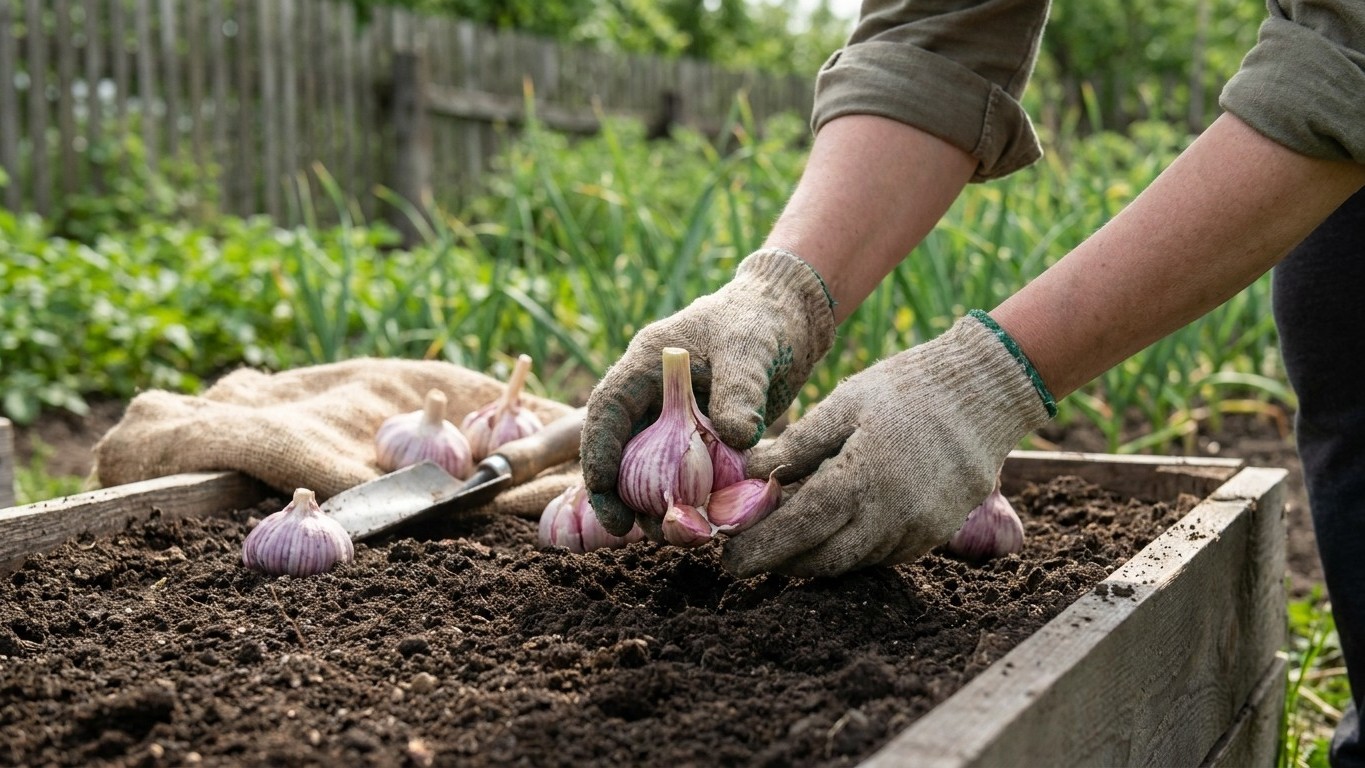

Chesnok Red is a hardneck garlic in the Purple Stripe family, the type cooks reach for when a recipe calls for whole roasted heads because the flavor turns rich and almost sweet in the oven. It will not tolerate a soft winter: without a real run of cold after planting, the clove stays whole instead of splitting into a head, and you dig up one round bulb where a dozen cloves should have been. Before you order seed stock, find out how many weeks your nearest official weather station spends below 40°F in a typical winter, because that single figure decides whether Chesnok Red is worth planting where you live.
What Chesnok Red actually is

Chesnok Red belongs to the Purple Stripe group, one of the hardneck garlic families, distinct from Porcelain types like Music or German White and from softneck Artichoke and Silverskin types grown widely in warmer climates. Hardneck means it sends up a stiff central stalk, called a scape, that has to be cut off in early summer so the plant puts its energy into the bulb instead of the top growth.
Seed catalogs typically describe Chesnok Red’s flavor as spicy and full-bodied raw, mellowing into a mild, almost buttery sweetness when roasted, which is why it shows up so often in recipes built around whole baked heads. The cloves are fewer per bulb than a softneck, usually somewhere around eight to ten, but each one is large and peels cleanly, a trait the Purple Stripe group is generally known for. Storage life is the tradeoff: Purple Stripes are typically cited as keeping four to six months in good conditions, shorter than the six to eight months often claimed for Porcelain types, so this is not a garlic to plant if you’re hoping to eat homegrown bulbs straight through to the following spring.
What Chesnok Red tastes like, and what to do with it
Most garlic loses intensity as it cooks. Heat breaks down the sulfur compounds responsible for raw bite, and given enough time — a slow roast, a long braise — almost any variety will soften into sweetness with little garlic character left. What sets Chesnok Red apart is that its flavor is described as full-bodied and lingering specifically because it holds up through that process rather than fading into background sweetness. That’s a different claim from simply tasting good roasted; it means the variety keeps asserting itself in dishes where garlic is cooked down rather than left whole.
That makes it worth reaching for in preparations where garlic has to survive sustained heat and still read as garlic: simmered sauces, soups, stocks, braises, anything where cloves are minced or crushed early and cooked alongside other ingredients for a long stretch. In a quick sauté or a raw preparation like a dressing, the difference between this and another purple stripe will be less obvious, since that’s not where its particular strength shows. It’s the slow, cooked-down dishes — a tomato sauce simmered for an hour, a braise, a soup base — where the flavor is reported to persist instead of thinning out.
Beyond that, there isn’t much published detail specific to Chesnok Red’s flavor profile at other stages — how it behaves raw and minced into something uncooked, for instance, or whether it favors any particular cuisine. What can be said comes from the category: Purple Stripe garlics are generally grown for rich, robust flavor rather than mildness, and Chesnok Red’s reputation as an all-around cooking variety fits that pattern rather than breaking from it.
Will it get the cold it needs where you are
Garlic is planted as a single clove and needs a genuine cold spell afterward to trigger the clove into splitting apart into a full head of new cloves. Hardneck types like Chesnok Red are generally the most demanding of the bunch, needing something in the neighborhood of six weeks with temperatures below 40°F to get that signal. Skip that stretch and the plant simply grows a bigger version of the single clove you planted. This is the part most general planting guides skip, and it matters more for a Purple Stripe than for almost any softneck on the market.
Where the cold falls short
In California, the reference station at Los Angeles logs essentially zero weeks below 40°F in an average winter, against the roughly six weeks Chesnok Red is looking for. The clove never gets the signal to divide. The same shortfall shows up at the reference stations for Louisiana (New Orleans), Texas (Houston), Florida (Jacksonville), Arizona (Phoenix) and Hawaii (Honolulu). In each of those states a grower who plants Chesnok Red anyway has two real options, not one: refrigerate the cloves for several weeks before planting to fake the cold the garden won’t provide, or plant a softneck type in the Artichoke or Silverskin group instead, since those varieties evolved for exactly this kind of mild winter and don’t need the vernalizing chill a Purple Stripe demands.
Where the cold comes easy, and why that isn’t the whole story
Go the other direction and the problem flips. Prince Edward Island, measured at Charlottetown, gets plenty of cold but only accumulates around 1,569 growing degree days across the season, described as a tight margin even for garlic. A precocious variety and a plastic mulch to trap extra heat make the difference there. Push further north and the cold requirement is met many times over, but the season simply doesn’t carry enough cumulative warmth to finish the bulb: Alaska (Anchorage) totals around 917 growing degree days, Yukon (Whitehorse) around 600, Northwest Territories (Yellowknife) around 905, Alberta (Calgary) around 1,171, and Nunavut (Rankin Inlet) as low as 159. In every one of those Territories a greenhouse or a low tunnel closes the heat gap that an open garden bed can’t.
| Territory | Reference station | What limits it | Verdict |
|---|---|---|---|
| California | Los Angeles | 0 weeks below 40°F, needs ~6 | Risky, no chill unless treated |
| Texas | Houston | 0 weeks below 40°F | Risky, refrigerate or switch type |
| Florida | Jacksonville | 0 weeks below 40°F | Risky, softneck a better fit |
| Prince Edward Island | Charlottetown | ~1,569 growing degree days | Marginal, early variety helps |
| Alaska | Anchorage | ~917 growing degree days | Cold is fine, heat is short |
| Yukon | Whitehorse | ~600 growing degree days | Needs a greenhouse or tunnel |
When to put the cloves in
Garlic goes in the ground in fall and comes out the following summer, and the exact planting window is set by the first fall frost rather than by a date on the calendar. The goal is a clove that has time to grow roots before the soil freezes solid, but not so much time that it pushes green top growth above ground, which then gets damaged by hard freezes over winter.
Warm-winter states plant late in the fall because their first frost arrives late and there’s little risk of a killing freeze catching new shoots. At the Louisiana reference station in New Orleans, growers set cloves out from late November into mid December, with bulbs ready in late August. Houston’s Texas window runs early to late November with an early August harvest, and Jacksonville’s Florida window is similar, early to late November into an early August lift. Compare that to the far north, where the ground freezes hard and early: Anchorage, Alaska plants in early September for a mid May harvest, and Whitehorse, Yukon plants even sooner, in early August, to be ready by mid April.
Extension services genuinely disagree on the exact number of weeks-before-frost to aim for, and that’s worth stating plainly rather than papering over with a false precision. The safest approach is to call your state or provincial extension office, ask for the fall garlic planting window tied to your county’s average first frost date, and work backward from there rather than from a date you saw on a seed packet grown somewhere else.
Hardneck or Softneck: what this one asks of you
Chesnok Red is a hardneck, and that habit shapes almost every decision you make with it after planting. A hardneck sends up a scape, a curling stalk that has to be cut off, not left to grow, usually once it curls through a loop or two, so the plant’s energy goes into the bulb instead of that stalk. In exchange for that extra step, you get cloves that are fewer in number but noticeably larger, and they peel far more easily than a softneck’s tightly packed small cloves.
The tradeoff runs the other way in storage. Softneck types, the Artichoke and Silverskin groups, produce more cloves per bulb, braid well because the neck stays soft and pliable, and typically outlast hardnecks in the pantry by a couple of months or more. Hardnecks like Chesnok Red are the better choice where winters are genuinely cold, since that’s the cold they were bred to expect, while softnecks are the sounder pick for a grower in a mild climate who also wants a garlic that keeps well past the holidays. If you’re weighing this variety against something with a different cold appetite for the same bed, the Bavarian Purple Rocambole is worth a look, since it shares the hardneck habit but carries a different flavor and clove count.
Growing and curing it without losing the crop
Plant Chesnok Red cloves pointed end up, spaced roughly four to six inches apart in rows a foot or so apart, deep enough that the tip sits a couple of inches under the soil surface. Mulch matters more for an overwintered crop than for almost anything else in the garden, because a loose layer of straw or shredded leaves buffers the freeze-thaw cycles that otherwise heave newly rooted cloves right out of the ground before they’ve anchored.
Reading the plant, not the calendar
- Stop watering once the lower leaves start yellowing, since wet soil late in the season encourages rot right at harvest
- Watch for roughly five or six green leaves left standing while the lower ones have browned, the classic sign a bulb is ready to lift
- Dig, don’t pull, using a fork to loosen soil well clear of the bulb so you don’t bruise or nick the skin
- Cure whole plants, tops and roots still attached, in a shaded spot with good airflow for two to four weeks
- Trim tops and roots only once the outer wrappers are fully papery and the neck has tightened down hard
The two mistakes that cost growers their whole harvest are lifting too late, once the wrappers have started splitting and the cloves are exposed to soil moisture, and curing in a spot with poor airflow, which traps humidity against the bulb and sets up rot that doesn’t show itself until the garlic is already in storage. Neither mistake is visible at the time you make it, which is exactly why they’re worth checking against a calendar rather than trusting a glance at the bed. If you’re comparing Chesnok Red against other hardneck and softneck options for the same garden, the full rundown of garlic varieties lays out the cold and storage tradeoffs side by side.
Common questions
What happens if I plant Chesnok Red somewhere too warm?
The clove typically fails to split and you dig up a single round bulb instead of a head of individual cloves. It’s still edible, but you lose the whole point of growing a named hardneck variety, and you’ll have no seed stock worth replanting the following fall.
Can I refrigerate the cloves myself instead of moving to a softneck?
Growers in mild-winter areas do this by holding seed cloves in a refrigerator for several weeks before planting to simulate the chill the garden won’t provide. It’s a reasonable workaround for a small home patch, though it adds a step that a softneck variety simply doesn’t require.
Is Chesnok Red the same thing as regular Purple Stripe garlic?
No. Purple Stripe is the broader botanical group, and Chesnok Red is one specific cultivar inside it, alongside others like Persian Star and Metechi. They share the group’s general cold requirement and clove-peeling ease, but flavor, clove count and days to maturity vary by cultivar, so don’t assume one Purple Stripe behaves exactly like another.
How long will my harvested Chesnok Red actually keep?
Expect it to hold for something like four to six months in a cool, dark, dry spot once properly cured, shorter than a Porcelain type and noticeably shorter than most softnecks. Plan to use it up through fall and early winter rather than counting on it lasting to next year’s harvest.