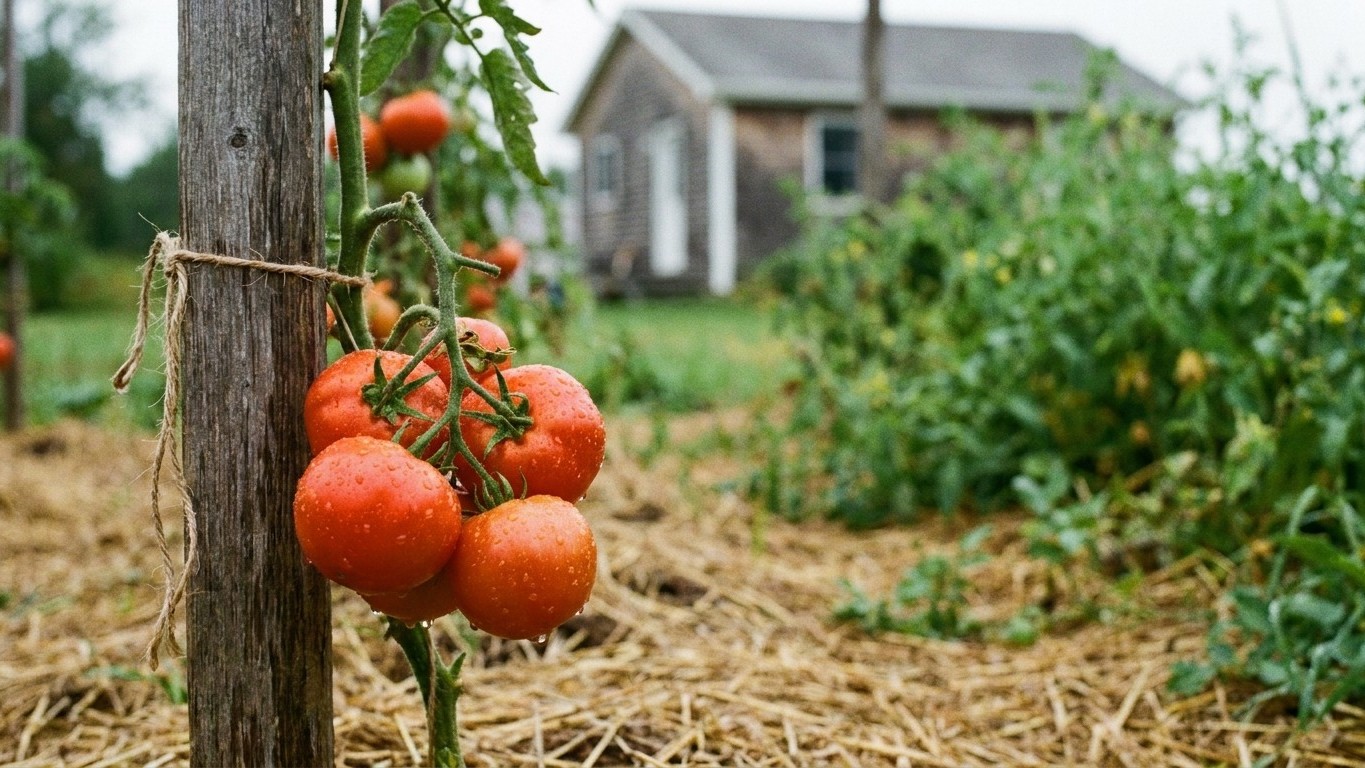

Short and mid-season tomato varieties ripen with room to spare in Prince Edward Island, but the long-season slicers and heirlooms cut it close most years. Environment and Climate Change Canada’s 1981-2010 climate normals put the average last spring frost at the Charlottetown A station on May 16 and the average first fall frost on October 17, a window that favors anything finishing in under 70 days from transplant. Check the days-to-maturity printed on the seed packet against that window before you commit a whole bed to any one variety.
What this comes down to in Prince Edward Island

Charlottetown’s frost window, from an average last spring freeze on May 16 to an average first fall freeze on October 17, gives the capital roughly five months of frost-free growing season according to Environment and Climate Change Canada’s 1981-2010 climate normals. That’s enough for nearly any short or mid-season tomato, but the number is a mean, not a guarantee: in one year out of two, the last spring frost falls after May 16, and in one year out of two, the first fall frost arrives before October 17. If you’ve already worked through the basics of growing tomatoes in Prince Edward Island, the next step is choosing among varieties for a bed that’s ready.
Varieties that finish inside 60 days of transplanting give even a stingy year two full months of slack before the first hard freeze. Varieties in the high 60s and low 70s still work reliably in most seasons. Anything past 75 days needs a warm, sheltered spot and a grower willing to accept some risk in a colder-than-average year. The fourteen varieties below are ordered from shortest season to longest, so you can see exactly where that line falls for your own garden.
Sakura

Sakura reaches its first ripe fruit about 55 days after transplant, and with plants set out in late May and ripening starting in late July, it leaves roughly 85 days of margin before the average first fall frost, the widest cushion of any variety here. It’s a small, round red cherry tomato bred for the table rather than for canning. Its resistance to nematodes, tomato mosaic virus and two races of fusarium wilt makes it forgiving for a first season in a new bed.
Edox

Edox matches Sakura almost trait for trait: 55 days to maturity, the same roughly 85-day cushion before frost, and the same three-way resistance to nematodes, tomato mosaic virus and fusarium wilt races 1 and 2. The fruit is also a small, round red cherry tomato, so the practical difference between the two comes down to seed availability and personal taste rather than season length.
Valentine

Valentine also finishes around 55 days from transplant, with the same roughly 85-day margin as Sakura and Edox ahead of the average October 17 fall frost. The fruit is a small, oblong red grape tomato, sweet enough for salads and firm enough for a lunchbox. Its intermediate resistance to early blight is useful in a wet Island summer, though it doesn’t carry the wider disease package of Sakura or Edox.
Glacier

Glacier is the only determinate plant among the 55-day group, meaning it sets one main flush of fruit rather than producing steadily through the season. That suits a gardener who wants a concentrated harvest for a small batch of sauce rather than a slow trickle of fruit all summer. Expect small, orange-red fruit and the same roughly 85 days of slack before frost as the indeterminate 55-day varieties.
Sun Gold

Sun Gold needs 57 days from transplant, leaving about 83 days of margin before the average first fall frost. The fruit is a small, round, golden-orange cherry tomato, one of the sweetest commonly grown types. Its resistance to tobacco mosaic virus and one race of fusarium wilt adds some insurance, though it doesn’t cover verticillium wilt the way some of the paste types on this list do.
Supersweet 100

Supersweet 100 takes 60 days to its first ripe fruit, for about 80 days of margin before frost. It produces small, round red cherry tomatoes in long clusters, sometimes twenty or more fruit per truss, making it a heavy producer for its size. Resistance to verticillium wilt and fusarium wilt race 1 helps it hold up through a full Island season without a mid-summer replant.
Juliet
Juliet also finishes at 60 days, matching Supersweet 100’s roughly 80-day cushion before the average fall frost. The fruit is a small, oblong red grape tomato, meatier than a round cherry type and good for roasting whole. Its intermediate resistance to both late blight and early blight is worth having in a season with a wet August.
Amalfi
Amalfi moves into the mid-season range at 68 days from transplant, leaving about 72 days before the average October 17 frost, comfortable but no longer generous. It’s a determinate plum tomato, oblong and red, bred for sauce rather than fresh eating. Amalfi’s combined resistance to nematodes, late blight and early blight makes it one of the better-defended paste tomatoes on this list.
Cherokee Purple
Cherokee Purple needs 72 days from transplant, working out to roughly 68 days of margin before frost, still comfortable in an average year but tighter in a late one. It’s a large indeterminate heirloom beefsteak with dusky pink-purple skin and darker shoulders, grown for flavor rather than disease resistance, since it carries none of the coded resistances on this list. Growing it here means trading some risk for taste.
Big Beef Plus
Big Beef Plus also needs 72 days, for the same roughly 68-day cushion as Cherokee Purple, but it carries resistance to nematodes, gray leaf spot and tomato mosaic virus that the heirloom lacks. The fruit is a large, round red beefsteak suited to slicing. It’s the steadier bet of the two in a season that turns wet or arrives late.
Tiren
Tiren takes 75 days from transplant, leaving about 65 days before the average first fall frost, enough in most years but with little room for a delayed spring. It’s an indeterminate plum tomato, oblong and deep red, grown for sauce and paste. Resistance to verticillium wilt, tomato mosaic virus and fusarium wilt race 1 makes it a solid pick for anyone who’s had disease trouble with paste tomatoes before.
Granadero
Granadero matches Tiren’s 75 days and roughly 65-day margin, with a similar oblong red plum fruit built for sauce. Its resistance covers nematodes, verticillium wilt and tomato mosaic virus, a slightly different set than Tiren’s, so a grower dealing with a known nematode problem in the soil might lean toward Granadero for that reason alone.
San Marzano II
San Marzano II is where the season starts to bite. At 78 days from transplant, it leaves only about 62 days of margin before the average October 17 frost, and that margin assumes the transplant goes in on schedule and the fall runs average or later. It’s a classic elongated red paste tomato, the shape used for canned sauce, and it carries none of the disease resistances listed for the other varieties here, so a cool, wet August can slow it further.
Celebrity Plus
Celebrity Plus needs the same 78 days as San Marzano II, for the same tight 62-day cushion before frost. It’s a determinate, round red slicer bred for reliability, and its resistance to nematodes, gray leaf spot and tomato mosaic virus offsets some of the risk of growing a longer-season variety this far north. It’s the safer of the two 78-day varieties here, but still one to start early and watch closely rather than plant and forget.
| Variety | Days to Maturity | Plant Type | Margin Before Average Fall Frost |
|---|---|---|---|
| Sakura | 55 | Indeterminate | ~85 days |
| Edox | 55 | Indeterminate | ~85 days |
| Valentine | 55 | Indeterminate | ~85 days |
| Glacier | 55 | Determinate | ~85 days |
| Sun Gold | 57 | Indeterminate | ~83 days |
| Supersweet 100 | 60 | Indeterminate | ~80 days |
| Juliet | 60 | Indeterminate | ~80 days |
| Amalfi | 68 | Determinate | ~72 days |
| Cherokee Purple | 72 | Indeterminate | ~68 days |
| Big Beef Plus | 72 | Indeterminate | ~68 days |
| Tiren | 75 | Indeterminate | ~65 days |
| Granadero | 75 | Indeterminate | ~65 days |
| San Marzano II | 78 | Indeterminate | ~62 days |
| Celebrity Plus | 78 | Determinate | ~62 days |
Working it out for your own garden
The frost window does the planting-date math for you if you work it in the right direction. Environment and Climate Change Canada’s average last spring frost at Charlottetown A falls on May 16, but since that’s a mean rather than a safe date, gardeners here typically hold transplants until the back half of May to give the soil time to warm and to sidestep the years frost lingers. For a full walk-through of when to start seed indoors and when to move transplants outside, see Tomato Planting Dates in Prince Edward Island: Counting Back From Your Frost Window. Counting forward from a late-May transplant with a 55-day variety like Sakura puts first ripe fruit in late July, exactly what the catalogue arithmetic shows. Counting forward from that same late-May transplant with San Marzano II’s 78 days lands first ripe fruit in mid-August instead, a full three weeks later.
Reading the arithmetic for a longer-season variety
From there, compare that ripening date against the average first fall frost of October 17. Sakura’s late-July first fruit leaves about 85 days before that frost, so even a fall that arrives two or three weeks early still leaves weeks of harvest. San Marzano II’s mid-August first fruit leaves only about 62 days before the same average frost date, and because that date is itself only a midpoint, a fall on the early side of normal could cut the harvest short before the plant has produced much beyond its first flush.
The same method works for any cultivar not on this list. Take the published days-to-maturity from the seed packet, add it to a late-May transplant date, and compare the result against October 17. Remember that days-to-maturity figures are counted under ideal warmth and light, so a cool coastal summer or a shaded bed can stretch that figure by a week or more in practice. A variety that pencils out with only two or three weeks of margin on paper is one to grow under a tunnel or against a warm wall, not out in the open where a lingering cold spell will nibble that margin down further.
The mistakes this state punishes

The costliest mistake here is planting into cold soil right after a warm spell, which happens most years once or twice before the last frost actually clears. A few warm days in early May don’t mean the soil four inches down has caught up, and a transplant set into cold, wet ground will sit and sulk for weeks even if it survives the next frost. Wait for the soil to warm, not just the air, before anything goes in the ground.
The second mistake is choosing a variety on flavor or reputation alone without checking its days-to-maturity against the frost window first. San Marzano II and Celebrity Plus both leave only about 62 days of margin from a late-May transplant to the average October 17 frost, workable in a normal year but with almost nothing spare in a season that runs cold or wet. Anyone new to gardening on the Island is better off starting with a 55 to 60-day variety like Sakura, Edox, Supersweet 100 or Juliet in the first year, and adding a longer-season plant once they know how their own yard behaves.
The third mistake is skipping succession thinking altogether: planting only long-season slicers and having nothing to harvest if a fall frost lands on the early side of the October 17 average. A mixed planting that includes at least one 55 to 60-day variety guarantees a harvest even in a year that turns cold early, while the longer-season fruit finishes in the years that run mild. Hedge the season rather than betting the whole bed on one maturity window.
Checking this against your county
Every figure above comes from the Charlottetown A weather station, and Prince Edward Island is not one climate. Coastal districts warm and cool more slowly than the capital, while low-lying inland pockets can run colder on a still, clear night than the provincial average suggests. Treat the May 16 and October 17 dates as a starting point, not as instructions for your particular yard.
Prince Edward Island’s provincial government keeps a topic page on agriculture at princeedwardisland.ca, with contacts for the extension staff who track conditions county by county. Before committing a whole bed to a longer-season variety, it’s worth a call to confirm how the current season compares to the long-term average, especially if the spring has run cold or wet.
Common questions
What if my transplants go in later than late May?
Every day past a typical late-May transplant date eats directly into the margin worked out above, so a variety that looked comfortable on paper can turn tight fast. If a cold snap delays planting into early June, favor the 55 to 60-day varieties on this list, such as Sakura, Sun Gold or Juliet, over anything past 70 days.
Is it worth starting seeds indoors instead of buying transplants?
It can widen your options rather than your risk. Starting seed several weeks before your own planting date lets you grow a longer-season variety like San Marzano II or Celebrity Plus to a decent size before it ever goes in the ground outside. Just don’t let the calendar push the actual transplant date earlier than the soil allows, since a bigger, cold-stunted plant gains nothing over a smaller, healthy one.
Do any of these tomatoes handle a wet PEI summer better than others?
The ones with intermediate resistance to early blight and late blight hold up best in a wet stretch, which on this list means Valentine for early blight, and Juliet and Amalfi for both early and late blight. None of the resistance ratings make a variety immune. They just slow the disease down enough to matter in a bad year.
Can I just plant a grocery-store tomato start and skip the days-to-maturity math?
You can, but you’re gardening blind, since store-bought starts rarely list the variety’s days-to-maturity or disease resistance on the tag. Checking the plant tag or asking the grower for the variety name lets you run the same frost-window arithmetic described above instead of guessing.