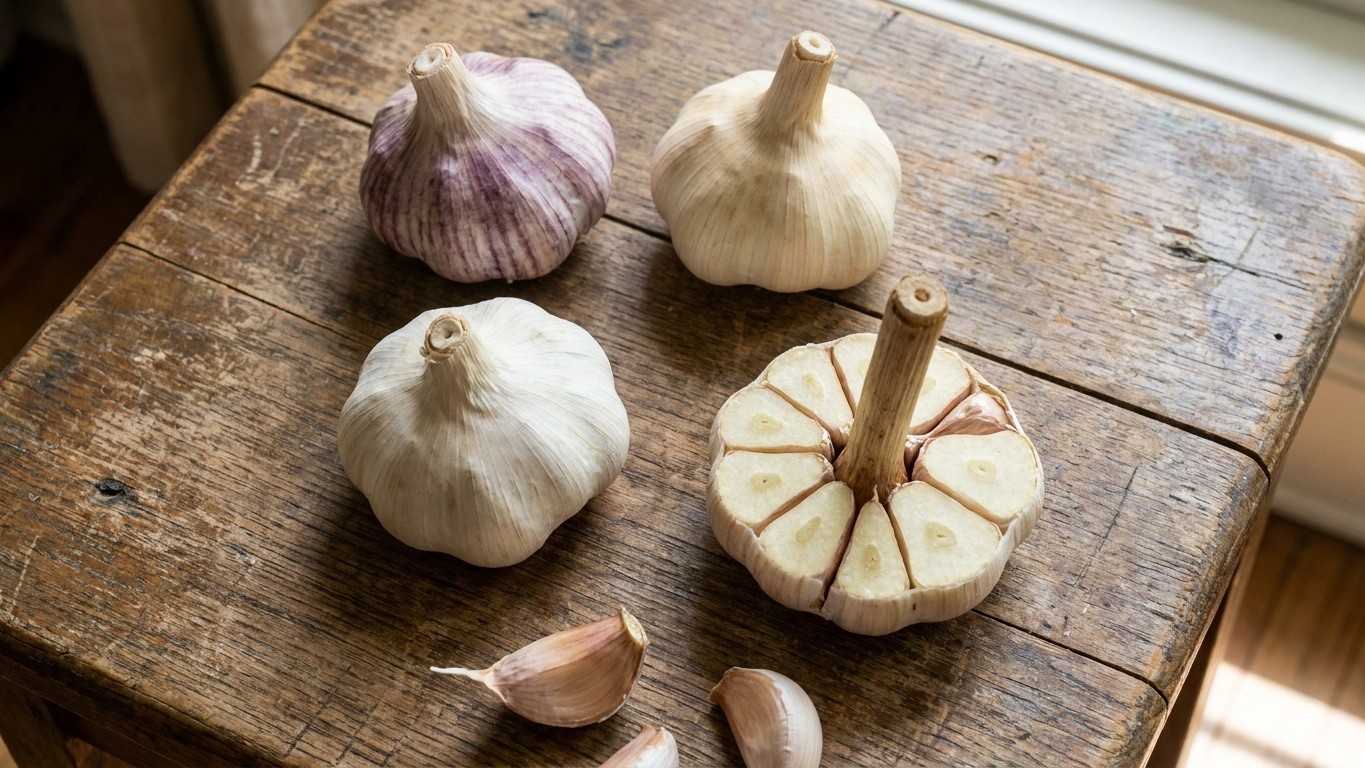

If you’re standing in your garden right now turning a bulb over in your hand, the short answer is this: grow a hardneck if your winters bite hard and you want big, easy-to-peel cloves with real character, and grow a softneck if you want a braid on the wall and cloves that keep until next summer. Past that first split, the choice comes down to how you cook, how patient you are with peeling, and how long you need the harvest to last in the pantry. So the one thing to do before you plant is figure out which of those two camps your climate puts you in.
Hardneck vs. Softneck: What Actually Separates Them

The names describe the stiff or floppy stalk, but that stalk is really just the visible sign of a much bigger set of differences underneath. Hardneck garlic needs a real winter chill to trigger bulb formation — it’s built for cold-climate growers, and it rewards that cold with a flowering stalk called a scape, which most growers snap off in early summer both to eat and to push more energy into the bulb. Because a hardneck plant puts its cloves in a single ring around that central stalk, you get fewer cloves per bulb, but they’re larger, more uniform, and noticeably easier to peel than a softneck’s tangle of small inner cloves. The tradeoff is storage: hardneck bulbs tend to soften and sprout sooner in the pantry than softneck bulbs do.
Softneck garlic is the type you’ll recognize from braided ropes in a farmhouse kitchen, and that flexible neck is exactly what makes braiding possible — there’s no stiff scape stalk in the way. Softnecks don’t need much winter cold to form bulbs, which is why they dominate in mild-winter and warm-climate gardens, and they typically pack cloves in multiple layers around the center, giving you more cloves per bulb, just smaller and fussier to peel individually. In exchange, softneck varieties are the long-haul keepers, holding up in storage far longer than most hardnecks. Within the softneck world you’ll mostly meet the silverskin varieties on this site; within hardneck, you’ll meet rocamboles, porcelains, purple stripes, glazed purple stripes, and artichokes — the last of which sits closer to the softneck side in some of its habits even though it’s classed as hardneck.
Rocambole
Rocamboles are the ones old-school garlic growers get sentimental about — they’re often held up as the “true garlic” flavor standard that other types get compared against, with an easy-peel skin and a habit of producing a dramatic, curling scape. Spanish Roja is probably the most planted rocambole in home gardens precisely because so many garlic lovers taste it and call it the flavor they think of as “real” garlic; it’s a mid-season variety. German Red brings a full-bodied, strong, and spicy character along with reliably large, satiny white-and-purple heads, also on a mid-season timeline. Bavarian Purple rounds out the group as another mid-season rocambole, distinguished within the type by its deep purple coloring even before flavor enters the conversation.
What all three share is the rocambole tradeoff: exceptional flavor and clove size, an easy peel, and a shorter shelf life than the porcelains or purple stripes, so they’re best planned as garlic you use earlier in the storage year rather than garlic you’re counting on for next spring.
A few other rocamboles round out this group’s reputation for flavor lovers. Russian Red is another variety prized by those who want garlic flavor turned all the way up, with 4-12 easy-peeling cloves — though like its rocambole cousins, it only keeps 3-4 months at room temperature, so plan to eat it first. Ukrainian Red carries a similarly rich, storied flavor and the same hardneck structure of 4-12 cloves that peel cleanly. Both share that familiar rocambole bargain: outstanding taste and easy peeling traded against a short shelf life.
Porcelain
Porcelains are the type most people picture when they imagine a “gourmet” bulb — glossy, smooth, ivory-white wrappers over just a handful of very large cloves. Music is the benchmark of the group, prized for a medium-hot, true garlic flavor and a mid-season harvest. Blue Music, an early-season relative, offers a smoother and milder flavor with just enough richness for everyday cooking without the heat taking over. Georgian Crystal is another mid-season porcelain, known for a rich, smooth, slightly smoky flavor that never turns too hot. Georgian Fire lives up to its name with a powerful flavor balanced by real spice, also mid-season. German White is the latest of the group to mature, valued as an adaptable variety that yields bulky bulbs with a succulent flavor and just a touch of spice.
Because porcelains generally form very large cloves — often only four to six per bulb — they’re a favorite for cooks who hate fussy peeling, though as a group they tend to sit in the middle of the storage-life range: better than rocambole, not as long as a good silverskin.
A few other porcelains round out the group, each carving its own niche. Mount Hood brings a vibrant punch that mellows nicely when roasted, while Norquay leans into a strong, spicy kick that holds up well raw. Polish Jenn stands out for its refined flavor and cold hardiness, and Romanian Red goes bold with a hot, pungent bite that lingers. Rosewood offers the gentlest introduction, starting mild and creamy before finishing with a light spicy edge — proof that even within one variety group, porcelains can range from subtle to fiery.
Purple Stripe
Purple stripe garlics are named for the streaks and blotches of color that break across their wrappers, and as a group they’re often singled out as the best type for roasting whole. Persian Star is an all-round garlic with only mild spice, harvested mid-season. Chesnok Red is considered one of the best all-around cooking varieties in the whole lineup because its full-bodied flavor actually lingers and holds up after cooking, rather than fading in the pan; it’s a late-season bulb. Duganski pairs a stunning appearance with large bulbs and a flavor that matches the looks, on a mid-season schedule. Metechi is the group’s powerhouse, delivering robust garlic flavor with a genuinely sharp bite, also mid-season.
Glazed Purple Stripe
Purple Glazer is technically its own branch of the purple stripe family — what growers call a “glazed” purple stripe, a subgroup within the group known for producing the best baked garlic of any hardneck type. Purple Glazer itself has a strong, lasting flavor that isn’t hot and leaves no aftertaste, and it matures mid-season. If you’re choosing a purple stripe specifically to bake whole and serve as a spread, this is the one to reach for first.
A few other purple stripes round out the group, all hardnecks with 4-12 easy-peeling cloves and a shorter room-temperature keep of just 3-4 months, so plan to eat them first. Krandasger Red offers a smooth, well-balanced flavor with rich garlic character but little heat. Siberian is clean and medium-to-strong, without the harshness that bold garlic can carry. Svea is eye-opening and spicy raw, then mellows into a nutty sweetness once roasted or baked. Vietnamese Red brings a mild spice that dissipates quickly, finishing pleasantly on the palate.
Artichoke
Artichokes take their name from the layered, overlapping way their cloves stack around the bulb, closer in structure to a softneck than most other hardnecks, and they’re generally the most productive type per plant. Inchelium Red is mild-flavored and especially good baked, on a mid-season timeline. Susanville offers a mild but unmistakably true garlic flavor that wins over even casual garlic fans, also mid-season. Red Toch is the most complex of the four — mild yet layered, smooth and aromatic eaten raw, then turning sweet and richly caramelized once roasted, and it’s mid-season as well. Lorz Italian breaks from its milder artichoke cousins entirely: it’s the pick for anyone who wants their garlic genuinely hot and spicy, and it too matures mid-season.
Because artichoke types produce more cloves per bulb than any other hardneck, they’re a practical choice if you’re growing to actually feed a kitchen rather than to show off a few enormous cloves.
Worth noting that these traits aren’t exclusive to artichoke types — softnecks bring their own strengths, distinct from the artichoke group above. Early Red Italian is a mild, creamy garlic that braids well and keeps 6-9 months at room temperature, making it the winter keeper. Italian Late offers a pungent flavor suited mainly to cooking. Messidor is smooth and mellow, turning gently sweet when roasted. Sicilian has a bold, spicy bite fresh that mellows into rich sweetness once cooked, making it an easy everyday choice. All four are softnecks with 10-40 cloves per bulb.
Silverskin
Silverskins are the softnecks proper on this list, and the ones you’d choose specifically for braiding and for staying power in storage. Nootka Rose is unusually strong-flavored for a softneck — a rich, bold taste that’s rare in this group — and it stores well for 6–9 months; it’s a late-season variety. Silver Rose is a reliably productive, mild-flavored silverskin that’s especially good baked or roasted, also late-season. Silver White starts out mild but develops a noticeably stronger bite the longer it sits in storage, meaning its personality actually changes over the months you keep it, and it too is a late-season harvest.
If long storage is the deciding factor in your garlic choice — more than flavor, more than clove size — the silverskins as a group, and Nootka Rose in particular, are where to start.
Rounding out the silverskins is Western Rose, whose smaller inner cloves sit tucked among larger outer ones, and every clove carries a sharp, assertive garlic flavor. Like its late-season siblings, it braids well and holds for 6–9 months at room temperature, earning its reputation as a true winter keeper. Whether you’re drawn to Nootka Rose’s boldness, Silver Rose’s mild roasting sweetness, Silver White’s evolving bite, or Western Rose’s sharp punch, the silverskin group consistently delivers the long shelf life that makes softnecks the storage-focused gardener’s natural choice.
Choosing by Climate and by How Long You Need It to Keep
Start with your winters. If you get real sustained cold, a hardneck will reward you with the scape, the easy peel, and the flavor range across rocambole, porcelain, purple stripe, glazed purple stripe, and artichoke types — but plan to eat those bulbs across fall and winter rather than banking on them lasting into next summer. If your winters are mild, softneck silverskins like Nootka Rose, Silver Rose, and Silver White will bulb reliably without the deep chill a hardneck demands, and they’ll still be sound in the pantry long after most hardnecks have started to soften.
If keeping power is your main concern regardless of climate, lean softneck first, then look to the porcelains among the hardnecks — types like Music or German White — before turning to rocamboles, which are best treated as the garlic you use up first. If it’s the cooking that matters most to you — a variety like Chesnok Red that holds its flavor through the pan, or a Purple Glazer built for roasting whole, or a fire-breather like Lorz Italian — pick that variety’s page next and read the growing notes specific to it. Either way, the split you make this autumn between hardneck and softneck is the one decision that shapes everything else about the bulb you’ll be pulling out of the ground next season.