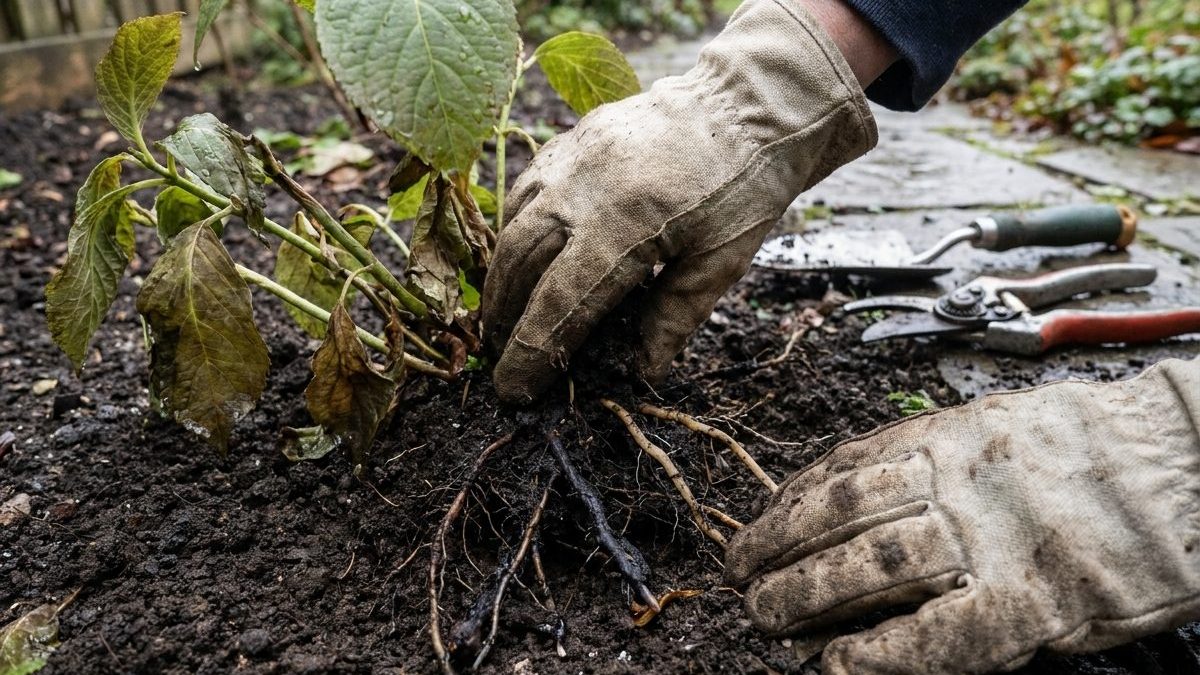

Root rot in hydrangeas is a soil-borne infection, not a leaf disease, and it kills from the ground up while the canopy above still looks almost normal. By the time wilting shows on top, the roots underneath are often already collapsing. It’s serious, frequently fatal once advanced, and the outcome depends entirely on how fast a gardener catches it and how well the site actually drains.
What you are looking at
The visible clues rarely start where you’d expect. A hydrangea with root rot usually shows trouble in the lower, older leaves first, while new growth at the tips still looks fine for a while longer. Wilting is the giveaway that sends most people down the wrong path, because the soil is often visibly moist or even soggy at the same time the leaves are drooping, which feels backward until you understand that drowned roots can’t move water any better than dry ones can.
Wilting Leaves That Don’t Recover Overnight
Healthy hydrangeas droop on a hot afternoon and perk back up by morning. With root rot, the wilted leaves stay limp even after a cool night and a soaking rain, and the wilting slowly spreads upward through the plant over a matter of weeks rather than reversing.
Blackened, Mushy Roots
Dig at the base and pull up a section of root. Healthy hydrangea roots are firm, pale tan to white, and hold together when you tug the outer layer. Rotted roots are dark brown to black, soft enough that the outer skin slips off in your fingers, and they often smell sour or sulfurous.
Stem Discoloration at the Soil Line
Where the main stem meets the ground, look for a dark, water-soaked band that wasn’t there before. This ring often feels slightly sunken compared to the healthy bark just above it.
Stunted or Yellowing New Growth
Once the root system is compromised enough, new leaves emerge undersized and pale yellow instead of the usual deep green, because there simply isn’t enough functioning root left to feed them.
What it is not
Three conditions get mistaken for root rot often enough that the mix-up is worth walking through carefully, because treating one as another wastes time the plant may not have.
Bacterial Wilt
This is one of the diseases documented in hydrangeas, and it produces wilting that looks nearly identical from a distance. The difference shows up when you cut into a stem near the base: bacterial wilt leaves a brown or discolored ring in the vascular tissue just under the bark, visible as a distinct circle when you slice the stem crosswise. Root rot doesn’t produce that ring; the damage stays confined to the roots themselves rather than climbing into the stem’s plumbing. Mistaking one for the other matters because improving drainage won’t touch a vascular infection, and pulling roots to check for rot won’t reveal a problem that’s actually higher up in the stem.
Drought Stress
A hydrangea that’s simply thirsty wilts hardest in the heat of the day and largely recovers once temperatures drop in the evening, at least in the early stages. Dig at the root zone and the soil itself tells the story: it’s dry several inches down, not saturated, and the roots you find are intact, pale, and merely a little limp rather than blackened and falling apart. Watering a drought-stressed plant fixes it within days. Watering a root-rotted plant makes it worse, which is exactly why this distinction matters before reaching for the hose.
Transplant Shock
A hydrangea moved within the past few weeks often wilts and looks generally unhappy simply because its root system hasn’t reestablished contact with the surrounding soil yet. The roots on a shocked transplant are pale and whole, not soft or discolored, and the plant typically shows visible improvement within two to three weeks as new root hairs form. Pulling a struggling new transplant and finding intact roots is reassuring, not alarming.
Where it comes from and when it strikes
Root rot in hydrangeas is caused by water mold organisms in the soil, most often species in the Phytophythium and Pythium groups, which behave less like typical fungi and more like aquatic organisms that need standing water to move and infect. They survive between growing seasons as resting spores buried in soil, sometimes for years, waiting for conditions wet enough to activate.
The usual point of entry is water itself. Spores swim through saturated soil and enter roots through natural openings or small wounds, which is why splashing irrigation, flooded low spots, and compacted clay that holds water for days after rain are the classic setups. Infected nursery stock is another common route: a hydrangea can arrive from the garden center already carrying the pathogen in its root ball, planted straight into a new bed without anyone knowing.
The weather pattern that favors this disease is straightforward, even without pinning it to a specific number: soil that stays saturated for extended stretches, combined with warm conditions, gives these organisms exactly the window they need. A single heavy storm rarely does the damage. It’s the soil that never quite dries out between waterings, week after week, that sets root rot in motion.
What to do about it now
Start by digging, not guessing. Expose a section of the root ball and assess how much is still firm and pale versus mushy and dark. If more than half the root mass is gone, the honest answer is that the plant likely can’t be saved, and continued watering only accelerates the collapse. That’s a hard thing to hear about a shrub someone has nursed for years, but pretending otherwise wastes effort that could go toward starting fresh in a better spot.
If the damage is limited to a portion of the roots, there’s a real chance of recovery. Cut away the blackened, rotted sections with a clean tool, let the remaining root ball air out for a day if practical, and replant in a location with genuinely better drainage, raising the crown slightly above grade rather than setting it in a depression. Stop watering on a schedule and instead water only when the top few inches of soil have dried out. Skip fertilizer, especially anything high in nitrogen, until new growth shows the plant is stabilizing, since pushing top growth on a damaged root system just adds stress.
Phosphite-based fungicide drenches, sold at garden centers for water mold diseases, can help suppress the pathogen in a plant caught early, but they won’t reverse rot that’s already extensive. There’s no rescue treatment for a plant that’s mostly lost its roots. On the food-safety question that comes up with plant diseases generally: hydrangeas aren’t a food crop, so there’s no harvest to worry about, though it’s worth knowing that bigleaf hydrangea specifically is documented as toxic if eaten in large quantities, a separate issue from root rot and one that matters more for households with pets or curious kids than for the disease itself.
Keeping it out next season
Site selection does more preventive work here than any product on a shelf. Avoid low spots where water visibly pools after rain, and if the planting area is naturally heavy clay, raising the bed even modestly changes the drainage picture substantially. Water at the base of the plant rather than overhead, and let the soil surface dry between waterings instead of keeping it constantly damp.
Both bigleaf and panicle hydrangeas are shallow-rooted, which makes them quick to suffer in compacted or waterlogged soil but also quick to benefit from a two to three inch mulch layer that moderates moisture swings, kept a few inches back from the stem itself so the crown doesn’t stay damp against the bark. No hydrangea cultivar is documented as resistant to root rot specifically, so prevention rests almost entirely on drainage and watering habits rather than on plant selection.
When buying new stock, inspect the root ball before it goes in the ground, looking for the same firm, pale roots described earlier, and avoid reusing potting soil or containers from a plant that was pulled for rot. Matching the hydrangea type to the site’s actual sun and moisture conditions also matters: a panicle hydrangea tolerates a wider range of conditions and full sun better than a bigleaf or mountain hydrangea, which prefer dappled shade and are pickier about consistently well-drained soil. Getting that match right from the start does more to prevent a repeat than any treatment applied after the fact.
Common questions
Can a hydrangea recover from root rot on its own?
No. Without intervention, an infected root system keeps deteriorating because the pathogen and the saturated conditions that caused it don’t resolve by themselves. Improved drainage and reduced watering are what turn the situation around, not time alone.
Will root rot spread to nearby plants?
The water mold organisms responsible live in soil and move through water, so nearby plants in the same low-lying, poorly drained spot are at real risk, especially if they’re watered from the same source or share irrigation runoff. Plants in well-drained soil elsewhere in the yard aren’t automatically threatened just because one hydrangea is affected.
Is it safe to replant a hydrangea in the same spot?
Only if the drainage problem that caused the rot has actually been fixed. Replanting in the same soggy hole without raising the bed or correcting drainage sets up the same failure again, regardless of which plant goes in.
How is root rot different from the other diseases hydrangeas get?
Leaf spot, powdery mildew, rust, and bacterial wilt all show their damage above ground, on foliage or in the stem’s vascular tissue, and several of them are manageable nuisances rather than fatal. Root rot is the one that starts invisibly below the soil line and often isn’t caught until the root system is already badly compromised.