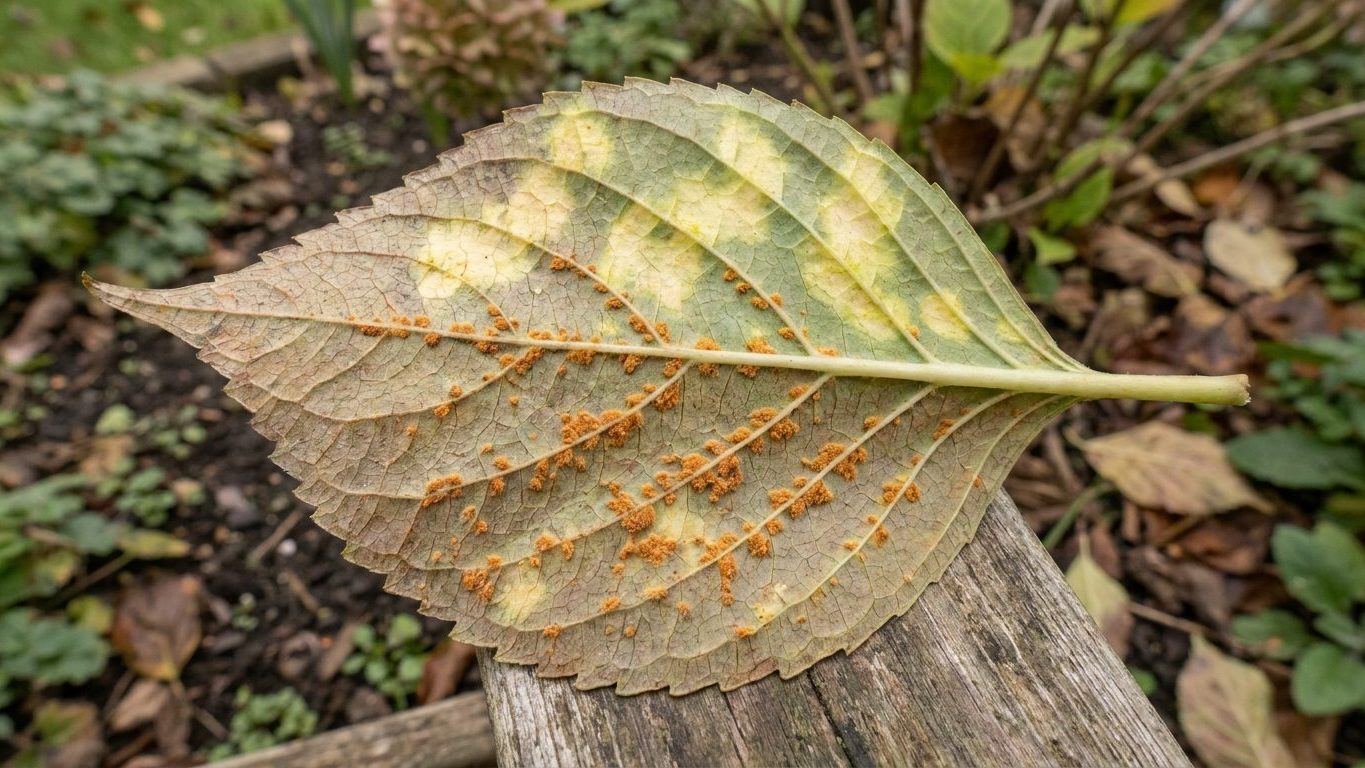

Orange, powdery pustules crowding the underside of a hydrangea leaf point to rust, a fungal disease that shows up most often on panicle hydrangea late in the growing season. It disfigures foliage and can strip a shrub early, but it rarely kills a mature plant outright. The infection spreads through a planting over weeks rather than days, which gives a gardener real time to act before it affects next year’s growth.
What you are looking at
Rust starts low and works upward, favoring the older leaves near the base of the shrub before it reaches new growth at the tips. It moves slowly compared to a wilt or a bacterial infection, so a plant that looked fine last week rarely collapses this week. The stems stay upright and the wood stays firm; this disease attacks leaf tissue, not the plant’s plumbing.
Orange pustules on the leaf underside
Flip a suspect leaf over and look for small, raised bumps clustered in patches, rust-orange to cinnamon in color, with a slightly fuzzy or dusty texture. Brush a finger across one and a fine orange powder often comes off, which is the spore mass itself. These pustules tend to cluster along the leaf veins rather than scatter randomly across the surface.
Yellow blotches on the upper leaf surface
Turn the same leaf back over and the top side shows pale yellow to yellow-green blotches directly above where the pustules sit underneath. The edges of these blotches are soft and irregular, not crisp rings, and they don’t have the dark border you’d see with a leaf spot lesion. Early on, a leaf can look almost stippled, with dozens of small yellow flecks before the underside pustules are even easy to spot.
Premature yellowing and leaf drop
As pustules mature and multiply, the yellow blotches merge into larger dead patches, and heavily infected leaves yellow all over and drop weeks ahead of a normal fall. On panicle hydrangea, this can mean a shrub that’s bare from the ground up by late summer while the top canopy still looks green. Flowers and stems themselves are not directly attacked; the damage is a leaf-by-leaf loss that thins the plant rather than kills it.
What it is not
Getting this wrong matters because the fix for each look-alike is different, and treating rust like something else wastes a season. Leaf spot, powdery mildew, and bacterial wilt are the three conditions gardeners most often confuse with rust on hydrangea, and each has one detail that settles the question fast.
Leaf spot
Leaf spot produces distinct, roughly circular lesions with a defined dark or purplish border, often with a tan or gray center, scattered across both leaf surfaces rather than concentrated on the underside. There’s no orange powder, and the lesion doesn’t rub off on your finger. A gardener who treats leaf spot as rust and focuses only on the leaf underside will miss the top-surface lesions where leaf spot actually does its damage, and keep applying the wrong sanitation routine.
Powdery mildew
Powdery mildew coats the leaf in a white to gray, flour-like film, usually starting on the upper surface and sometimes covering both sides evenly. It wipes off as a pale dust, not orange, and it doesn’t cluster into raised bumps. Mistaking mildew for rust usually means reaching for the wrong fungicide timing, since the two fungi favor different weather and respond to different active ingredients.
Bacterial wilt
Bacterial wilt shows up as sudden, one-sided drooping of stems and leaves rather than leaf discoloration, and a stem cut near the wilted section often reveals a brown, discolored ring inside where the vascular tissue has been colonized. There are no pustules and no yellow blotching pattern at all. This distinction matters most, because bacterial wilt cannot be cured with sanitation or fungicide the way rust symptoms can be managed; a wilting stem is already lost, and the real decision is whether to remove the whole plant to protect its neighbors.
| Condition | Where it shows | Distinguishing sign |
|---|---|---|
| Rust | Leaf underside, lower leaves first | Orange, powdery pustules that rub off |
| Leaf spot | Both leaf surfaces, scattered | Defined dark-bordered circular lesions |
| Powdery mildew | Upper leaf surface, often widespread | White, flour-like film, no bumps |
| Bacterial wilt | Stems, one side of the plant | Brown ring visible in a cut stem |
Where it comes from and when it strikes
Hydrangea rust is caused by a fungus in the rust family, a group of organisms known for surviving between growing seasons in fallen, infected leaf debris left on the ground rather than in the soil itself. When conditions turn favorable again, spores form on that old debris and are carried by wind or splashing rain onto new foliage, where infection restarts the cycle. Some rust fungi also depend on a second, unrelated host plant to complete part of their life cycle, though that detail isn’t settled for every hydrangea rust case and shouldn’t be assumed for a given yard.
The weather that favors this disease is the same combination that favors most foliar fungi: warm temperatures paired with high humidity and long stretches of leaf wetness, whether from rain, dew, or overhead irrigation that keeps foliage damp overnight. Dense plantings that trap moisture and block airflow between leaves give the fungus more time on wet tissue to establish, which is part of why rust tends to show up worse in crowded, shaded corners of a bed than in an open, breezy spot.
Because the fungus overwinters on fallen leaves rather than in soil, a planting can go rust-free one year and get hit hard the next simply because old leaf litter wasn’t cleared away, or because a wet spring extended the window of leaf wetness longer than usual. The disease doesn’t arrive on wind from hundreds of miles away the way some fungal pathogens do; local debris and local humidity do most of the work.
What to do about it now
Start by removing the worst-affected leaves and any that have already dropped, bagging or burning that material rather than tossing it on a compost pile that won’t reliably kill the spores. This single step, done consistently through the season, does more to slow rust than any spray applied without it.
Cut back on overhead watering and switch to watering at the base of the plant if that’s practical, since wet foliage overnight is exactly what the fungus needs. Thinning crowded stems and giving the shrub more space from its neighbors improves airflow and shortens how long leaves stay damp after rain or dew, which matters more for rust control than most gardeners expect.
Fungicides labeled for rust on ornamental shrubs can help protect healthy, uninfected leaves if applied before the disease has spread widely, but they won’t reverse damage already done to yellowed or pustule-covered foliage. Spraying is a preventive tool at this point in an active outbreak, not a cure for the leaves you’re already looking at.
There’s no harvest question here in the usual sense, since hydrangea isn’t grown for eating. Worth remembering, though: bigleaf hydrangea foliage, bark, and flowers are documented as toxic if eaten in large quantities by people or by pets, causing nausea, stomach pain, and vomiting, so bagged diseased leaves are also a reasonable thing to keep away from a curious dog rather than left in a pile in the yard.
Keeping it out next season
Raking up and destroying fallen leaves at the end of the season is the single most effective habit against a fungus that overwinters on leaf litter rather than in soil. Do this every fall around the shrub, not just when symptoms were obvious that year, since spores can build up quietly on debris from a mild infection that never got noticed.
Spacing and pruning for airflow help every season after that, though how and when to prune depends entirely on which hydrangea type is planted. Panicle hydrangea flowers on new growth and tolerates a hard cutback in late winter, while bigleaf hydrangea sets its buds the previous summer and loses its blooms if pruned at the wrong time. That timing question, along with hardiness by zone, belongs on the pages specific to each hydrangea type and each state rather than a single blanket answer here.
No rust-resistant hydrangea cultivars are documented in the extension source behind this page, so cultivar choice isn’t the lever to pull for this particular disease the way it is for some others. What the source does note is that rust is called out specifically on panicle hydrangea, so a gardener battling repeated outbreaks on that type might reasonably consider whether a smooth or oakleaf hydrangea would suit the same spot with less pressure from this fungus, understanding that swap trades one set of considerations for another rather than guaranteeing a rust-free bed.
Buying transplants from a source that inspects stock for foliar disease before sale, and giving new shrubs enough room from established plantings that already carry rust, rounds out the prevention picture for the following year.
Common questions
Does rust on hydrangea leaves spread to other plants in the yard?
Rust fungi tend to be fairly host-specific, and the strain affecting hydrangea is not documented as a major threat to unrelated garden plants nearby. It can spread between hydrangea shrubs in the same bed through windblown or splash-carried spores, which is the main reason to isolate and remove infected leaf debris rather than let it sit near healthy plants.
Will rust come back if I just remove the infected leaves this year?
Removing infected leaves through the season helps, but the fungus survives on debris left on the ground over winter, so a fall cleanup of every fallen leaf around the shrub matters more for preventing next year’s outbreak than anything done mid-season.
Is rust the same fungus that causes rust on roses or lawn grass?
No. Rust fungi as a group share a similar look and life cycle, orange pustules included, but the specific organism affecting hydrangea is not the same species that infects roses, lawns, or other garden plants, even though gardeners often lump them together by symptom.
Can a heavily rusted hydrangea recover the following year?
Yes, in most cases. Because rust attacks leaf tissue rather than the stems or roots, a shrub that drops leaves early from a bad infection typically leafs out again normally the next spring, provided fallen debris was cleared and conditions that favored the outbreak, like poor airflow or overhead watering, are addressed in the meantime.