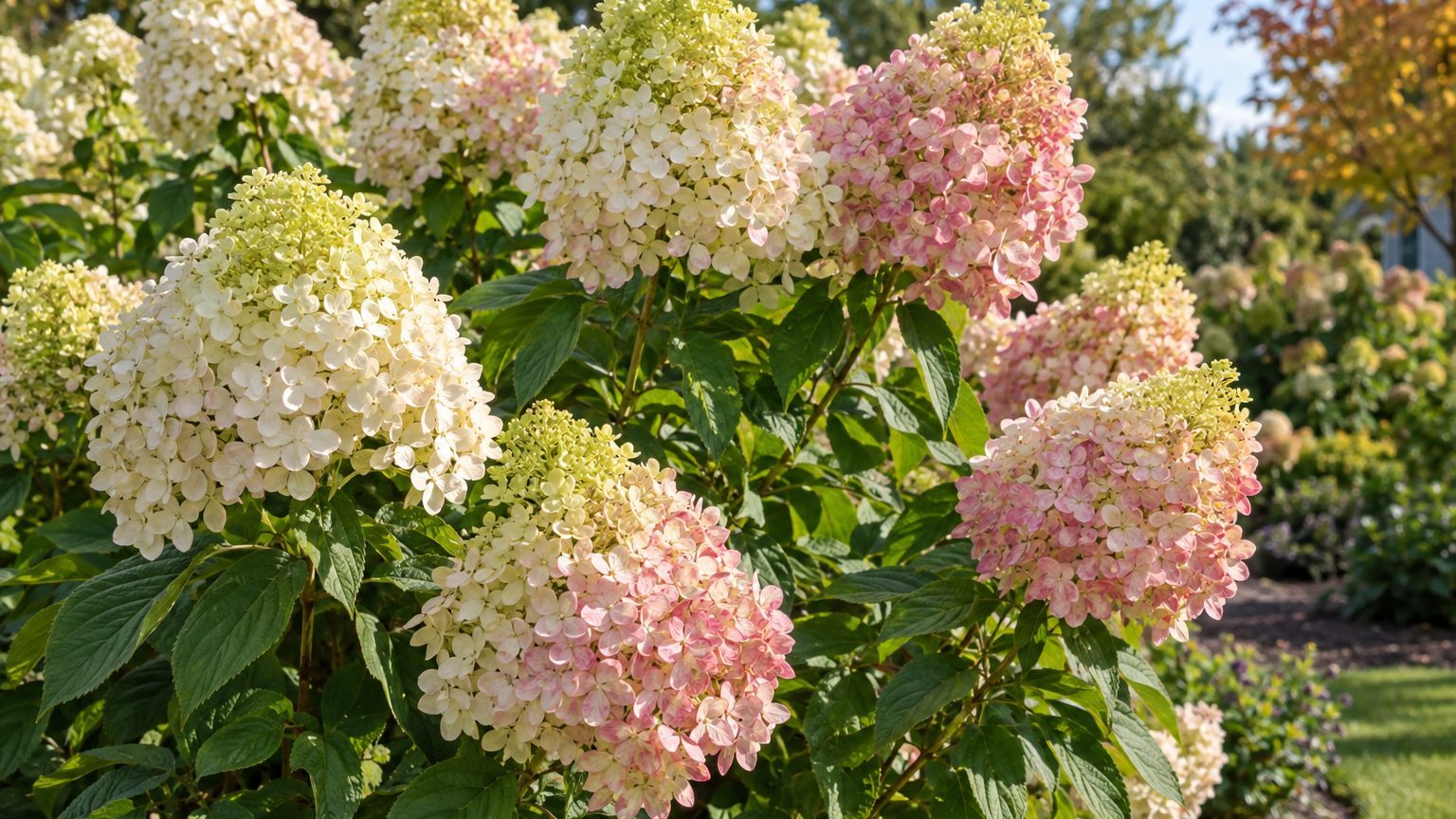

Phantom is a panicle hydrangea with very large flower heads that open cream-white to lime green and age to pink, and it is hardy in USDA zones 3a through 8b. If you came looking for a tomato-style days-to-maturity figure, there isn’t one. Nothing about a hydrangea is timed from transplant to harvest, and nothing here belongs on a plate. The question that does carry over is whether Phantom blooms reliably where you live. It flowers on the current season’s growth, so the answer is kinder than most gardeners expect.
What Phantom actually is
Three facts decide whether this shrub suits a yard: its hardiness range, the wood it flowers on, and how its flowers change color. The North Carolina Extension Gardener Plant Toolbox, the source for every figure on this page, gives Phantom’s type as panicle hydrangea, hardy in USDA zones 3a through 8b. It flowers on the current season’s growth, and the source describes the blooms as very large panicles, cream-white to lime green, then pink. The color runs white to cream, then pink, then tan as the flowers age.
No days-to-maturity number exists for it, so none is offered here. The nearest equivalent is the new-wood habit. The plant builds fresh stems each spring and sets its flowers on them, so it doesn’t depend on buds that had to survive the winter.
On size, the source gives a range for the panicle type as a whole: 8 to 25 feet. A catalogue figure for Phantom itself is not published here, so check the tag on the plant before you decide where it goes. The same source calls the type the only hydrangea that takes full sun well, rates the genus low-maintenance, and lists panicle Hydrangeas among the rapid growers. Panicles are shallow-rooted and benefit from mulch. It says nothing specific about staking Phantom’s heads, so don’t assume they need it or don’t.
The panicle type is also the one the source recommends as a substitute for the mop-head hydrangea where that species isn’t winter hardy. The wider family is laid out on the Hydrangea Varieties page.
What Phantom is good for

Not a food plant
Phantom is a landscape shrub, and the source documents no culinary use and no flavor. What it does record is toxicity. Only bigleaf hydrangea (H. macrophylla) is documented as toxic, and only when large quantities are eaten, with nausea, stomach pain, vomiting and sweating. The toxic principle is hydracyanosides, in the bark, flowers, leaves and stems. Phantom is a panicle, and the source lists no toxicity for that type. Still, nobody should eat it.
What it does well instead
The job of a panicle is to bloom on wood it grows that same year. That has a practical payoff. Because the flowers come on new growth, the plant can be cut back hard while dormant and still flower. A bigleaf pruned at the wrong time loses its buds, so this matters.
Color is the other thing people ask the plant to do, and Phantom won’t. Soil pH moves flower color only in bigleaf and mountain Hydrangeas (blue below about pH 5.5, pink above about pH 6.5, purple between). Phantom does not respond. Its progression from cream-white to pink to tan happens with the season, whatever is in the soil. What bigleaf flowers actually need for blue is available aluminum, which acidity releases. Aluminum sulfate acidifies soil and lime pushes it the other way, yet neither will tint a Phantom.
There is one wildlife use worth knowing. Native bees nest in dead hollow stems, and the source suggests cutting stems back to 12 to 24 inches and leaving them standing until they disintegrate.
Where it ripens in time, and where it is a gamble
The arithmetic, redone for a shrub
For a tomato, you subtract the soil-warming fortnight and the days to maturity from the frost-free window and see what is left for picking. Phantom has no such sum. There is no catalogue figure for days to bloom, and no frost-window data for named weather stations is published here, so don’t expect a city-by-city table. The working version is simpler. Find your USDA zone. If it falls between 3a and 8b, you are inside the range the source gives for Phantom. If it falls outside, the source gives no basis for promising success, and that is a gamble rather than a verdict.
The margin in the cold zones comes from the flowering habit. Flowers form on the current season’s growth, so a late frost can nip new shoots without erasing flowers that were set the previous summer. Bigleaf hydrangeas are the ones that lose their flowers that way, since their buds form the summer before.
| Type | USDA range | Flowers on |
|---|---|---|
| Panicle (Phantom, peegee) | 3a-8b | Current season’s growth |
| Bigleaf / mop-head | 6a-11b | Last year’s wood |
| Smooth | Hardiest of the genus | New wood |
| Oakleaf, mountain, climbing | Not stated here | Old wood |
What this means by region
Cold northern gardens sit comfortably inside the panicle range, which reaches down to zone 3a. A bigleaf would struggle there, which is why the source names panicles as the substitute. In the warm end, the range stops at zone 8b. Gardeners in the Gulf Coast or southern Florida belt should treat Phantom as a question mark, because the source holds no hardiness figure beyond 8b and no heat-tolerance data for the cultivar.
Pruning dates, zone verdicts and planting specifics are state-by-state matters, and they live on the state pages. Phantom’s neighbors in the same type, such as the Pee Gee Hydrangea: When to Plant the Tomatoes That Ripen All at Once page, share the same new-wood habit, so the same zone logic applies. The Fire Light Hydrangea: When to Plant the Tomatoes That Ripen All at Once page covers another variety worth comparing for bloom color.
The two ways a season goes wrong
With tomatoes, a long season can still fail in two ways that a frost table can’t show. In the north, accumulated warmth can run short even when the frost-free window is long, and fruit won’t set when nights fall below 50F. In the south, heat above roughly 86F sterilizes pollen and the middle of summer is lost. Those are fruit-set rules. Phantom is not grown for fruit, and the source carries no comparable temperature threshold for its flowers, so importing the numbers would be guessing.
Two failures are documented for this type. The first is a mismatch between zone and plant. The panicle range is 3a to 8b, and outside it the source offers no support. The second is a mismatch between plant and method: handling Phantom like a bigleaf. Bigleaf care means protecting old-wood buds and pruning before August 1. Apply that to a panicle and you fuss over a plant that doesn’t need it. Reverse the mistake and treat a bigleaf like a panicle, cutting it back hard in late winter, and you remove its flowers. Because the bloom season is set by new growth rather than surviving buds, Phantom is rarely lost to a late cold snap the way a bigleaf’s flowers are.
What it resists, and what it does not
The source grades no disease resistance for Phantom, high or intermediate. That is an absence of data, not a clean bill of health, and no protection should be assumed. What the source does give is a genus-level list of problems: leaf spot, bacterial wilt and powdery mildew. On panicle hydrangeas specifically it adds rust and bud blight. Those are the diseases to watch for.
Pests get a gentler report. Aphids, scales, nematodes and mites are listed as rarely a problem. Deer are different. The source names them as a damage agent and, inconsistently, also lists them under resistance to challenges on the genus page. Where one source disagrees with itself, go with what gardeners observe: hydrangeas are browsed. Don’t count on Phantom being safe from deer, and if they roam your area, plan for a fence or repellent before you plant.
Growing it without the usual mistakes
Site, soil and support
Phantom takes full sun, which few hydrangeas do. The source says it will grow in clay, loam or sand, at any pH from acid to alkaline, as long as drainage is good (occasionally wet is tolerated). Shallow roots are the practical detail, and mulch is how you manage them. Keep it in place so the roots don’t dry out in a hot spell. Spacing is where the species range of 8 to 25 feet comes in: check the tag for the cultivar’s mature size and give it room, since the source does not give a Phantom-specific figure.
Feeding, pruning and the classic slip
On feeding, the source gives no stop date for Phantom. One detail worth passing on is that high-phosphorus fertilizer locks aluminum up in the soil and pushes blue bigleaf flowers toward pink. That is a color issue for bigleaf and mountain hydrangeas, not for Phantom.
Phantom flowers on the current season’s growth and can be cut back hard while dormant. The month depends on your state, so use your state page rather than a national rule. The classic slip is applying the bigleaf calendar to a panicle, or the reverse. Wood type decides the pruning, not the word “hydrangea.” If you grow a Climbing Hydrangea Hydrangea: When to Plant the Tomatoes That Ripen All at Once alongside it, that one flowers on old wood and needs a completely different plan.
Propagation is by stem cutting or layering. The source notes panicle hydrangeas can also be grown from seed, but for a named cultivar like Phantom, cuttings are the usual route.
Common questions
Is there a days-to-maturity number for Phantom?
No. That figure belongs to vegetable catalogues. For Phantom the source gives only type, hardiness (USDA 3a through 8b), flowering wood (the current season’s growth) and color progression.
Will Phantom turn blue if I acidify the soil?
No. Color change with pH applies to bigleaf and mountain hydrangeas only. Phantom goes white to cream, ages pink, then tan, regardless of soil.
Can I cut Phantom back hard?
Yes, while it is dormant, because it flowers on the current season’s growth. The right month depends on your state, so check your state page rather than copying a date from another region.
Is Phantom poisonous?
The source documents toxicity only for bigleaf hydrangea, and only when large quantities are eaten. It lists none for panicles. Even so, Phantom is not a food plant, so keep it out of the kitchen and away from pets and livestock that might chew on it.