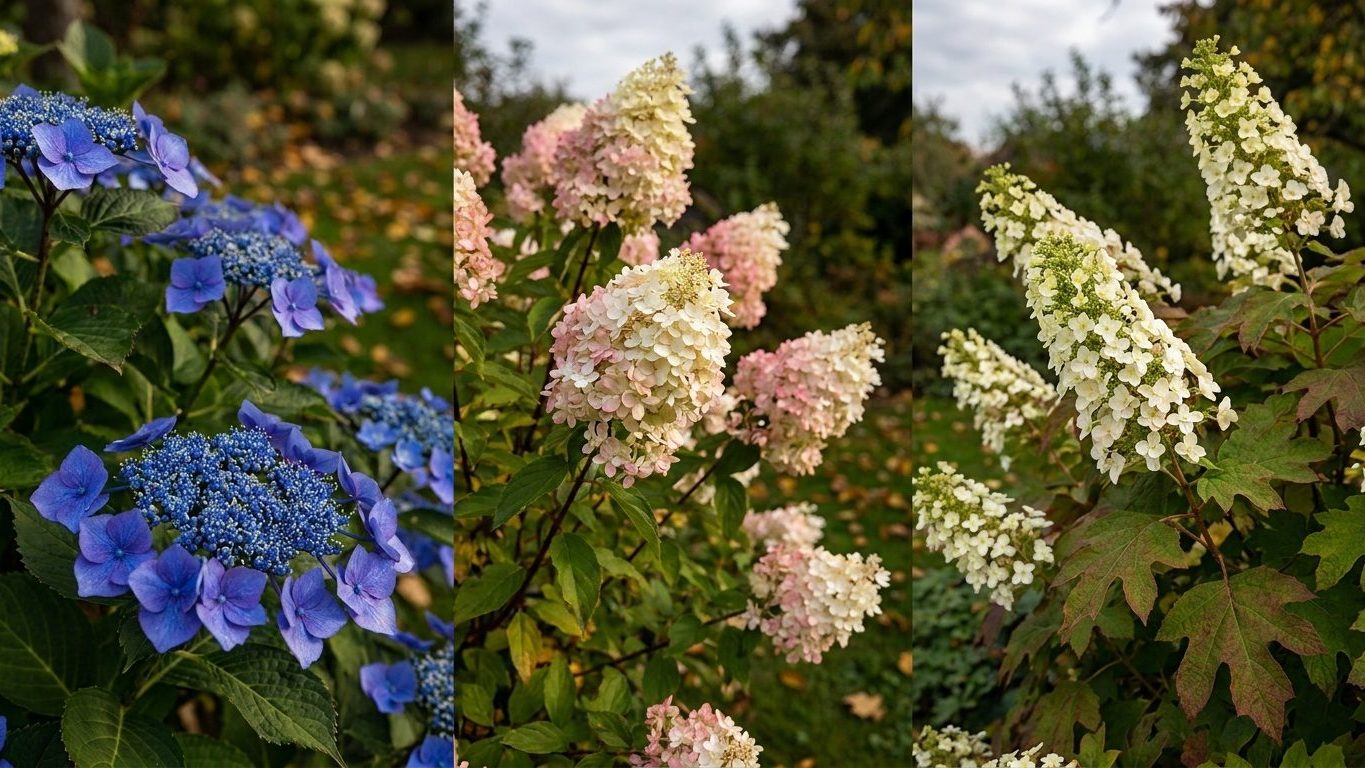

Picking the right hydrangea comes down to four questions: what USDA zone you garden in, whether the variety blooms on old wood or new wood, how much sun the spot gets, and whether you actually want to control flower color. Answer those first, and the shrub practically picks itself.
Why this matters
A hydrangea that’s wrong for its zone or its wood type doesn’t just underperform. It can skip flowering entirely for a full season, or worse, die back to the ground every winter and never mature past knee height. A bigleaf hydrangea (H. macrophylla) planted in a zone where late frosts are common will form flower buds one summer, only to have those buds killed before spring even arrives. No amount of good soil or feeding fixes that. The bud is simply gone.
The wood-type mismatch shows up just as often with pruning. Cut a bigleaf, oakleaf, mountain or climbing hydrangea back hard in early spring, thinking you’re tidying it up, and you’ve removed the exact wood that was going to carry this year’s flowers. Meanwhile a panicle or smooth hydrangea, which blooms on new growth, tolerates that same hard cut without losing a single bloom. Same genus, opposite outcome. Getting the variety right at the start avoids a whole category of frustration that no amount of fertilizer or watering will undo later.
When to do it
The moment to sort out variety and wood type is before you plant, not after a disappointing bloomless summer forces the question. If you already have an unlabeled shrub in the ground, watch it through one full year: does it flower on stems that grew this spring, or on the thicker, woodier stems left over from last year? That single observation tells you almost everything about how to prune it and what winter protection it needs.
Nursery tags help, but they’re not the whole story. A tag that just says “hydrangea” or shows a glossy blue bloom photo tells you nothing about whether that color is fixed by genetics (it isn’t, for bigleaf and mountain types) or whether the plant will survive your winters at all. Check the tag for the species name, macrophylla, paniculata, arborescens, quercifolia, serrata, or petiolaris, since that name is what actually determines hardiness and pruning timing. If a plant is already established and you’re trying to identify it, look at when it flowers relative to new growth emerging: old-wood types show flower buds swelling on stems that overwintered, while new-wood types don’t show buds until fresh green stems have already grown several inches.
How to do it
Start with your USDA hardiness zone, since that single filter eliminates most bad choices immediately. The genus as a whole spans zones 3a through 9b, but that range is misleading if you look at it as one number. Panicle hydrangea is the toughest of the flowering types, hardy from 3a to 8b, and it’s genuinely useful as a stand-in wherever bigleaf hydrangea can’t survive the winter. Bigleaf hydrangea itself is far more tender, reliable only from 6a to 11b. Smooth hydrangea (the Annabelle type) is the hardiest performer in the whole genus. Mountain hydrangea sits close to bigleaf in hardiness but its flower buds tolerate a late frost noticeably better, which matters in a garden with unpredictable spring cold snaps.
Next, sort by wood type, because this decides your entire pruning calendar. Bigleaf, oakleaf, mountain and climbing Hydrangeas all flower on old wood, meaning the buds form the previous summer and overwinter on the stem. Panicle and smooth Hydrangeas flower on new wood, the current season’s growth, which is why they can be cut back hard in late winter without any risk to that year’s blooms.
Then factor in light and mature size. Panicle hydrangea is the only type in the group that genuinely takes full sun well, and it can grow anywhere from 8 to 25 feet, so give it room. Bigleaf hydrangea wants dappled sun or partial to deep shade, staying 3 to 6 feet tall and wide, and needs protection from afternoon sun in particular. Oakleaf hydrangea tops out around 5 feet and rewards you with wine-red fall foliage most other types don’t offer. Climbing hydrangea is the outlier: it clings by aerial rootlets, reaches 15 feet or more, and is notoriously slow to start flowering, so patience matters more than technique with this one.
Finally, decide whether color control matters to you. If it does, only bigleaf and mountain hydrangeas respond to it. Everything else, panicle, smooth, oakleaf, and climbing, will go white, cream, pink or green as the season ages regardless of what you do to the soil, because their color is not pH-driven at all.
| Type | USDA zones | Blooms on | Mature size | Light | Color changes with pH? |
|---|---|---|---|---|---|
| Bigleaf / mop-head / lacecap | 6a-11b | Old wood | 3-6 ft | Dappled to shade | Yes |
| Panicle / peegee | 3a-8b | New wood | 8-25 ft | Full sun tolerant | No |
| Smooth (Annabelle) | Hardiest of genus | New wood | Varies | Partial sun to shade | No |
| Oakleaf | Not specified here | Old wood | ~5 ft | Partial shade | No |
| Mountain | Close to bigleaf | Old wood | Similar to bigleaf | Partial shade | Yes |
| Climbing | Not specified here | Old wood | 15+ ft | Partial shade | No |
Exact zone limits for oakleaf and climbing hydrangea, along with the pruning window and any recommended mounding depth for your specific location, depend on your state and the per-type guide is the place for that detail. This page is meant to get you to the right category first.
What goes wrong
The most common mistake is buying based on a photo of blue blooms without checking the species name on the tag. That blue color is achievable, but only on bigleaf and mountain hydrangeas, and only by managing soil pH: blue develops below about pH 5.5, purple in the middle range, and pink above about pH 6.5. Aluminum sulfate acidifies the soil to push toward blue; lime pushes it more alkaline toward pink. Try that same trick on a panicle or smooth hydrangea and nothing happens, because their color shifts with the season, not the soil.
Coffee grounds and citrus peel are a widely repeated home remedy for turning flowers blue, and they’re mostly a disappointment. The pH shift they produce is small, and what actually moves the color is available aluminum in the soil, which acidity releases. A cup of used coffee grounds scattered around the base isn’t doing that job reliably.
A mistake that looks like extra care is heavy feeding with a high-phosphorus fertilizer. It sounds generous, but phosphorus locks aluminum up in the soil, and that pushes blue flowers toward pink even when the pH itself hasn’t changed much. If a bigleaf hydrangea that used to bloom blue starts drifting pink without any lime applied, check the fertilizer bag before you check anything else.
Pruning at the wrong time is the other repeat offender, particularly on bigleaf hydrangea, where cutting after flower buds have already set removes next year’s show entirely.
Doing it differently
Container growing changes the calculation slightly. Bigleaf and mountain hydrangeas do well in pots because their smaller mature size suits container life, and moving the pot to a sheltered spot in winter solves the hardiness gap for gardeners a zone or two colder than the plant’s range would normally allow. Panicle hydrangea can be container-grown too, but its larger mature size means a bigger pot and more frequent watering, since both bigleaf and paniculata are shallow-rooted and dry out fast without a layer of mulch.
For small yards or foundation plantings, smooth hydrangea (Annabelle types) or mountain hydrangea generally fit better than panicle, simply on account of scale. For anyone gardening where deer traffic is heavy, know that hydrangeas are documented as browsed by deer rather than resistant to them, so a variation like fencing or repellent matters more than the species choice itself.
For a hedge or screen in full sun, panicle hydrangea remains the standout choice, and it’s specifically useful as a substitute in areas where bigleaf hydrangea simply won’t survive winter. Propagation differs by type too: most hydrangeas root readily from a stem cutting or layering, while panicle hydrangea can also be started from seed, which is worth knowing if you’re trying to grow several plants cheaply from one parent shrub.
Common questions
Can I turn a white hydrangea blue?
Only if it’s a bigleaf or mountain hydrangea. White or pale panicle, smooth, oakleaf and climbing varieties do not respond to soil pH and will not turn blue no matter what’s added to the soil.
Are hydrangeas toxic to pets?
Only bigleaf hydrangea is documented as toxic, and only if large quantities are eaten. The bark, flowers, leaves and stems contain hydracyanosides, cyanogenic glycosides that can cause nausea, stomach pain, vomiting and sweating in people, and are also a concern for cats, dogs and horses.
What pests and diseases actually affect hydrangeas?
Leaf spot, bacterial wilt and powdery mildew are named for the genus, with rust and bud blight added for panicle hydrangea specifically. Aphids, scales, nematodes and mites are listed but are rarely a problem. Deer are the notable pest, and they do browse hydrangeas, so don’t count on any variety being deer-resistant.
Should I cut hydrangea stems all the way down in fall?
Not entirely. Native bees nest in dead hollow stems, so cutting back to 12 to 24 inches and leaving that stubble standing until it naturally breaks down supports pollinators through winter, whatever type you’re growing.