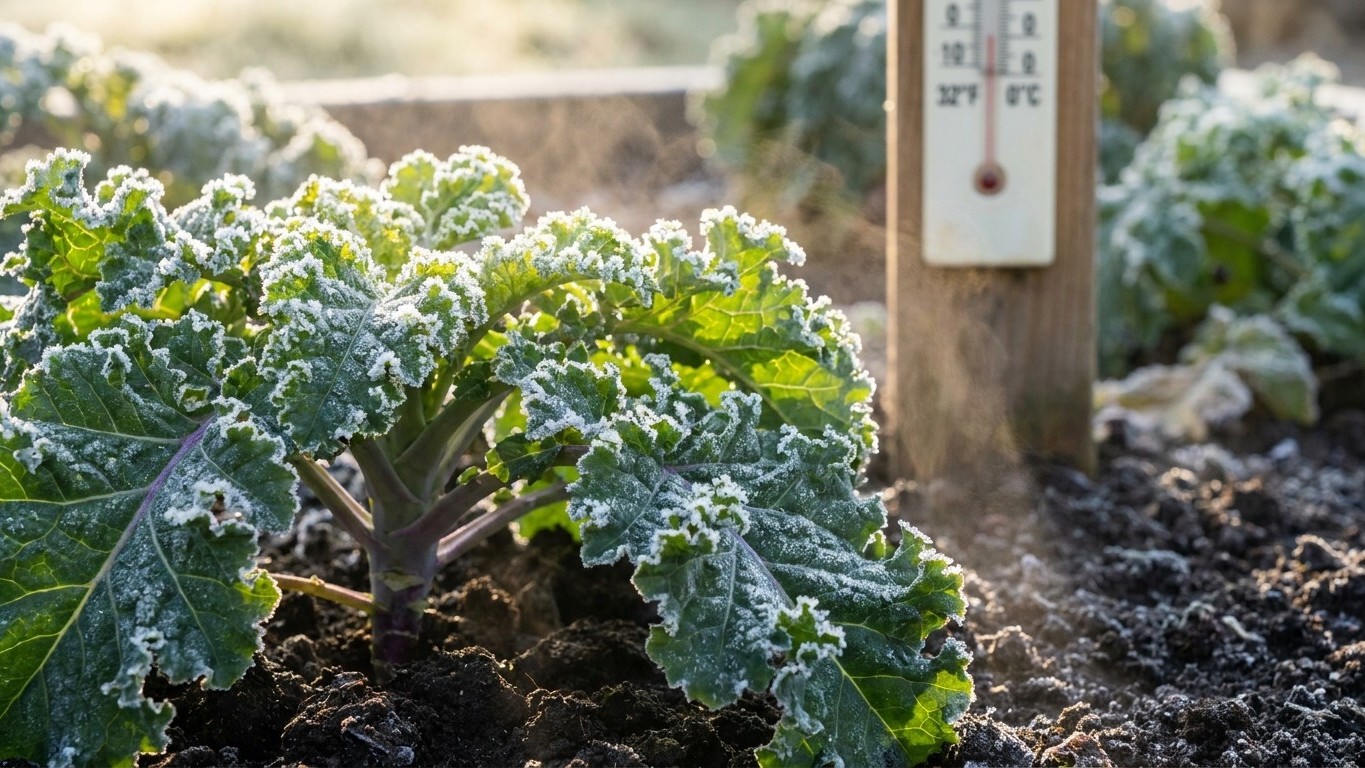

Frost doesn’t hurt fall kale. It improves it. Utah State University Extension states plainly that frosts help improve the flavor of the fall planted crop, making kale the one vegetable in this cocoon where cold weather is the goal, not the risk. Everything else about growing it, timing, spacing, feeding, follows from that single fact.
The short answer
Utah State University Extension is the authority behind every figure in this guide, and its answer to timing is specific: transplants should go into the ground 4-5 weeks before the last frost free date for the growing area. Seeded kale can go in on that same schedule. That makes kale the earliest crop grown from this series of guides. Cabbage and broccoli wait until 2-3 weeks before the frost date. Cauliflower waits until 1-2 weeks before. Lettuce goes out right at the frost date. Kale jumps the line by a full month, tucked into cold soil while other transplants are still hardening off on a porch.
That early planting works because kale’s tolerance for cold isn’t marginal. Young plants aren’t seriously damaged by temperatures down to 25 degrees Fahrenheit, according to the source, which gives a gardener real room for error if a late cold snap rolls through after transplanting. No comparable figure exists for mature plants; the same source only describes them as extremely hardy, without naming a threshold. That gap matters more than it sounds. It means a gardener can’t assume mature kale simply survives colder than 25 F, only that it survives something colder, unspecified.
The flavor payoff shows up specifically in the fall crop. Utah State University Extension frames the fall planting as deliberately aimed past the first frost, not before it, with maturity timed to land 2-3 weeks after that first frost hits. That’s a reversal of how most cold-season vegetables are scheduled, and it’s worth sitting with for a second: gardeners plant lettuce to beat the frost, and they plant kale to meet it.
So if the question is whether frost makes kale better, the source answers with more than a general nod to cold tolerance. It ties the improved flavor specifically to the fall crop, specifically to frost exposure, and it builds the entire fall planting schedule around making sure that exposure happens before harvest.
What actually decides it
Two different kinds of hardy
The 25 F figure applies to young plants only. Utah State University Extension doesn’t extend that number to mature kale, describing mature plants only as extremely hardy and capable of withstanding very cold temperatures, with no degree attached. Treat these as two separate facts rather than one sliding scale. A young transplant has a documented floor. A mature plant has a reputation for toughness but no published number behind it in this source, so don’t assume it’s simply “colder than 25 F plus some margin.” It’s a different claim entirely, and the honest answer is that the source doesn’t quantify it.
The two-ended season, with a bad middle
Kale grows best when temperatures stay at or below 75 F, and high summer heat does more than slow it down. According to the source, that heat reduces growth, lowers quality, and causes bitter or off flavors to develop. The practical shape of the kale season follows from this: plants taste best when they grow fast and mature either before summer heat arrives or after fall frosts occur. Summer isn’t the growing season for kale. It’s the gap between two better ones.
Water consistency, not just water volume
Moisture fluctuations cause kale leaves to toughen and develop off flavors, the source notes, which is a separate mechanism from heat stress even though both produce a similar disappointing result at the table. The fix isn’t more water on a whim when the soil looks dry. It’s about 1-2 inches per week, applied deep and infrequent rather than in shallow, irregular doses. Mulch also plays a role here once temperatures climb above 80 F, cooling the soil and helping steady that moisture supply through the hottest stretch.
The frost mechanism itself
On exactly how frost improves flavor, the source states the effect (frosts help improve the flavor of the fall planted crop) without detailing the biochemistry behind it. That’s worth naming plainly rather than guessing at an explanation the source doesn’t give. The fact stands on its own: frost exposure before harvest makes fall kale taste better.
How to do it
- Find your area’s last frost free date. Kale transplants go into the ground 4-5 weeks before that date, so count back 4-5 weeks from it to set your planting day. This is roughly a month earlier than cabbage or broccoli would go out.
- If starting from seed indoors, transplants generally need 5-6 weeks to grow to 4-6 mature leaves with a well-developed root system. Count back that additional 5-6 weeks from your planned transplant date to know when to start seeds.
- Alternatively, seed kale directly outdoors on the same schedule as transplants, 4-5 weeks before the last frost date, sowing 1/4 to 1/2 inch deep.
- Thin direct-seeded kale once plants reach 3-4 true leaves. The thinnings aren’t waste; they can be transplanted into adjacent areas rather than discarded.
- Space plants 12 inches apart within the row, with rows 2 feet apart.
- Water deeply and infrequently, aiming for about 1-2 inches per week total, to avoid the moisture swings that toughen leaves.
- Apply nitrogen at 1/2 cup per 10 feet of row (21-0-0) about 4 weeks after transplanting or thinning.
- Once temperatures push above 80 F, add organic mulch to keep soil temperatures down through summer.
- For a fall crop timed to meet frost, plant 50-75 days before the anticipated maturity date, aiming for that maturity date to land about 2-3 weeks after the first fall frost.
- Harvest by stripping the older, outer leaves first, leaving younger inner leaves to keep growing. This single habit is what stretches one planting across most of a season.
What goes wrong
- Aphids show up as crinkled, curled leaves. Treat with insecticidal soap, or knock them off with a strong stream of water before reaching for anything stronger.
- Cabbage worms and loopers chew visible holes through the leaves. Insecticides or biological control measures address them directly; catching the damage early keeps it from spreading across a whole row.
- Flea beetles are the one that can actually take out a stand, reducing plant numbers or killing seedlings outright rather than just marring leaves. Treat at seeding time or right after emergence, before populations build.
- Bitter or off flavors in midsummer come from heat pushing past that 75 F comfort zone. There’s no rescuing a bitter batch already grown; the fix is scheduling plantings to mature before the heat arrives or after fall frosts occur, so the plant is never asked to grow through the hottest stretch.
- Tough, off-flavored leaves from irregular watering trace back to moisture fluctuations rather than heat. Keep to that 1-2 inch weekly total, applied deep and infrequent, instead of quick sprinkles whenever the soil surface looks dry.
- Skipping row covers means missing a two-for-one fix. Fabric covers protect seedlings and transplants from frost, and from insect pests, at the same time, so a cover put on for a cold snap is also doing flea beetle and worm-moth duty without any extra effort.
Common questions
How cold can young kale plants get before they’re damaged?
Utah State University Extension puts the threshold at 25 F for young plants without serious damage. No comparable number exists for mature plants in that source, only a description of them as extremely hardy.
Can kale really stay in the garden all winter?
Yes. The source notes that plants can be left in the garden throughout the winter to supply greens out of season, and many gardeners do exactly that rather than pulling the crop at first frost.
Which kale variety holds up best to cold?
The source names three: Starbor (green, 55 days), Red Russian (purple, 50 days), and Scarlet (redleaf, 55 days), crediting all three with excellent production, eating quality, and cold hardiness.
Why does kale taste worse in the middle of summer?
Temperatures above 75 F reduce growth and quality and cause bitter or off flavors, per the source. Kale tastes best when it matures quickly before that summer heat arrives, or after fall frosts set in, leaving the hot middle of the season as the one stretch to plan around rather than plant through.