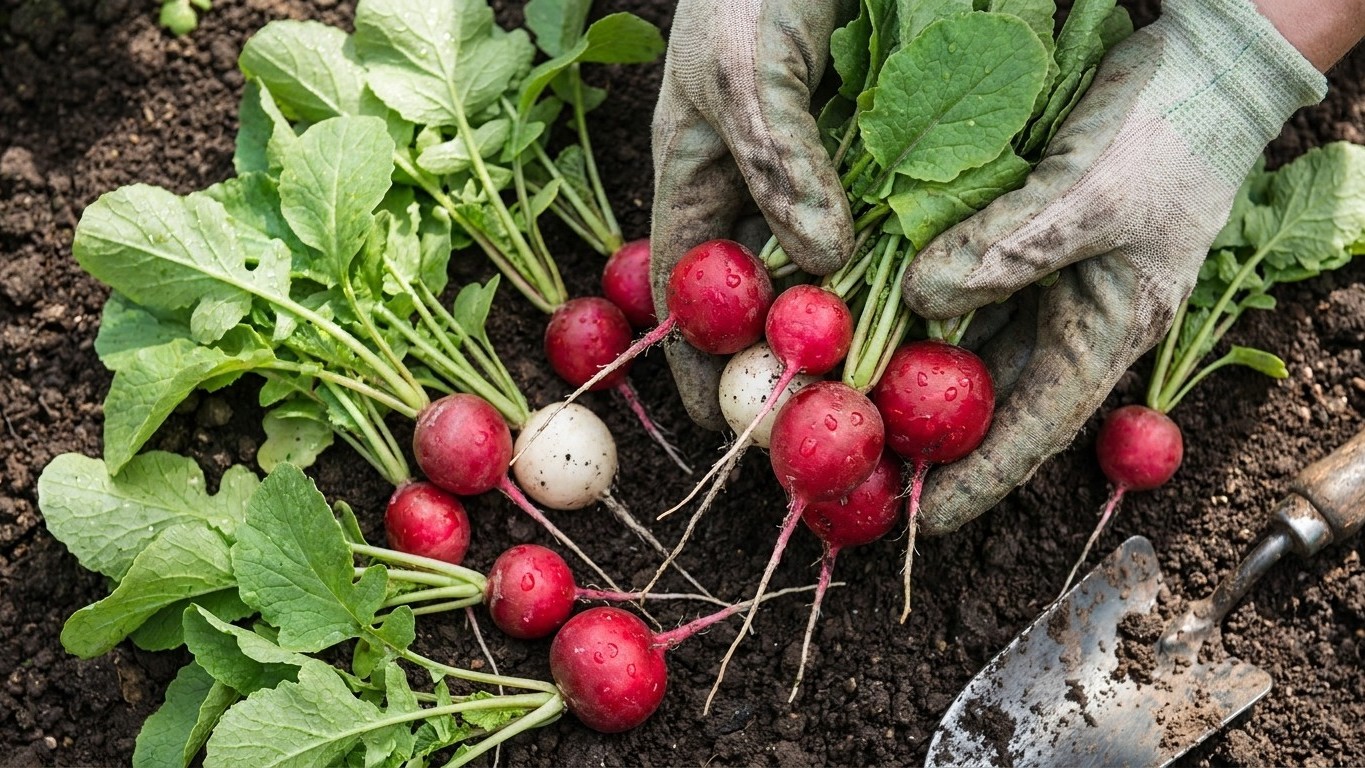

Radishes are the fastest crop you’ll ever grow in a home garden. Utah State University Extension pins root maturity at 25-45 days from seeding, depending on variety. That number isn’t just a scheduling detail. It’s the entire logic of the crop: every fault a radish can develop, from a bitter bite to a hollow center to a plant that bolts before it bulbs, comes down to something that slowed the clock between seed and harvest.
The short answer
Utah State University Extension states it plainly: radishes mature in 25-45 days from seeding, and the range depends on variety, not on luck. That’s a tight window compared to almost anything else in the garden, and it’s the reason radishes reward gardeners who move fast and punish those who dawdle.
Because radishes are always grown from seed, there’s no head start from transplants to bank on. The clock starts the moment seed hits soil. Utah State recommends planting 2-3 weeks before your last spring frost date, which means you count forward from a date you already know, not from a month on a calendar that may not match your climate at all. A gardener in coastal Oregon and one in the Texas Panhandle have wildly different last-frost dates, but the “2-3 weeks before” rule travels with them.
The same logic runs in reverse for a fall crop. Radishes should be pulled before heavy frosts or freezes damage the roots, so the planting date for autumn radishes isn’t a month either. It’s the harvest deadline (your first heavy frost) minus the 25-45 day maturity window. Count backward from that date and you land on a safe sowing day no matter where you garden.
One more figure matters here: succession planting at 10-day intervals. That’s the tightest replanting rhythm of any common vegetable, tighter than beans or peas, which tolerate two to three weeks between sowings. Radishes need that short rhythm because their window of peak quality is short too. Miss it and the roots don’t wait around politely; they get pithy, hot, or hollow while you’re still deciding whether to pull them.
What actually decides it
Radishes operate on one governing principle: speed. A radish that grows quickly, without interruption, from germination to harvest, produces a crisp, mild, solid root. A radish that gets slowed down anywhere along the way produces some version of a bad radish. Every defect on Utah State’s list traces back to time spent in the ground under stress rather than time spent growing.
Heat turns days into pungency
Utah State Extension makes a point that surprises a lot of gardeners: the “hotness” of a radish isn’t a fixed trait of the variety. It results from how long the root has been growing under stress. Radishes that grow too slowly, get heat-stressed, or simply sit too long in the soil turn hot and bitter. Temperatures above 80 F push many varieties toward flower stalk development instead of root growth, and that same heat causes root hollowness. The plant isn’t malfunctioning; it’s redirecting energy away from the root because the conditions have told it to reproduce, not to bulk up.
The first six weeks decide the whole crop
Stress during the first six weeks of growth often leads to premature flowering and low yields, according to Utah State’s guidance. That’s a short, unforgiving window. A cold snap, a dry spell, an overcrowded seedbed, any interruption during that early stretch can push a radish toward bolting before it ever forms a usable root. Because the entire crop cycle is only 25-45 days long, six weeks of vulnerability covers nearly the whole growing period.
Crowding is competition, not just cosmetics
Thinning isn’t tidying up a row for appearances. Utah State’s fact sheet is direct about this: radishes planted too thickly and not thinned properly fail to grow sizable roots. The plants spend their limited time competing for space and nutrients instead of bulking up a root, and once that early competition happens, there’s no catching up given how short the crop’s life is. Weeds do the same damage. Radishes don’t compete well with weeds, and weed pressure hurts most during germination and early establishment, exactly when growth is already slow and the plant can least afford a rival.
How to do it
- Wait until soil temperature reaches at least 40 F before sowing. Germination is best between 55-75 F, and seeds take 5-10 days to emerge at those temperatures.
- Sow seed 1/2 inch deep directly in the garden bed. Radishes are always direct-sown; there’s no transplanting step to shortcut.
- Keep the soil surface uniformly moist until seedlings emerge. Uneven moisture at this stage produces uneven stands.
- Plant in fertile, well-drained, deep, sandy soil where possible. If your soil is heavy, work in plenty of compost first so roots can develop without resistance.
- Once seedlings are up, thin to 1-2 inches between plants in the row, with rows spaced 10-12 inches apart. This step determines whether you get roots or just leaves.
- Control weeds by hand or shallow cultivation only. Avoid deep cultivation near the plants; root pruning from aggressive cultivation damages growth and cuts yield.
- Apply 1/4 cup of a nitrogen-based fertilizer (21-0-0) per 10 feet of row about 3-4 weeks after emergence.
- Irrigate frequently and uniformly rather than deeply and infrequently. Radishes need a steady moisture supply, not occasional soakings.
- Sow a new row every 10 days to keep a continuous supply of roots at peak quality rather than one large batch that all matures and declines together.
- Harvest before heavy frosts or freezes hit. Pull plants by the tops, trim off the leaves, wash the roots, and store them in plastic bags in the refrigerator for 2-4 weeks.
What goes wrong
- Hot, bitter flavor. This comes from time, not variety. Radishes that grow too slowly, get heat-stressed, or simply age too long in the ground turn hot and bitter. The fix is to keep growth uninterrupted and to harvest promptly once roots reach size, rather than leaving them in the ground “just in case.”
- Root hollowness. Temperatures above 80 F cause this directly. The remedy is timing: get the crop planted and finished before hot weather arrives, or plant the fall crop early enough to mature before summer heat, using the 25-45 day window counted back from your first heavy frost.
- All tops, no root, from overcrowding. Unthinned rows put plants in competition and roots never bulk up. The fix is mechanical: thin to 1-2 inches between plants with rows 10-12 inches apart, and don’t skip it because the seedlings look fine at first.
- All tops, no root, from heat. When temperatures run too hot, whether from late planting or an unseasonable warm spell, bulbing gets suppressed even in a properly thinned row. The fix here is re-timing the planting, not thinning harder.
- All tops, no root, from shade. Roots grown in too much shade won’t fill out completely no matter how well-spaced or well-timed the crop is. The fix is location: move the bed to a spot with fuller sun.
- Cracking and splitting. Old radishes left too long in the ground split on their own. A heavy watering after a dry spell also splits mature roots by swelling them faster than the skin can stretch. The fix is twofold: harvest younger, and keep irrigation frequent and uniform instead of letting the soil dry out between waterings.
- Bolting before harvest. Stress during the first six weeks of growth, cold, drought, crowding, often triggers premature flowering and cuts yield. Protecting the crop during that early window matters more than anything done later.
- Root maggots, flea beetles, and root rot. Maggots burrow into the root and bulb; flea beetles chew tiny holes in cotyledons and leaves, and floating row covers exclude them; root rots respond to crop rotation and improved soil drainage.
Common questions
How many radishes should I expect to harvest?
Utah State Extension estimates about 10 bunches of radishes per 10 linear feet of planted row. For fresh eating, the sheet suggests planting 3-5 feet of row per person, which gives a sense of scale for a household planning a bed.
Which varieties does Utah State Extension mention?
The fact sheet names Champion, Cherry Belle, Daikon Long White, Icicle, and Easter Egg, noting that root shape, size, and color vary among varieties. It doesn’t attach maturity days or size ratings to any of them, so variety choice comes down to root shape and color preference rather than speed.
Can I start radish seeds indoors to get a head start?
No. Radishes are always grown from seed sown directly in the garden. There’s no transplant stage to shortcut the timeline, which is part of why the direct-sow date matters so much.
Why do my radishes keep splitting after rain?
Splitting happens when mature or aging roots take on water too fast, typically from a heavy watering or rainfall following a dry stretch. Keeping soil moisture frequent and uniform, rather than letting beds dry out between waterings, prevents the swings that crack the roots.