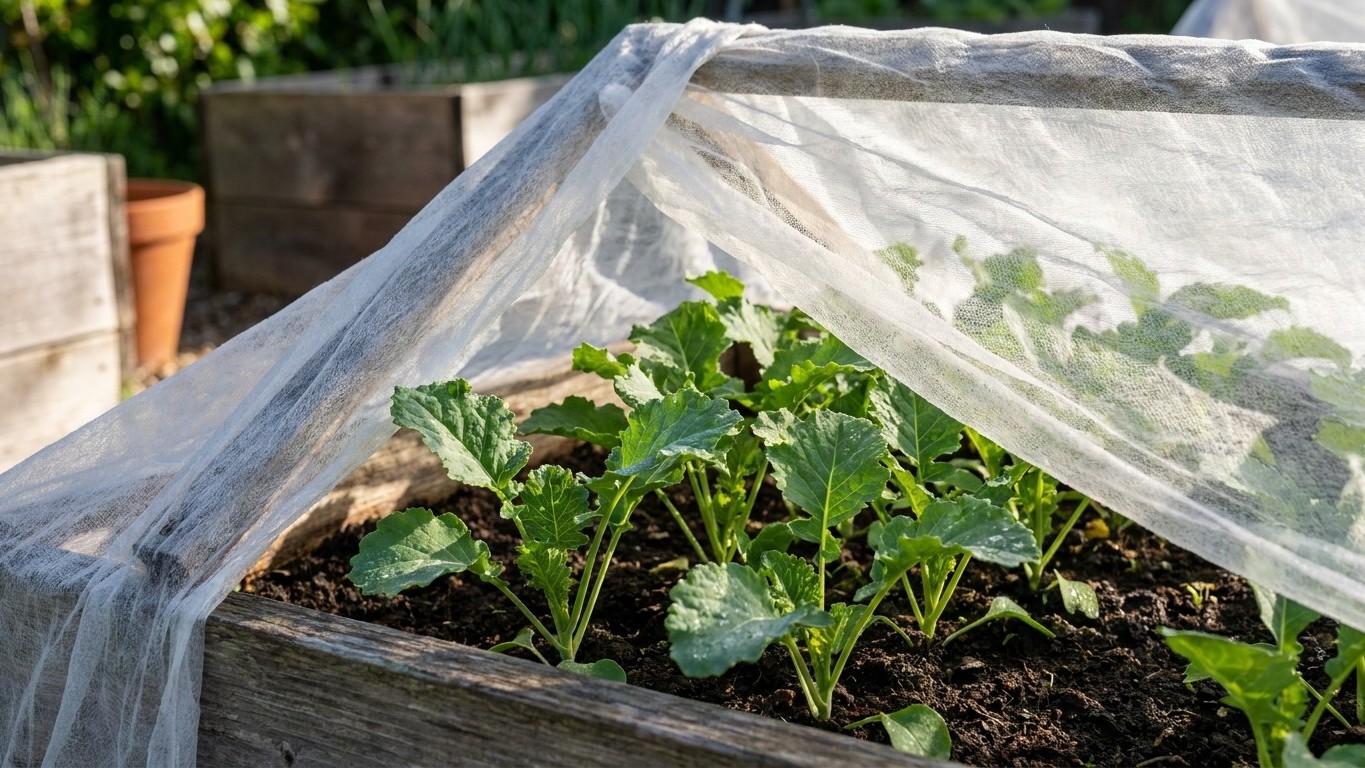

A single sheet of lightweight fabric, laid over kale seedlings, does double duty: it holds off frost damage and it keeps flea beetles from shredding young leaves before they get established. According to Utah State University Extension’s Kale in the Garden guide, fabric covers are used to protect seedlings and Transplants from frosts and insect pests at the same time. That means one purchase, one task, two problems solved for the earliest planting in the whole brassica lineup.
The short answer
Kale faces three recurring pest pressures once it’s in the ground, and Utah State University Extension names all three directly. Aphids show up first as a cosmetic problem: leaves become crinkled and curled, a sign the insects are feeding on the underside where they’re easy to miss until the damage is done. The fix, per the same source, is insecticidal soap or a strong stream of water to knock the colonies off the plant. Neither requires a chemical aisle trip, and both work on small infestations before they spread.
Cabbage worms and loopers are the next wave, and they’re visible in a way aphids aren’t: worms and loopers chew holes in leaves, leaving the kind of ragged, see-through damage that gets a gardener’s attention fast. Utah State University Extension lists insecticides or biological measures as the response, without naming a single product, which leaves room for whichever method fits a given garden’s tolerance for spraying.
Flea beetles are the pest that actually threatens the crop’s survival, not just its looks. The source is specific: flea beetles can reduce plant stands or may kill seedlings outright. That’s a different category of damage than curled leaves or chewed holes, because a seedling that’s killed doesn’t recover. The recommended window for treatment is at seeding or after emergence, meaning the response has to be ready before the first true leaves are even up.
This is where the fabric cover earns its place. It isn’t a pest-specific tool bought to fight one bug; it’s a physical barrier laid down for frost protection that happens to block flea beetles from ever reaching the seedlings in the first place. A gardener who puts the cover on to guard against a cold snap gets the insect protection as a side effect, not an extra chore. That overlap is the whole reason this cover shows up on the kale checklist earlier than it does for almost any other vegetable in the garden.
What actually decides it

Three separate mechanisms are at work here, and Utah State University Extension gives a figure for some of them and none for others. Mixing those numbers up is the fastest way to misjudge risk.
Aphid feeding and the curl response
Aphids feed by piercing the leaf and drawing out sap, and the plant’s response, the crinkling and curling, is a visible symptom rather than the damage itself. There’s no population threshold given in the source for when curling starts; the guidance is behavioral, not numerical: knock them off with water or treat with insecticidal soap once the curling appears. No count of aphids per leaf is specified, so the trigger for action is the visual sign, not a tally.
Chewing damage from worms and loopers
Cabbage worms and loopers work differently: they eat leaf tissue directly, leaving holes rather than distortion. Utah State University Extension doesn’t attach a figure to how much leaf loss is tolerable before treatment is warranted, only that insecticides or biological measures are the response once holes appear. That absence of a number matters, because it means the decision to treat is a judgment call based on how much of the crop is being lost, not a hard rule.
Flea beetles and the seedling-stage vulnerability
Flea beetles are the one pest where the source draws a sharp line by growth stage. The damage described (reduced plant stands, killed seedlings) applies specifically to the earliest phase of the plant’s life. There’s no figure given for how mature kale tolerates flea beetle feeding, and the source doesn’t say mature plants are safe from them, either; it simply concentrates its warning on seeding and post-emergence. That’s why treatment timing is anchored to that window and not carried forward as an ongoing concern once plants are established.
The physical cover addresses exactly this seedling-stage gap: it’s a barrier during the one period the source flags as most vulnerable, which is also the same period frost risk is highest for a crop planted this early.
How to do it
- Count backward 4 to 5 weeks from your own last frost date. Kale goes out earlier than cabbage or broccoli (2 to 3 weeks before frost) and earlier than Cauliflower (1 to 2 weeks before), so use your garden’s actual last-frost date, not a calendar month, to set the planting day.
- Choose a variety with the days-to-maturity figure that fits your season. Utah State University Extension credits Starbor (green, 55 days), Red Russian (purple, 50 days), and Scarlet (redleaf, 55 days) with cold hardiness, so any of the three suits an early, frost-adjacent planting.
- Set transplants or direct-seed with the understanding that young plants tolerate cold down to 25 F. That figure applies to young plants specifically; mature kale is described only as extremely hardy, with no threshold attached, so don’t use the 25 F number to judge a plant that’s already well established.
- Lay a fabric row cover over the bed at planting, before any frost event and before flea beetles are active. The cover’s job at this stage is dual: it buffers the seedlings from a cold snap and physically blocks flea beetles from reaching leaves during the emergence window the source flags as highest-risk.
- Check under the cover regularly for aphid curling and chewed leaves from worms or loopers, since the fabric barrier doesn’t stop insects already present in the soil or introduced before the cover went down. Treat aphids with insecticidal soap or a water stream, and treat worms and loopers with insecticides or biological measures, as needed.
- Remove or vent the cover once frost risk has passed and plants are past the seedling stage flagged for flea beetle damage, watching for the curling or chewing signs that call for the treatments above.
What goes wrong

- Cover goes on too late. If the fabric is laid down after flea beetles have already found the seedlings, the barrier can’t undo damage that’s already happened. The remedy is timing the cover to planting day, not to the first sign of feeding, since the source’s own guidance is to treat at seeding or after emergence, before damage is visible.
- Aphid curling gets mistaken for a nutrient problem. Crinkled, curled leaves are sometimes chalked up to watering or fertility issues, delaying treatment. The remedy is checking the underside of curled leaves for aphids before assuming a soil-based cause, then applying insecticidal soap or a strong water stream once they’re confirmed.
- The 25 F figure gets applied to mature plants. Treating an established kale plant as though it will fail below 25 F, or assuming a young seedling shares the “extremely hardy” resilience of a mature plant, both misjudge risk in opposite directions. The remedy is keeping the two facts separate: young plants tolerate 25 F specifically, mature plants are simply described as extremely hardy with no number attached.
- Chewed leaves get ignored until the plant is stripped. Worms and loopers can do a surprising amount of damage between checks, especially under a cover where the leaves aren’t seen daily. The remedy is a regular under-cover inspection, treating with insecticides or biological measures as soon as holes appear rather than waiting for a heavier infestation.
- Planting date borrowed from a different brassica. Using cabbage’s 2-to-3-week window, or cauliflower’s 1-to-2-week window, for kale means planting too late and losing the early-season advantage the cover is meant to protect. The remedy is counting 4 to 5 weeks back from the reader’s own last frost date specifically for kale, not reusing another crop’s timeline.
Common questions
Does the fabric cover replace insecticidal soap for aphids? No. The cover is a physical barrier laid down mainly for frost and flea beetle protection; it doesn’t treat aphids already on the plant. Curled leaves still call for insecticidal soap or a strong water stream, per Utah State University Extension.
Can I leave the cover on all season? The source ties the cover’s insect-blocking value to the seedling and emergence stage, when flea beetle damage is worst. It doesn’t specify a removal date, so venting or removing it once plants are established and frost risk has passed follows the guidance’s own logic rather than a fixed rule.
Is 25 F safe for a seedling I just transplanted under a cover? Utah State University Extension credits young plants with tolerance to 25 F, which is the relevant figure for a seedling. That number doesn’t apply to how cold mature kale can handle, since the source describes mature plants only as extremely hardy without a Temperature attached.
Which variety is best for an early, cover-protected planting? The source names three cold-hardy options with their days to maturity: Starbor (green, 55 days), Red Russian (purple, 50 days), and Scarlet (redleaf, 55 days). Any of the three fits a planting timed 4 to 5 weeks Before the Last Frost.