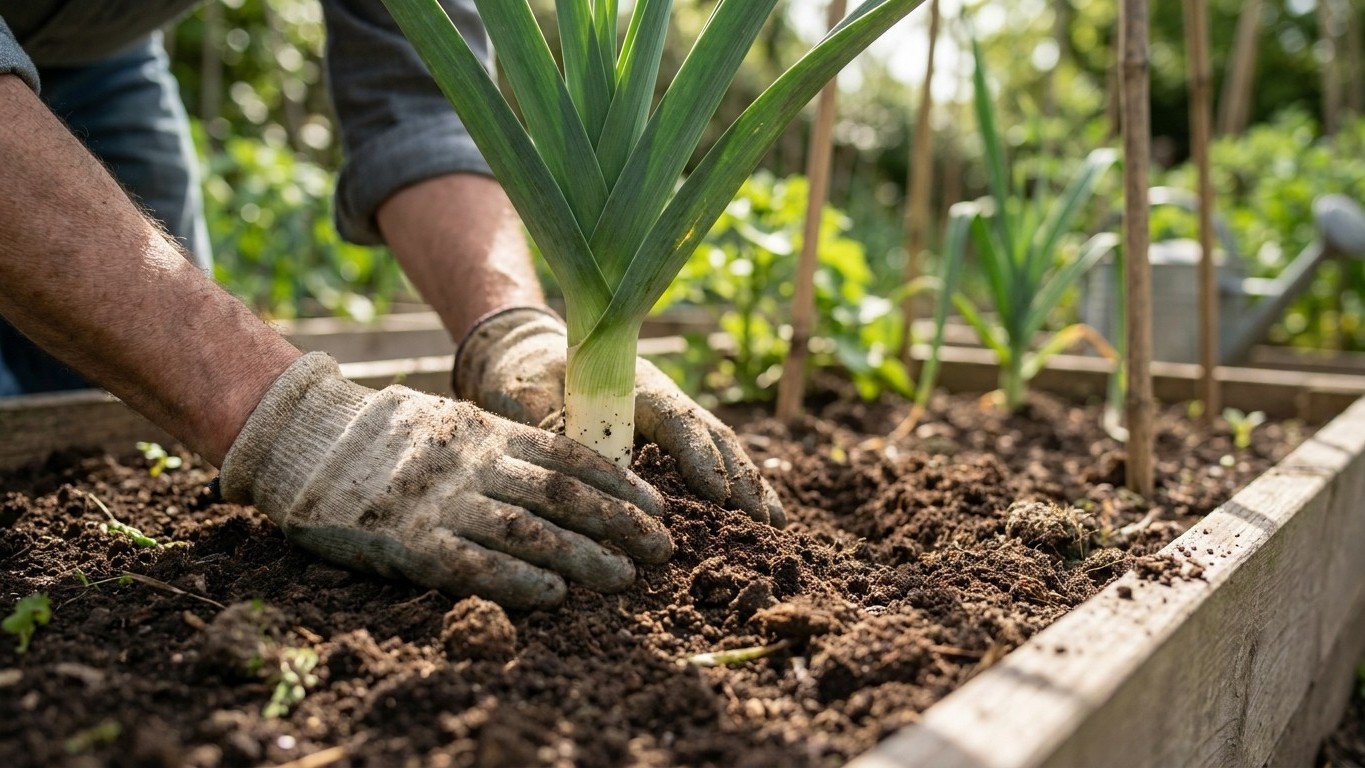

Leeks build their signature white stem the same way a mason builds a wall: layer by layer, blocking light from reaching what’s underneath. Utah State University Extension calls the leek “a hardy cool-season biennial,” and its growing guide is explicit that the pale sheath isn’t a variety trait at all. It’s manufactured, either by banking soil around the stalk two or three times during the season or by dropping the transplant deep into a hole from the start.
The short answer
Growing leeks well comes down to one mechanical fact: the white part of the stem is whatever length you kept out of the light, not a trait bred into the seed. Utah State University Extension lays out two ways to get there. The traditional route is hilling: as the plants grow, soil is mounded up around the base two to three times over the season, adding 2 to 3 inches of banked soil each time. Hilling encourages taller growth and produces a longer blanched edible stem, according to the Extension guide.
The second route skips most of that repeated labor. Transplants that are 10 to 12 inches tall go into a dibble hole 6 inches deep, get watered into place, and then the hole is gradually filled in as the plant grows. Utah State University Extension notes that transplanting with the dibble method partially eliminates the need for multiple hilling. Same result, different sequence: one method spreads the soil-banking across the growing season, the other front-loads it into a single planting hole.
Before either method matters, though, the plant has to be ready. Leek transplants need six to eight weeks of growth before they go into the garden. Count backward from your own last transplanting date, not from a calendar month someone else uses. If your region’s soil and weather let you set plants out once the ground has warmed, back up six to eight weeks from that date to know when to start seed indoors or in a nursery bed.
Seed itself goes in shallow, 1/4 to 1/2 inch deep, and gets thinned to 4 to 6 inches apart in rows spaced 8 to 16 inches apart. Transplants use that same spacing once they’re moved to their permanent spot. From there, the plant follows a long, slow biennial rhythm: it wants to build a thick stalk in year one, not flower, and everything from watering to nitrogen timing is aimed at keeping that vegetative growth steady rather than stressed.
What actually decides it

Three separate mechanisms drive whether a leek harvest turns out thick, long-shanked, and blanched, or thin and green most of the way down. None of them are about the seed packet.
Light exclusion, not variety
The white sheath is a light-blocking effect, full stop. Whether you hill soil around an already-growing plant or bury a tall transplant to start, the mechanism is identical: any part of the stem covered by soil stays pale and tender, and any part left exposed turns green and tougher. Utah State University Extension’s language is direct about this, describing hilling as something that “encourages taller growth thus producing a longer blanched edible stem.” Skip the hilling or the deep dibble hole, and you get a leek that’s mostly green, edible but shorter on the prized white portion.
Shallow roots make water non-negotiable
Leeks root shallowly, which changes how forgiving they are of dry spells. Utah State University Extension states plainly that water needs are critical because of this shallow rooting, and that drought stress during growth will decrease yield. The guide’s benchmark is specific: soils need to stay near field capacity, moistened thoroughly to a depth of 18 inches every 7 days. A shallow-rooted plant can’t chase water down through dry soil the way a carrot or a tomato might, so the watering schedule isn’t a suggestion, it’s a substitute for what the roots can’t do on their own.
Nitrogen timed to growth stage, not calendar
Leeks get a side dressing of nitrogen at a rate of 1/4 pound of 21-0-0 fertilizer per 100 square feet, applied twice during the season, once at a mid-season point and again later in the growing stretch. The timing matters more than the date attached to it in any one region’s calendar. What the plant needs is a nitrogen boost during active vegetative growth, delivered in two applications spaced apart rather than dumped in all at once.
How to do it
- Sow seed 1/4 to 1/2 inch deep, whether in a nursery bed or in the row where the plants will mature.
- Thin seedlings to 4 to 6 inches apart, in rows spaced 8 to 16 inches apart, giving each plant room to bulk up its stem.
- Let transplants grow six to eight weeks before moving them to the garden. Count that stretch backward from your own last-frost or transplanting date rather than any specific month.
- Choose your method for building the white stem: dig a dibble hole about 6 inches deep for each 10- to 12-inch-tall transplant, water it into place, and gradually fill the hole in as the plant grows, or plan to hill soil around seeded plants as they develop.
- If hilling, bank 2 to 3 inches of soil around the base two to three times over the course of the season, spacing those hillings out as the stalk lengthens.
- Weed carefully during the first two months of growth, when plants grow slowly and compete poorly with weeds, taking care not to damage the shallow root system while doing it.
- Water to maintain soil near field capacity, moistening thoroughly to a depth of 18 inches every 7 days throughout the season.
- Side dress with nitrogen (1/4 pound of 21-0-0 per 100 square feet) at two points during active growth, spaced apart rather than combined into one application.
- Check stalk diameter as harvest approaches. Leeks can be pulled as early as 60 days after seeding, though they generally need 100 to 120 days to mature, and they’re ready to eat once the stalks reach 1 inch in diameter.
- Leave what you don’t need in the ground. In most areas, leeks can overwinter right in the garden if you hill soil around the plants and cover them with a thick layer of mulch, leaves, or soil.
What goes wrong

- Short, mostly green stems. This happens when hilling gets skipped or done only once, or when a transplant goes in shallow instead of into a proper 6-inch dibble hole. Remedy: commit to one of the two light-exclusion methods before the plant gets tall, since fixing it mid-season means burying an already-tough green stem instead of a tender one.
- Silvery, twisted, or dying leaves. This is the signature of thrips, which hide near where the leaf and bulb meet and are easy to miss until damage is visible. There’s no separate remedy listed beyond monitoring that junction point closely and catching the problem early.
- Seedlings chewed off, roots or bulbs damaged by a white worm, or underground stems and roots hollowed out. These are the signs of onion maggot and wireworm (the larval stage of the click beetle), and both share the same fix: rotate crops out of the same ground where alliums grew previously, and avoid piling on excessive organic matter, which gives both pests more cover and food.
- Stunted growth and lower yield despite otherwise decent care. Because leek roots run shallow, they can’t reach down for moisture the way deeper-rooted vegetables can. Drought stress during growth decreases yield directly. Remedy: hold to the 18-inch depth, 7-day watering schedule rather than watering on a lighter, more casual rotation.
- Weak, outcompeted seedlings early in the season. Leeks grow slowly at first and lose ground fast against weeds during their first two months. Remedy: weed on a tight schedule during that early window, working carefully so shallow roots aren’t disturbed in the process.
- Soft, shriveled leeks in storage. In very cold regions, harvested leeks lose moisture quickly if left in ordinary conditions. Remedy: store them cold, between 32 and 40 degrees Fahrenheit, in humid conditions such as wet sand, to slow moisture loss.
Common questions
How much garden space does one leek plant actually need?
One seed or transplant yields a single sheath, 6 to 8 inches long and 1 to 2 inches wide. Utah State University Extension recommends planning for 3 to 6 feet of row per person, which gives a rough sense of how much row space a household needs for a season’s worth of leeks.
Do leeks need to be dug up before winter?
Not necessarily. Utah State University Extension notes leeks can be overwintered in the garden in most areas, provided the soil is hilled up around the plants and covered with a thick layer of mulch, leaves, or soil. The garden itself functions as storage, which is one of the clearest differences between leeks and bulb onions.
How do I know when a leek is ready to harvest?
Diameter is the marker to watch, not a fixed date. Leeks are ready to eat once the stalks reach 1 inch in diameter. They can technically be pulled as early as 60 days after seeding, but generally need 100 to 120 days to reach full maturity.
Does variety choice change how big or how white a leek gets?
Utah State University Extension names three varieties, Large American Flag, Comanche, and King Richard, without attaching any specific size, days-to-maturity, or hardiness figure to any of them. The white stem length is a function of hilling or dibble planting, not the variety planted, so the growing method matters more than the name on the seed packet.