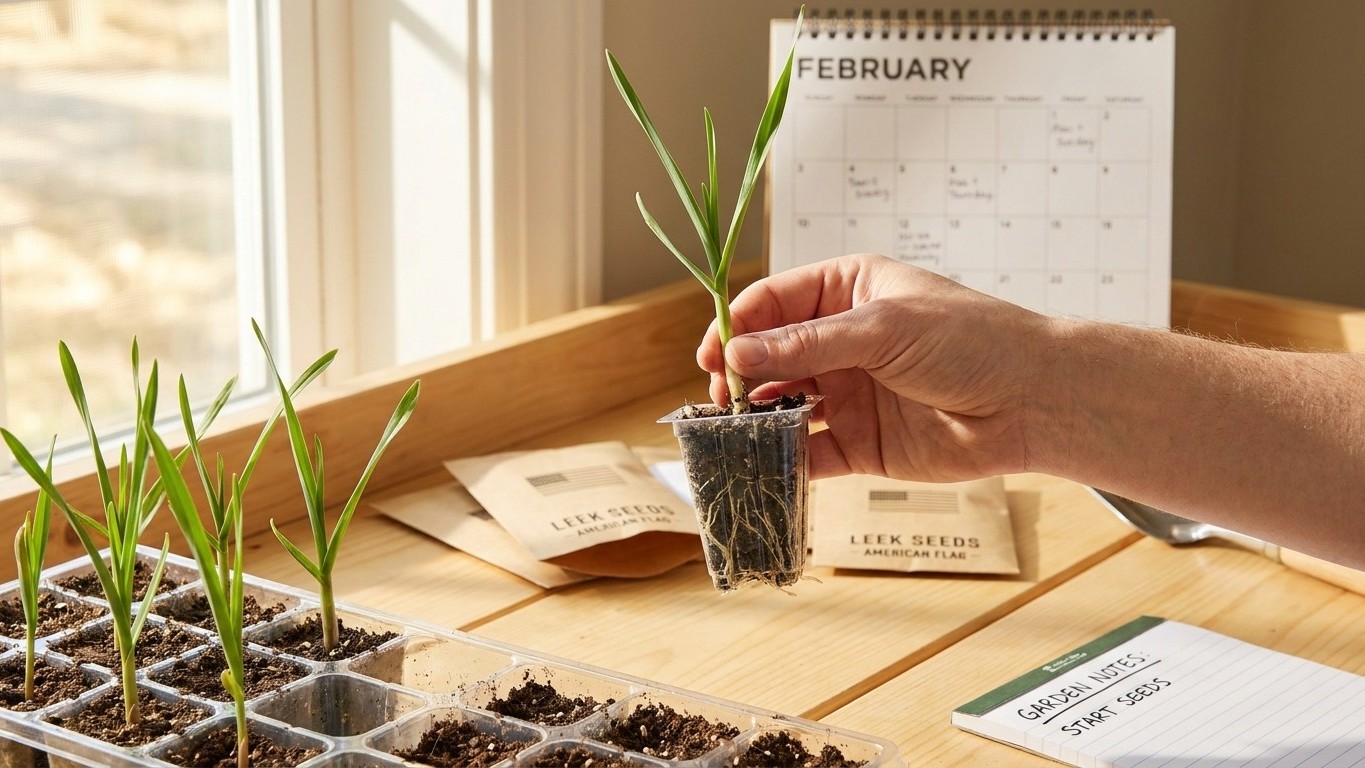

Six to eight weeks. That’s the growing window a leek transplant needs before it goes into the ground, according to Utah State University Extension’s guide, Leeks in the Garden. Not a calendar month, not “early spring”, a count you run backward from the day you actually plan to set plants outside, which depends on where you garden, not on a fixed date printed in a seed catalog.
The short answer
Utah State University Extension states it plainly: transplants need six to eight weeks of growth before planting in the garden. That’s the number to work from, whether you garden in coastal Georgia or the high plains of Montana. A month name attached to that number only works for one specific climate zone, and this guide is written for readers scattered across dozens of them, so the count is the only piece of information that travels well.
Here’s why the count matters more than a date. Leek is, in the words of the same source, a hardy cool-season biennial. That single fact changes how you think about timing. A biennial doesn’t rush. It spends its first season building leaf and stem tissue, not flowering, which means the plant tolerates a slower, more deliberate start than a warm-season vegetable that’s racing to set fruit before frost. Six to eight weeks of indoor or protected growth gives a leek seedling time to develop a real root system and enough top growth (the source specifies 10 to 12 inches tall at transplant time) to survive the shock of being moved.
The practical move is this: find your own average last-frost date, whatever your state extension office lists for your zip code, and count backward six to eight weeks from your intended transplant day. That transplant day itself is usually set a couple of weeks after your last frost, since leek seedlings go out as sturdy young plants, not fragile sprouts, and a little residual cold hardiness in the biennial habit gives you some cushion. But the arithmetic always starts from your own frost date, not from a national average and not from a month that happens to work in Utah’s Cache Valley.
This is also where a lot of seed packets mislead people. A packet printed for national distribution often prints a single window because it has to fit on a small label, and that window quietly assumes a specific climate. Utah State University Extension’s guidance sidesteps that problem by giving a duration instead of a date: six to eight weeks of growth, full stop. Apply that duration to your own transplant target and the guidance holds no matter which of the lower 48 (or beyond) you’re gardening in.
What actually decides it

The six-to-eight-week figure isn’t arbitrary. It’s manufactured by three separate biological and mechanical realities working together, and understanding each one explains why shaving the timeline short causes problems later.
Slow germination and early growth
Leek seed doesn’t sprint out of the ground. Compared to fast growers like radish or lettuce, allium seedlings spend their first weeks putting energy into a single thin blade and a modest root, not a flush of leaves. That slow early pace is baked into the six-to-eight-week figure. Cut the indoor growing period to four weeks and you’re transplanting a seedling that hasn’t built the root mass to handle outdoor conditions, no matter how carefully you handle it.
The biennial habit sets the pace
Because leek is a hardy cool-season biennial, its whole first-year strategy is vegetative growth, not reproduction. The plant is, in a sense, in no hurry to flower, and that patience shows up in a growth curve that rewards a longer, steadier start rather than a rushed one. A six-to-eight-week runway matches that natural pace instead of fighting it.
Transplant size determines survival
Utah State University Extension is specific here: plants should be 10 to 12 inches tall when they go into a 6-inch deep dibble hole. That height isn’t decorative. A plant that size has enough root and stem structure to be watered into place and gradually backfilled without collapsing or drying out. Seedlings started too recently simply haven’t reached that height, and pushing them into the ground undersized is one of the most common ways home growers lose a leek crop before it ever gets going.
How to do it
- Find your own last-frost date. Check your state or county extension service for the average date in your area. Every other step below counts backward or forward from this single number, not from a generic calendar month.
- Set your transplant target date. Leek transplants generally go outside a short while after that last-frost date, since the seedlings need mild conditions to establish. Mark this date on your own calendar.
- Count back six to eight weeks from your transplant date. That’s your seed-starting day, whether it lands earlier in the year for a warmer zone or later for a cold one. Six weeks gives you the minimum runway; eight weeks gives seedlings more time to bulk up before the move.
- Sow seed 1/4 to 1/2 inch deep in trays or a prepared seed bed, following Utah State University Extension’s depth guidance.
- Thin seedlings as they grow to 4 to 6 inches apart, whether you’re growing them in rows spaced 8 to 16 inches apart in a bed or in cells destined for transplant.
- Watch for the 10 to 12 inch mark. This height, not the calendar, is the real signal that seedlings are ready to move outdoors.
- Dig a dibble hole about 6 inches deep for each transplant, exactly as specified in the Utah State University Extension guide.
- Set the plant in the hole and water it into place rather than firming soil around it immediately.
- Gradually fill in the dibble hole over subsequent waterings, letting soil settle around the stem instead of packing it in all at once.
What goes wrong

- Seedlings transplanted too small. If plants haven’t reached the 10 to 12 inch mark, they lack the structure to handle the dibble-hole method described above. The remedy is patience: hold seedlings indoors or in a protected bed until they hit that height, even if it pushes your transplant date later than planned.
- Starting from a month instead of a count. Copying a “start in [month]” instruction from a source written for a different climate zone routinely produces seedlings that are either too small or overgrown by the time local conditions allow transplanting. The fix is the same in both directions: recalculate from your own last-frost date and count six to eight weeks backward, rather than borrowing someone else’s calendar.
- Seed sown too deep or too shallow. Planting outside the 1/4 to 1/2 inch range slows or uneven germination. Check sowing depth against a ruler rather than guessing, especially in a tray where it’s easy to bury seed too deep by habit.
- Overcrowded rows. Skipping the thinning step, or thinning to a spacing tighter than 4 to 6 inches, produces thin, weak stalks competing for the same root space. Thin promptly once seedlings are large enough to handle, and don’t let sentimentality about pulling healthy-looking sprouts stop you.
- Firming the dibble hole immediately. Packing soil tightly around a newly set transplant, instead of watering it in and filling gradually, can snap fragile roots or leave air pockets that dry the plant out. Follow the water-first, fill-gradually sequence every time, even if it feels slower than a one-step planting.
Common questions
Can I start leek seed indoors under lights instead of in a seed bed? The Utah State University Extension guidance doesn’t specify a starting location, only the six-to-eight-week duration and the seed depth. Either method works as long as seedlings reach transplant size (10 to 12 inches) within that timeframe.
Does variety choice change the six-to-eight-week count? Utah State University Extension names Large American Flag, Comanche, and King Richard as varieties suited to home gardens, but the source gives no separate timing, size, or hardiness figures for any one of them. Treat the six-to-eight-week window as the standard reference regardless of which of these you plant.
What if my seedlings hit 10 to 12 inches before my last frost has passed? Hold them where they are rather than transplanting early. The height figure only matters once outdoor conditions are also suitable; a tall seedling planted into a hard frost still faces the same risk as an undersized one planted too early.
Is six weeks ever enough, or should I always aim for eight? Both numbers come from the same source, and six weeks is described as sufficient. Eight gives more buffer for slower germination or cooler indoor conditions, but there’s no indication that six weeks under good conditions produces a weaker plant.