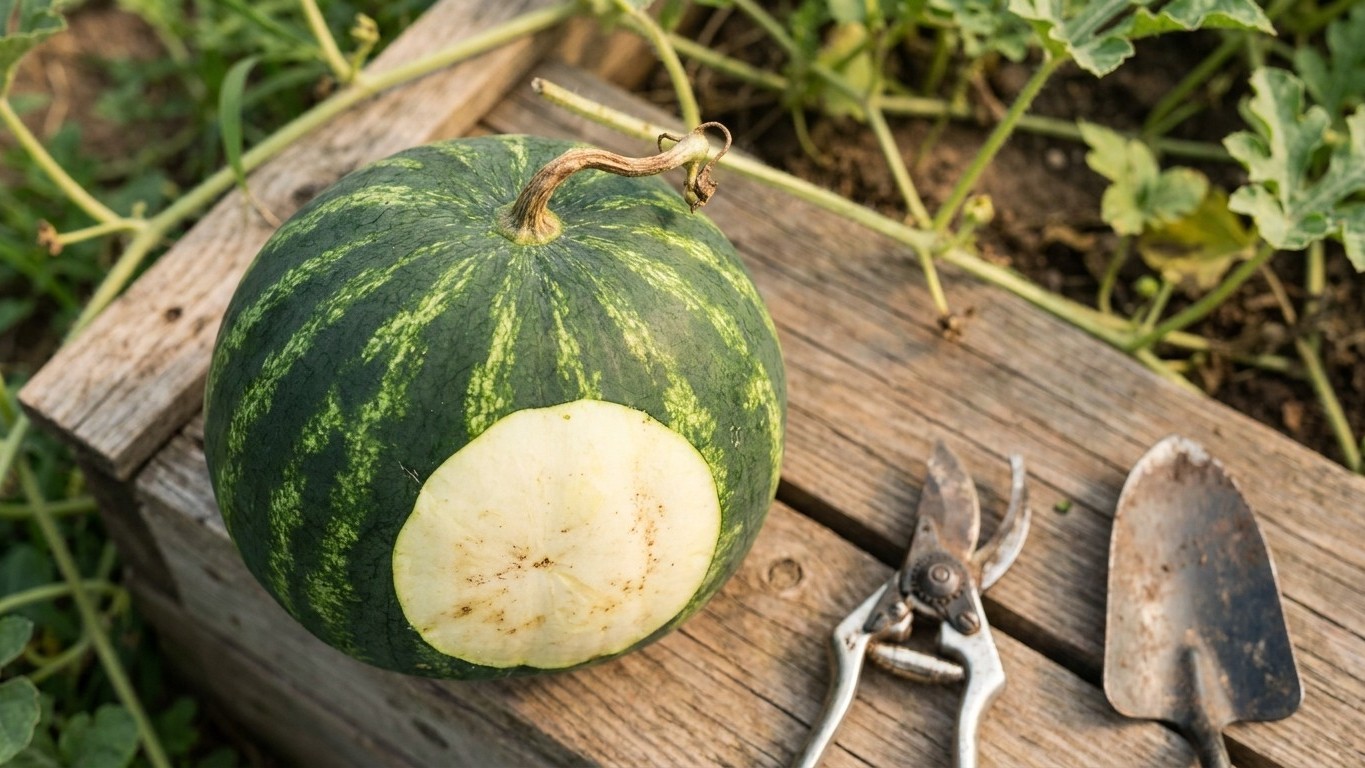

A ripe watermelon announces itself through three signals working together: a drying, browning tendril at the point where the fruit stem meets the vine, a ground spot that has shifted from pale white to creamy yellow, and a dull, hollow thump instead of a bright, tinny one. No single signal is foolproof, but read together they’re about as close to certain as a garden gets.
What is actually going on

The thing to understand here is that a watermelon never slips. Cantaloupes and some other melons form an abscission layer where the stem meets the fruit, so a ripe one detaches from the vine with a light tug. Watermelons don’t build that layer. The stem stays fused to the fruit right through harvest, which is exactly why so many home gardeners get fooled: they’re waiting for a cue that will never come.
Sugar accumulation inside a watermelon happens entirely while the fruit is still attached. The vine’s leaves photosynthesize, the plant moves sugars through the stem into the fruit, and that process runs until the moment someone cuts or breaks the connection. Once separated, the flesh can soften a bit and the texture can shift, but sweetness is locked in. A watermelon does not ripen on the counter, and it will not ripen on a windowsill no matter how much sun it gets. Whatever sugar was inside at harvest is whatever sugar will ever be inside. This is the single fact that makes ripeness timing on the vine so much more important for watermelon than for fruit that keeps developing after picking.
Because there’s no slip to rely on, growers learned to read proxies instead: physical changes elsewhere on the fruit that happen to track internal ripening fairly well. The tendril closest to the fruit’s stem dries out as the plant redirects energy in the final stretch of maturation. The patch of rind resting on the soil, cut off from direct sun, changes color as the fruit matures because pigment development responds to the plant’s internal chemistry, not just light exposure. And the sound a fruit makes when tapped changes as flesh density and moisture content shift with age. None of these are the ripening itself, they’re side effects of it, which is exactly why using more than one at a time matters.
Different types of watermelon, from the large oblong picnic types to the smaller round or personal-sized types, can vary slightly in how strongly each signal shows up. That’s a case-by-case matter of variety, not something a single national guide can spell out reliably. A state extension service that has trialed varieties suited to local growing conditions is the better source for those specifics.
In the garden
Here’s how the three signals rank by reliability, and what tends to go wrong with each one when it’s used alone.
| Signal | What to look for | Confidence | When it goes wrong |
|---|---|---|---|
| Tendril near the fruit stem | The curly tendril closest to where the fruit’s stem meets the vine turns brown and dries out, often shriveling completely | Highest | If that tendril was already damaged, eaten by insects, or missing, there’s nothing to read. Some plants also drop that tendril earlier than others under stress, giving a false-early signal. |
| Ground spot color | The patch of rind touching the soil shifts from pale white or pale green to a creamy or buttery yellow | Moderate to high | Fruit resting on plastic mulch, straw, or a support cradle may show a muted or delayed color change because the rind isn’t in true soil contact. Disease lesions or sunscald can also discolor the spot in ways that mimic or mask ripening. |
| Sound when thumped | A ripe fruit gives a dull, low, hollow-sounding thud rather than a sharp, ringing note | Lowest, useful only as a tiebreaker | This one depends heavily on the ear doing the listening and on rind thickness, which varies by fruit and by type. Two experienced growers can disagree on the same melon. Used by itself, it leads to more mistakes than any other method. |
The order matters. Start with the tendril, because it’s the most consistent across different growing seasons and conditions. If the tendril is gone or ambiguous, move to the ground spot, checking it against the memory of what that same fruit’s ground spot looked like a week or two earlier, since the shift is gradual rather than sudden. Thumping should be the last check, a way to build a little more confidence when the first two signals agree, not a stand-alone test. A grower who thumps first and looks at the tendril second has the process backward, and it shows in how often those fruit come out underripe.
Counting days from bloom to harvest can help narrow the window, but it’s a supporting detail rather than a hard rule, since heat, water availability, and the specific type of watermelon being grown all shift that window in ways a single number can’t capture. Treat any day count as a reminder to start checking the physical signals closely, not as a countdown to a guaranteed harvest date.
What it depends on where you are
The three signals themselves, tendril, ground spot, sound, work the same way everywhere watermelon is grown, because they’re tied to the plant’s own biology rather than to climate. What changes by region is the calendar: how long the growing season runs, how much heat accumulates during the fruit-filling stretch, and how much rain or irrigation the plant receives while the fruit is sizing up.
A longer, hotter season generally compresses the time between fruit set and ripening, while a cooler or shorter one stretches it out. Heavy rain or inconsistent watering close to harvest can also affect how the ground spot looks and how firm the rind feels, sometimes making the visual signals a little harder to read cleanly. None of that changes what to look for. It changes when to start looking, and that’s exactly the part a national guide can’t answer responsibly, because it depends on a specific garden’s soil, exposure, and the particular growing season underway.
This is where a state’s cooperative extension service earns its keep. Those programs track which watermelon types perform well under local heat and rainfall patterns, and many publish rough regional timing windows based on years of trial data specific to that state. Pairing that local information with the universal signals covered above, tendril, ground spot, sound, gives a far more accurate picture than either one alone. For a look at how these factors play out across different growing regions, the other guides in this melon series break down variety selection and regional timing in more detail.
The mistake that costs the most
The single costliest mistake is waiting for a watermelon to slip from the vine the way a cantaloupe does. It’s an easy trap, because that’s how melon ripeness works for so many other types, and the instinct to wait for the fruit to let go on its own feels safe. With watermelon, that instinct backfires in one of two directions. Some growers, waiting for a release that will never happen, leave fruit on the vine well past its peak, ending up with flesh that’s gone grainy, mealy, or hollow at the center. Others, sensing that something is off after enough time passes, get anxious and cut the fruit early out of caution, landing on pale, watery, under-sweet flesh instead.
Both outcomes trace back to the same root cause: trusting a signal that doesn’t exist for this fruit instead of learning the three that do. The fix isn’t complicated, but it does require a shift in habit. Stop checking for looseness at the stem entirely. Start tracking the tendril nearest the fruit from the point it begins to dry, note the ground spot’s color every few days rather than checking once, and treat the thump as confirmation rather than as the deciding test. Since a watermelon’s sugar content is fixed the moment it’s cut, there’s no safety net on the back end the way there is with fruit that keeps softening and sweetening on a counter. Getting the picking moment right, using the tendril and the ground spot as the primary evidence, is the only chance a grower gets at that specific fruit’s best flavor.