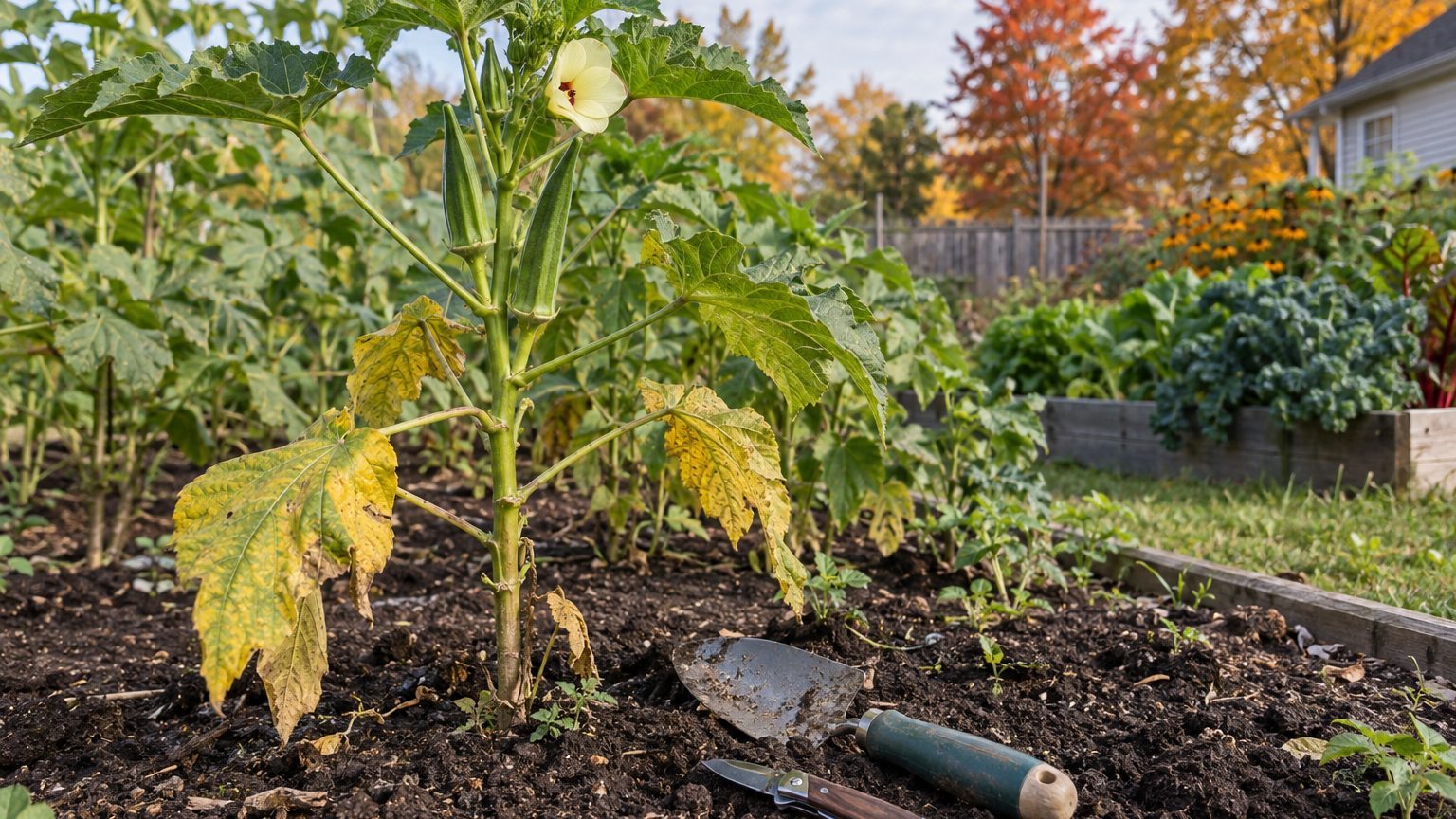

Okra that yellows from the bottom up and droops in the afternoon is usually telling you one of five things: the soil is too wet or too dry, the plant is running low on nitrogen, the season is winding down, or something in the soil is attacking the roots (root-knot nematodes, Fusarium wilt, or southern blight). Which one it is can be figured out in about ten minutes with a trowel, a pocketknife and a close look at the stem base. Start there before you reach for fertilizer or fungicide, because the wrong fix can make this problem worse.
Read the pattern before you pull anything
Lower leaves are the oldest leaves, and every okra plant sheds some of them. A plant pushing toward 5 or 6 feet drops shaded leaves near the ground as it puts energy into pods higher up. If you see a few yellow leaves at the base, the upper canopy is deep green, and the plant is still setting pods, you are looking at ordinary aging. Pick off the yellow leaves, toss them, and move on.
Trouble looks different. Yellowing that climbs steadily, affects leaves in the middle of the plant, or shows up on just one side of a stem deserves attention. So does wilting that persists after sundown. A healthy okra plant can droop a little during a 95-degree afternoon and perk up by evening. A plant still limp at 8 p.m., or still limp the next morning, has a root or vascular problem, not a thirst problem.
Three quick checks sort most cases. First, push a finger 2 to 3 inches into the soil beside the plant and note whether it is soggy, damp or dust-dry. Second, dig up one struggling plant (sacrifice one to save the rest) and look at the roots. Third, slice the lower stem lengthwise with a clean knife and look at the inside. Healthy tissue is pale green or white. Brown streaks running up the stem point to a vascular disease.
It also helps to know where you are in the season. Today is early October, and across much of the country nights have started dipping into the 50s. Okra is a heat lover that slows down sharply when temperatures drop, so late-season yellowing in a plant that was fine in August is often just the beginning of the end. In the northern half of the country it can also be an early cold snap, and nothing is wrong with the soil at all.
Water, food and crowding: the fixable causes
Water problems cause more yellow okra than any disease. Too little water produces a predictable sequence: afternoon wilting that recovers overnight, lower leaves turning yellow and crisp at the edges, and pods that come out small and tough. Okra’s taproot reaches deep, so it handles dry spells better than tomatoes or cucumbers, but it still wants roughly an inch of water a week during pod production, and more in sandy soil or in a Texas or Arizona heat wave. A 2 to 3 inch layer of straw or shredded leaves keeps moisture even and holds soil temperature steadier.
Too much water is sneakier. Waterlogged soil starves roots of oxygen, and the plant responds with yellow lower leaves, midday wilting, and sometimes a soft, brown, rotten-smelling root system. Heavy clay in places like Georgia, Mississippi or the Texas Blackland Prairie is a common setting, particularly after a stretch of tropical rain. Pythium and similar water molds move in once roots are stressed. If your finger comes up muddy, hold the hose. If the bed stays wet for days after rain, raising it by 6 to 8 inches next year changes the odds considerably.
Nitrogen shortage has its own signature. The yellowing is even and pale, starting on old leaves and creeping upward, with no spots, streaks or one-sided patterns, and the roots look clean and white. Okra is not a heavy feeder, and too much nitrogen gives you a leafy tower with few pods, so a soil test beats guessing. Your state’s cooperative extension office can run one for a modest fee, and it will also show pH. Okra does best between roughly 6.0 and 6.8. Outside that range, nutrients lock up even when they are present.
Crowding matters more than most gardeners expect. Plants set too close shade each other’s lower leaves, hold humidity in the canopy and drop those leaves early, which looks alarming but is mostly cosmetic. Dense stands also let leaf diseases and root problems spread plant to plant. If your rows look like a hedge, How Much Room an Okra Plant Needs lays out the spacing that keeps lower leaves lit and airy.
When the soil itself is the problem
If water and nutrition check out and plants keep declining, one or more soil-borne organisms are the likely cause. They tend to travel together, and telling them apart changes what you do next year.
Root-knot nematodes
These microscopic roundworms burrow into roots and trigger swollen, bumpy galls. Pull a wilting plant and look for lumps ranging from the size of a pinhead to a marble, fused into knotted strings along the roots. They do not wash or rub off, which separates them from clinging bits of soil or compost. Above ground the plant looks starved and thirsty: stunted, pale, wilting in the heat even when the soil is moist, because the damaged roots cannot move water. Okra is one of the most susceptible garden vegetables, and sandy soils in the Southeast are particularly prone to heavy populations. The full diagnosis and control options are in Knots on Okra Roots.
Fusarium and Verticillium wilt
These fungi live in the soil and enter through roots, then clog the plant’s water-conducting tissue. The classic sign of Fusarium wilt is yellowing and wilting that begins on lower leaves, often on one side of the plant or even one side of a single leaf, while the other side looks fine. Cut the stem near the soil line and you will see tan to dark brown streaking inside. Plants may hang on for weeks, producing a few stunted pods, before collapsing. Hot weather speeds the decline. Verticillium wilt looks similar but favors cooler conditions, with blotchy yellow and brown patches between the leaf veins.
Without a lab culture you cannot reliably tell the two apart, and for a home garden you do not need to. Both survive in soil for years and neither can be cured with a spray. Cut-and-look diagnosis is good enough to decide on action. Many state extension plant diagnostic labs accept samples of an affected stem and root, and they can confirm the pathogen for a small fee, which is worth doing if you plan to keep gardening in that spot. Fusarium and nematodes also work as a team: root wounds from nematode feeding give the fungus an easy way in, which is one reason plants with both problems fail faster than plants with either alone.
Southern blight is the fast one. Look at the stem right at the soil line for white, cottony threads and small, round, tan-to-brown balls about the size of mustard seeds (sclerotia). The plant wilts fast in hot, humid weather, sometimes within days. The fungus attacks the stem base, not the vascular system, so the slice-the-stem test may look clean higher up. If you spot those little seed-like balls, remove the plant along with the top few inches of surrounding soil, and do not shake it off into the bed.
What to do this season and next
For a plant that is clearly diseased, pull it. Bag it and put it in the trash, not the compost pile, since most home piles never get hot enough to kill Fusarium or sclerotia. Wipe pruners and knives with 70 percent rubbing alcohol or a 10 percent bleach solution between plants, and wash soil off your boots and tools before moving to another bed. A single trowel can carry infested soil across a garden.
A few steps give you better odds next year:
- Rotate hard. Keep okra out of the infested spot for at least three to four years. Okra belongs to the mallow family along with cotton and hibiscus, which share some of the same diseases, so keep those out of the rotation too. Corn and other grasses are safer fillers.
- Choose seed or transplants labeled resistant or tolerant to Fusarium wilt and root-knot nematodes if your region has a history of either. Catalogs flag this, and your local extension office knows which varieties hold up locally.
- Where nematodes are the issue, solarize the bed in the heat of summer under clear plastic for six to eight weeks, and plant French marigolds as a cover in the off-season, as extension programs in several Southern states recommend.
- If the whole garden is infested, grow okra in large containers with fresh potting mix or in a new raised bed filled with clean soil. Fungal spores and nematodes do not appear out of nowhere.
Plain old good practice also helps. Plant when soil has warmed to at least 65 or 70 degrees, because cold, stressed seedlings are the easiest targets. Water at the base in the morning rather than overhead at night. Stake or give plants room so air moves through. And pick pods daily once they start; an overloaded plant under stress is more likely to give up. The broader growing basics, including heat needs and harvest timing, are covered in Growing Okra: Heat, Daily Picking, and the Slime Question.
One last nuance for gardeners who have lost plants to Fusarium: soil testing for the fungus is not a routine service everywhere, and a clean result does not guarantee the bed is safe. Nematode assays, on the other hand, are widely available through extension labs, and the sample has to be taken from the root zone of living plants, ideally before the plants die back. Take that sample while the plants are still green, and you will know what you are dealing with before you plant again.