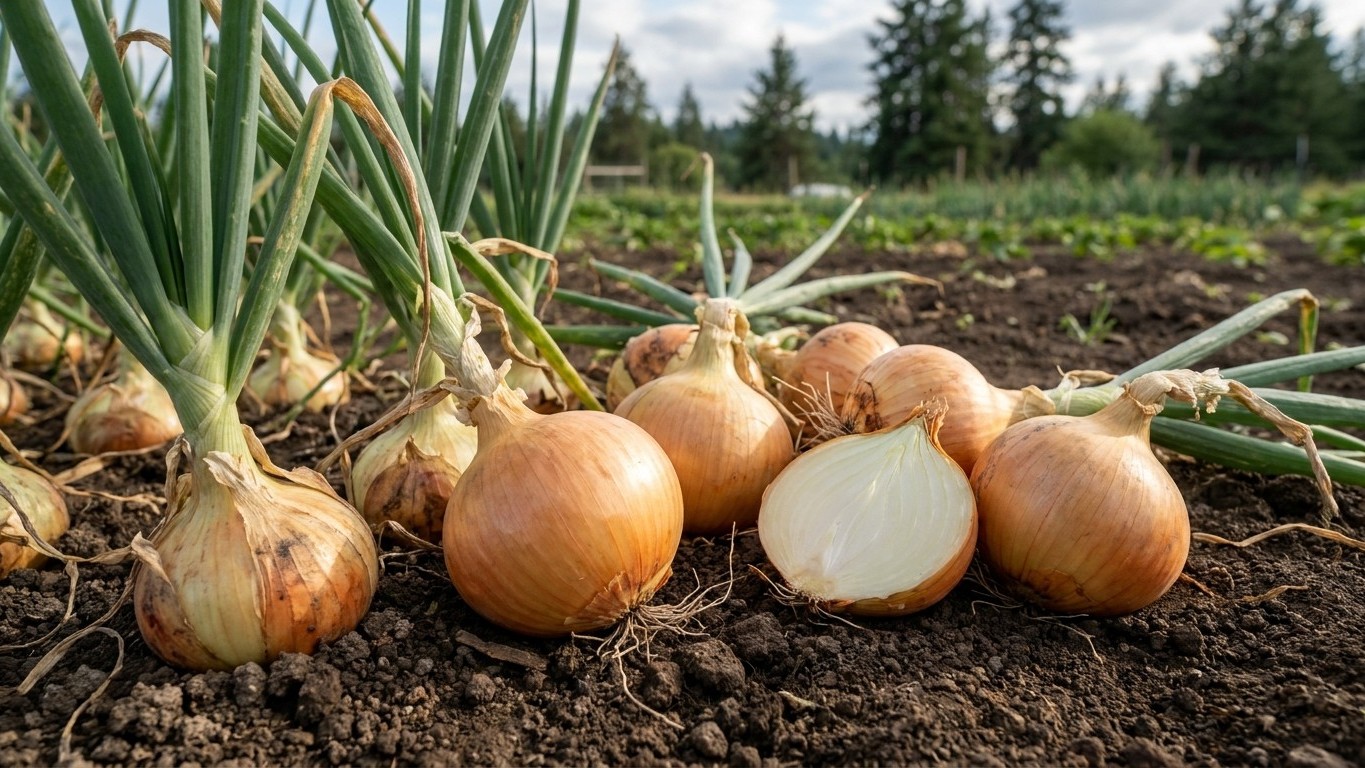

Lift onions in Missouri when the tops fall over and the necks go soft, which in most gardens means summer, after the longest day has passed. Then cure them. Spread the bulbs somewhere warm, dry and airy until the necks are tight and the skins papery, and only then put them in storage. Skip the curing and a good crop turns to mush by winter. The calendar matters less than the plant itself, and the reason is day length.
The short answer for Missouri
Kansas City sits at 39.30 degrees north, and on the longest day of the year it gets 14 h 46 of daylight. That is the geometric figure, with the horizon treated as a clean line. Atmospheric refraction adds roughly seven minutes of real daylight on top. Those two numbers explain nearly everything about when onions finish in this state, because an onion does not count warm days. It counts light.
Here is the mechanism. A young onion plant makes leaves, and each leaf eventually becomes one ring of the bulb. When the days stretch past a variety’s threshold, the plant stops adding leaves and starts swelling its base. Clemson Cooperative Extension puts the threshold for short-day types at about 12 hours. Long-day types wait for 14 to 16 hours. Missouri’s longest day clears the bottom of that long-day range, but only around midsummer, which is why the choice of variety matters so much here. (The Best Onion Varieties for Missouri page sorts that out.) Bulbing is the signal, and the falling tops are the receipt. Harvest follows when the plant has finished.
Reading the tops
Forget the date on the seed packet and watch the foliage. When the green tops begin to yellow, flop over at the neck and the necks soften, the bulb has stopped growing. Pick a dry day, loosen the soil with a garden fork so you do not stab the bulbs, and lift them gently. Leave the tops attached. They are the plumbing that carries moisture out of the neck during curing.
Lifting in the morning and letting the bulbs lie on the soil surface for a few hours is fine if the sky is clear. Direct afternoon sun on bare bulbs can scald them, so move them under cover by midday. From there they go to the curing spot: a porch, a garage with the door cracked, a shed with a fan, anywhere with moving air and no rain. Lay them in a single layer on screens or slatted crates, not piled in a bucket. The test for finished curing is by hand, not by clock. The neck should be tight and dry, with no moisture when you squeeze it, and the outer skins should rustle like paper.
What will not work here
Planting late does not push the harvest back. It shrinks it. Whatever size the plant has reached on the day the light triggers bulbing is the size the bulb will be, give or take. An onion set out weeks behind schedule has fewer leaves when that moment arrives, so it makes fewer rings and a smaller bulb. The trigger does not wait for the slow ones. A gardener who plants in a hurry in spring and gets marble-sized onions in July has not met bad luck. The plant simply ran out of calendar.
The same logic applies to variety. A long-day onion needs 14 to 16 hours of light before it will bulb. Where the day never gets that long, it just makes leaves all season, then collapses and rots. Missouri reaches 14 h 46 only near the solstice, so a long-day variety planted too late gets a short window to bulb, or none. The Onions in Missouri overview covers planting windows in detail.
Harvest and curing mistakes that cost you the crop
- Lifting while the tops are still green and upright. The bulb is still sizing, and the neck is thick and wet, which is exactly where rot enters.
- Bagging onions straight from the ground. Uncured bulbs carry moisture in the neck and outer layers, and they spoil in storage within weeks.
- Trimming the tops at harvest. A cut green stem leaves an open wound in the neck. Trim only after curing, when the neck is tight.
- Curing in rain or in a damp basement. Moisture is the thing you are trying to drive out, so a wet room defeats the purpose.
- Washing the bulbs. Water on the skins invites mold, and a light brushing of dry soil is all they need.
- Counting on a sweet variety to last the winter. It will not, for reasons covered below.
Pests can also undo a late lift. Bulbs left in wet ground are easier targets, and What Eats Onion in Missouri, and When lays out what to watch for and when.
What changes across Missouri
The figures above belong to Kansas City, the city whose station supplies the climate normals for this page. Missouri is a tall state, and it runs a good distance from the Iowa line in the north down to the Bootheel in the south. That spread of latitude is enough to move day length and, with it, the schedule.
| Location | Latitude | Longest day | What it changes |
|---|---|---|---|
| Far north Missouri | Higher than 39.30 degrees north (exact figure not published here) | Longer than 14 h 46 | Long-day varieties reach their threshold sooner and hold it longer. Bulbing is more dependable. |
| Kansas City (reference) | 39.30 degrees north | 14 h 46 | The baseline for every figure on this page. |
| Bootheel and far south | Lower than 39.30 degrees north (exact figure not published here) | Shorter than 14 h 46 | Long-day types get a narrower window. Short-day types bulb early and finish sooner. |
In practice, a northern Missouri gardener sits closer to the territory where long-day onions behave well, while a Bootheel gardener lives in country that leans toward short-day types. Neither is wrong, but planting dates shift by a matter of weeks between the two ends, and harvest shifts with them. Someone near the Iowa border should not copy a Bootheel neighbor’s calendar, and the reverse holds too.
This page does not publish exact latitudes or day lengths for the northern and southern edges. If you garden far from Kansas City, look up your own coordinates (the last section shows how) and compare them against 39.30 degrees north. A degree or two of latitude changes day length by a matter of minutes at midsummer, but those minutes decide which onions finish.
Sweet now, or onions that last
Every onion gardener in the Midwest eventually meets the same trade. Sweet onions taste wonderful raw and rot in the pantry. Sharp ones make you cry at the cutting board and sit happily in a crate for months. University of Missouri Extension (guide G6355) says it plainly: “As a rule, ‘sweet’ onions do not store as well as the more pungent types.”
The reason is chemistry, not luck. The bite of an onion comes from volatile sulfur compounds, and those same compounds are what protect the bulb in storage. A sweet variety carries fewer of them. That is why it is better raw, and why it will not last the winter. Calling a variety “mild” hides the mechanism. What you are really choosing is how much of that built-in defense the bulb has.
The trade also lines up with day length. Short-day types run sweeter, and long-day types keep longer. A gardener in the southern part of the state tends to end up with onions to eat soon. A northern gardener tends to end up with onions that feed the household into March. Neither choice can promise you both, and no variety should be sold to you as a sweet onion that stores.
Picture the pantry in March. In a household that grew sweet types, the crate is empty or the last bulbs are soft and sprouting. In a household that grew pungent types and cured them well, the bulbs are firm and papery, the flavor has mellowed a bit in storage, and there is still a bag left. Clemson Extension gives the target conditions for keeping them: “Ideal conditions are between 45 °F and 55 °F, and 50 to 60 percent humidity.” Onions want it dry, not damp. That is the opposite of carrots and other roots, which prefer a humid cellar, so one cellar cannot hold both crops well. Give the onions their own shelf, crate or mesh bag somewhere cool and dry.
Checking this against your own garden
The numbers on this page are exact for Kansas City and informed estimates everywhere else. A state-wide figure never applies to every garden in it, so verify the details that matter for your own plot. Each of these can be done this week:
- Find your latitude. Pull up your address on any mapping tool that shows coordinates and compare it with 39.30 degrees north. The farther you are from Kansas City, the more your schedule may differ.
- Get your local frost dates from your county extension office. This page carries no frost date because the verified figures here do not include one.
- Note the date you planted and how big the plants were in early summer. Next year’s schedule starts from that record.
- Walk the rows and look at the tops. If they are green and upright, the bulbs are still growing. If they are down and soft at the neck, it is time to lift.
- Test your storage spot. A cheap hygrometer will tell you whether the room sits in the 50 to 60 percent range, and a thermometer will show whether it stays between 45 °F and 55 °F.
Your county extension office is the right place to take questions the state-wide picture cannot answer. They know the local soils, the typical bulbing dates in your part of Missouri and which varieties have done well nearby.
Common questions
Can I lift onions while the tops are still green?
You can, but the bulbs will be smaller than they would have been, and the necks will be thick and wet. Those onions are best eaten fresh and soon. They will not cure well and should not go into storage.
How do I know curing is finished?
Check by feel. The neck should be tight and dry, with no moisture when squeezed, and the outer skins should be papery and rustle in your hand. The length of time depends on the weather and your space, and this page does not publish a fixed number of days.
Where should I store cured onions?
Choose a cool, dry, airy spot. Clemson Extension gives the ideal range as 45 °F to 55 °F with 50 to 60 percent humidity. A damp cellar suited to carrots is the wrong place.
Can I keep sweet onions through the winter?
Not reliably. University of Missouri Extension notes that sweet onions do not store as well as pungent types, because they carry fewer of the sulfur compounds that protect the bulb. Eat them first and save the sharper bulbs for late winter.