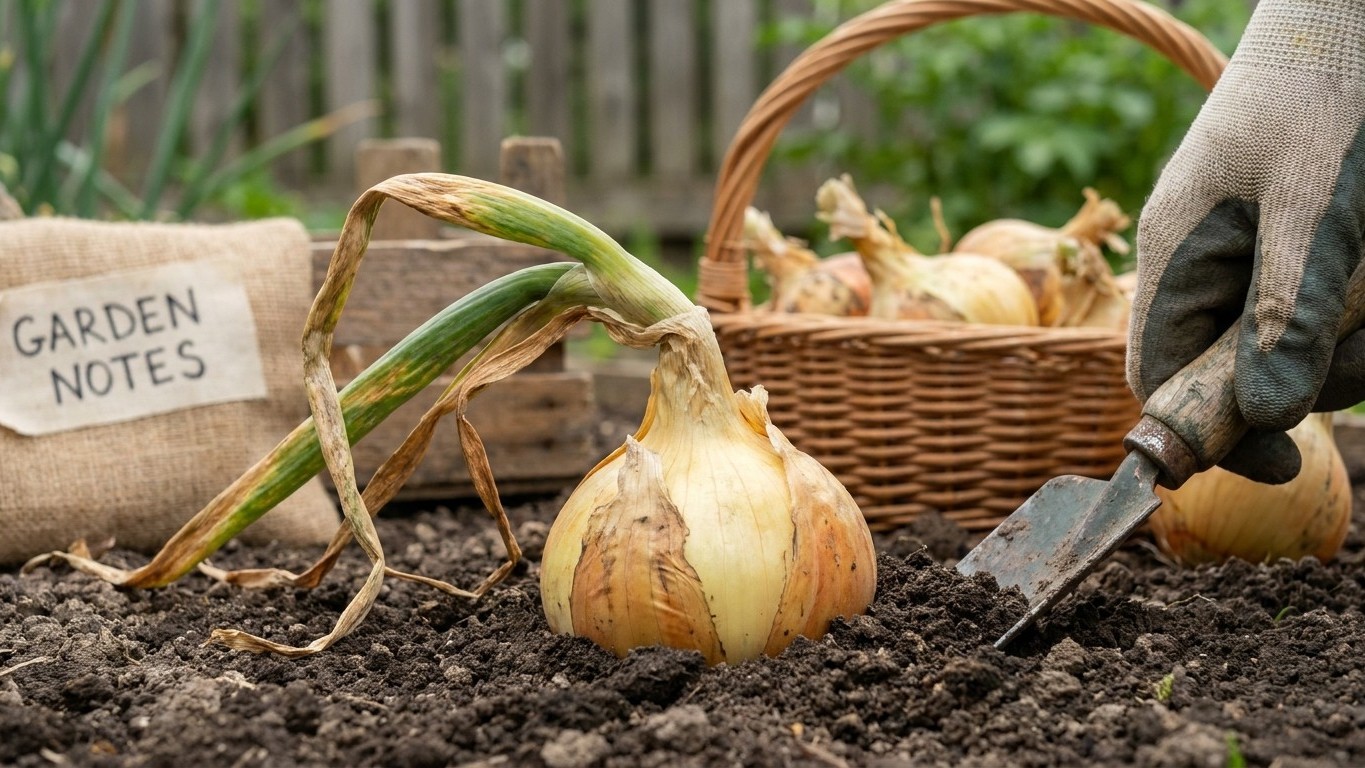

The onion tops flopping over in the bed, some flat at the neck and some still standing tall, are telling you the crop is finishing on its own schedule, not yours. Harvest onions once about half to most of the tops have gone down on their own. Check the row this week: if half are down, pick a dry day and lift the rest, but don’t push the upright ones over to speed things along.
When to Harvest Onions
The tops falling over on their own is the only signal that matters here, not a date circled on the calendar and not a bulb size guessed at from across the row. Once about half to most of the tops have gone down, the bulb has stopped growing, and there is nothing left to gain by leaving it in the ground.
Reading the tops
The tops fall because the plant is shutting down leaf growth as it finishes the bulb below ground. The stalk softens right where it meets the neck, and the leaves can no longer hold themselves upright. It happens plant by plant rather than all at once across the bed, which is why you check the row over several days instead of pulling everything the moment the first one goes down.
Resist the urge to speed this along. Bending the tops down by hand to hurry the crop interrupts the bulb before it has finished, and that shows up later as onions that don’t keep as well in storage. The plant needs to complete this collapse on its own, however tidy it would feel to knock the standing ones flat while you’re out there.
If you’ve grown onions before and gotten this far, the plant has already spent the whole season building the bulb underground. Harvest timing is just recognizing that the building has stopped, not making it stop.
Not every plant in the row reaches this point together. Bulbs that got more competition from weeds, sat in a shadier corner of the bed, or came from smaller starts will often lag a week or more behind their neighbors. That’s why the threshold is a fraction of the row, half to most, rather than every single top. Waiting for the last few stragglers costs nothing if the majority are already down, but it does mean walking the row rather than judging it from one end.
The tops don’t need to be brown or dead to count as down, only flat. A leaf can still be green and lying across the soil, and that plant has already told you it’s finished. Waiting for it to yellow on top of falling over adds nothing, since the bulb stopped growing the moment the top went down.
Judging by bulb size alone is unreliable early in the season, since a bulb can look full size at the shoulder while it’s still actively swelling underground for another week or more. The tops are the plant’s own signal, not a stand-in for one, which is why waiting for the fall itself works better than estimating from what you can see above the soil.
Check the bed every few days once the first tops start to lean. Some plants in the same row will flop earlier than others, and that’s normal rather than a sign anything went wrong. Wait for the count to cross the halfway mark before you commit to a lifting day, and treat any tops still standing upright as onions that need more time, not onions you missed.
| Stage | Tops | What to do |
|---|---|---|
| Too early | Most still standing upright | Wait, don’t force tops down |
| Right time | Half to most fallen over on their own | Pick a dry day and lift |
| Too late | Nearly all down, some regrowing green centers | Lift promptly and use those first |
How to do it

Start watching the bed as soon as a handful of tops begin leaning instead of standing straight. This is the point to start checking, not the point to start pulling.
Step by step
- Walk the row every few days and count how many tops are down versus still upright.
- Once half to most are down, watch the forecast and pick the next dry day for lifting.
- Loosen the soil under each bulb with a fork instead of pulling straight up on the leaves.
- Lift the whole plant, bulb and tops together, and set it on top of the dry soil rather than piling straight into a bucket.
- Move the crop under cover, out of rain and direct sun, before curing begins.
Lift on a dry day. A bulb pulled out of wet soil carries that moisture straight into curing, and it starts the process at a disadvantage it doesn’t fully recover from. If rain is forecast for the next several days once you’ve crossed the halfway mark, that’s reason enough to lift a little earlier within the window rather than wait for a perfect day that isn’t coming.
Whichever tool you use, work it in a few inches back from where you think the bulb sits, not right against it. A fork tine or spade edge that nicks the bulb opens a spot for rot to start later in storage, even if the wound looks minor on lifting day.
Leave the bulbs where you lifted them for the first few hours if the day stays dry, tops and all, rather than hauling them inside right away. Piling them straight into a bucket or wheelbarrow traps moisture against the necks before curing has even started, so give them room to sit uncrowded in a single layer, whether that’s on the soil, a screen, or a tarp.
The same trigger applies if you’re growing in a pot instead of open ground. Onions grown in containers finish the same way, tops folding over on their own, though a container dries out and warms faster than garden soil, so check it a little more often once the tops start to lean.
If you’re growing more than one variety, keep them in separate rows or mark them as you lift, since some cure and store longer than others. Mixing varieties at this stage makes it hard to know later why one batch is going soft while another is still solid in the pantry.
Curing is a separate step from harvesting, and it decides how long the crop keeps, not the lifting itself. Get the onions dry, out of the weather, and out of direct sun as soon as they’re out of the ground, and treat the lifting day as the start of curing rather than the end of the job.
What goes wrong
The most common mistake is lifting before the halfway point, usually because the row looks done enough or because rain is coming and pulling early feels safer than waiting for the right day. Onions pulled while most of the tops are still upright haven’t finished sizing, and they tend to come up with thick, wet necks that won’t cure down properly. If this has already happened, don’t plan on storing those bulbs long term. Use them first in the kitchen, ahead of the ones that finished on their own.
Early, late, and wet
The opposite problem shows up when the crop sits too long after the tops have already gone down, especially through a wet stretch of weather. The necks stay soft, some bulbs push up new green growth from the center, and the outer skin starts to slip rather than dry papery. Once you see new growth coming up through the top of a bulb, that one is done as a keeper. Eat it soon instead of setting it aside with the storage crop.
Wet lifting causes its own trouble. A bulb pulled from soaked soil carries moisture into curing that it should never have had, and that moisture is exactly what lets rot start weeks later, long after you’ve forgotten which onions came out on the damp day. If you had no choice but to lift in the rain, keep those onions separate from the rest of the harvest and watch them closely. Plan to use them sooner rather than tuck them away with the main crop.
None of this means the whole harvest is ruined if a few bulbs show these problems. Sort as you cure: pull the soft-necked or sprouting bulbs out of the batch entirely, keep them separate, and let the firm-necked majority cure normally. Mixing a handful of bad bulbs in with the good ones is how a whole storage crate goes soft together.
Undersized bulbs at harvest usually point to a problem that started weeks earlier, not at the lifting stage itself. If the bulbs coming out of the ground are consistently smaller than expected no matter when the tops went down, the cause is generally further back in the season, covered in why your onions stayed small. No amount of adjusting harvest timing fixes a bulb that never had the room or nutrition to size up in the first place.