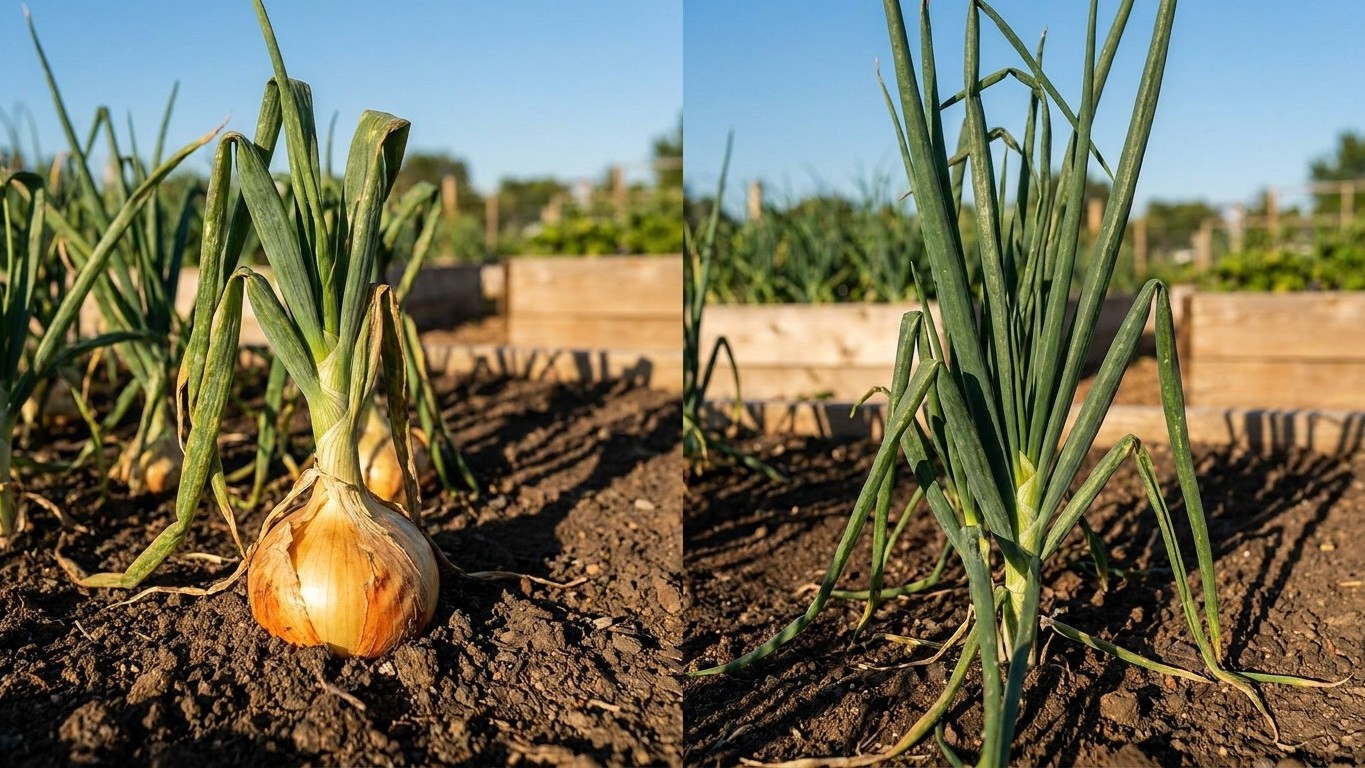

An onion bulbs when daylight hits a specific threshold, not when the weather warms up. Miss that number and you get a plant that stays green all summer and never forms a bulb worth harvesting—though if that’s actually your goal, see Growing Scallions: Onions That Never Bulb. Everything else, from which variety to buy and whether you start with Onions from Seed, Sets or Plants to when to plant it—whether that means Overwintering Onions for an Early Harvest or waiting for spring, and even whether you’re Growing Onions in Containers or straight in the ground, not to mention How Far Apart to Plant Onions—flows from this one fact about day length and where you garden, and ultimately determines When to Harvest Onions and how well those bulbs hold up once you’ve gone through Curing Onions and moved on to Storing Onions Through Winter. Get the timing wrong and you may also end up dealing with premature flowering; see Why Onions Bolt, and What to Do With One That Has for that particular headache.
The one thing that decides everything

Most vegetables respond to soil temperature or frost dates. Onions respond to sunlight duration, a signal called photoperiod. Once the number of daylight hours crosses a variety’s threshold, the plant stops building leaves and starts building a bulb. Get the wrong variety for your latitude, and the plant either bulbs too early on a scrawny top—Why Your Onions Stayed Small—or waits for a day length that never arrives where you live and just keeps growing leaves until it rots in the ground. Choosing the right variety is only part of the equation, though; good results also depend on What to Plant Next to Onions in the same bed, and on staying on top of Keeping Weeds Out of an Onion Bed.
The part that trips up new gardeners: the far north gets more summer daylight than the south, not less. A June evening in Minnesota or Maine stays bright well past 9 p.m.; a June evening in southern Texas or coastal Georgia does not. That’s why onion varieties bred for northern gardens simply won’t bulb in a Gulf Coast backyard, and why southern varieties bulb too fast and too small if planted in Vermont.
Three groups, three latitude bands
Growers sort onions into three day-length groups. Short-day types bulb at 10 to 12 hours of daylight and belong between roughly 20 and 38 degrees north, which covers the Deep South and most of the desert Southwest. Intermediate-day types need 12 to 14 hours and fit the broad middle of the country, from about 32 to 50 degrees north. Long-day types require 14 to 16 hours and are built for the northern tier, from around 35 up to 65 degrees north, where summer days stretch long.
| Group | Day length needed | Latitude range | Varieties covered in depth |
|---|---|---|---|
| Short-day | 10 to 12 hours | 20 to 38°N | Documented here, none with enough published data yet for its own page |
| Intermediate-day | 12 to 14 hours | 32 to 50°N | 10 varieties with a dedicated page |
| Long-day | 14 to 16 hours | 35 to 65°N | 14 varieties with a dedicated page |
The territories this site covers span 21 to 63 degrees north, and that spread is the whole reason the geography pages exist. The longest day of the year runs around 13 hours at the southern edge of that range and stretches to nearly 20 hours at the northern edge. That’s not a small difference. It’s the entire reason a Georgia farmer and a Maine gardener are never shopping for the same onion.
Sweet, or keeps, not both
Ask any longtime grower why a farmers-market onion tastes so mild and they’ll tell you it won’t survive the winter in a pantry basket. The flavor and the shelf life come from the same chemistry, and you cannot maximize both.
The sharp, eye-watering bite of a raw onion comes from volatile sulfur compounds. Those compounds do double duty: they deter pests and pathogens in the field, and they slow the bulb’s breakdown in storage. A bulb loaded with them holds up for months in a cool, dry space. A bulb with fewer of them tastes sweet enough to eat raw on a sandwich, but it starts going soft within a few weeks.
Where day length fits in
This trade-off lines up almost perfectly with the day-length groups. Short-day onions, grown through the mild Southern winter and pulled in late spring, tend to run sweeter and milder because they mature fast under warm, humid conditions that don’t favor heavy sulfur buildup. Long-day onions, grown through a long northern summer, develop thicker layers and higher concentrations of those same sulfur compounds, which is exactly what lets a Northern-grown onion sit in a root cellar until the following spring.
So the practical question isn’t “which onion is better.” It’s “what do I want from it.” A cook after a mild onion for salads and sandwiches should lean short-day or intermediate. A gardener trying to fill a pantry through winter needs a long-day variety, accepts the stronger bite, and gets months of storage in return.
Getting a crop the first year
Growing a first onion crop comes down to three decisions made in the right order. Skip the order and even good seed won’t save you.
- Pick the day-length group your latitude allows. Check where your garden falls on the 20 to 65 degrees north range and choose short-day, intermediate-day, or long-day accordingly. This single choice determines whether anything else you do matters.
- Decide between seed, sets, and plants. Seed gives the widest variety selection but needs the longest lead time, often started indoors 8 to 10 weeks before transplanting. Sets, small dormant bulbs sold in early spring, are the fastest and most forgiving option for a first-time grower, though the variety choice is usually limited to whatever’s available locally. Transplants, young plants started by someone else, split the difference: less lead time than seed, more variety choice than sets.
- Get the plants sized up before bulbing starts. Once day length crosses the threshold for your variety, the plant commits to bulbing with whatever leaf mass it already has. A plant with only three or four thin leaves at that point will only ever produce a small bulb, no matter how well you water or fertilize afterward. Early planting and steady early growth matter more than anything you do once bulbing begins.
Guides that go deeper
Each of these steps has its own dedicated guide on this site: one walks through starting onions from seed indoors, another compares sets against transplants for a first-year garden, and a third covers timing the planting date so leaf growth finishes before the local day length triggers bulbing. Reading the latitude and variety pages first will save a wasted season.
What goes wrong most often
Onion problems tend to fall into three buckets, and each one traces back to a specific mismatch between the plant and its conditions rather than bad luck.
Small bulbs
This is almost always a leaf-size problem in disguise. The bulb’s final size is set by how much leaf growth happened before day length triggered bulbing, not by anything done afterward. Late planting, crowded spacing, or weak seedlings all shrink the leaf canopy, and a shrunken canopy caps the bulb size regardless of fertilizer or water applied later. A dedicated guide on plant sizing before bulb set covers the spacing and timing fixes in detail.
Bolting
Bolting is a plant sending up a flower stalk instead of finishing its bulb, and it’s usually triggered by a cold snap during early growth. Onion plants that experience an extended stretch of cold weather while still small can mistake it for winter and respond the way biennials do: flower the following season to complete their life cycle, except that “following season” arrives the same summer because the cold hit at the wrong stage. Choosing bolt-resistant varieties and avoiding very early planting in a cold spring both reduce the risk, and a dedicated guide on cold-triggered bolting walks through the specifics by region.
Rot in storage
Storage rot usually starts before the onion ever reaches the shelf. Bulbs harvested with thick, wet necks, cured too briefly, or bruised during handling almost always fail in storage even if they looked fine at harvest. Because short-day and sweeter varieties carry fewer protective sulfur compounds to begin with, they’re inherently more storage-prone than long-day types, so a soft, mild onion going soft in three weeks isn’t a storage mistake so much as its nature. A separate guide covers curing time, humidity, and sorting techniques that cut storage losses for whichever group you grew.