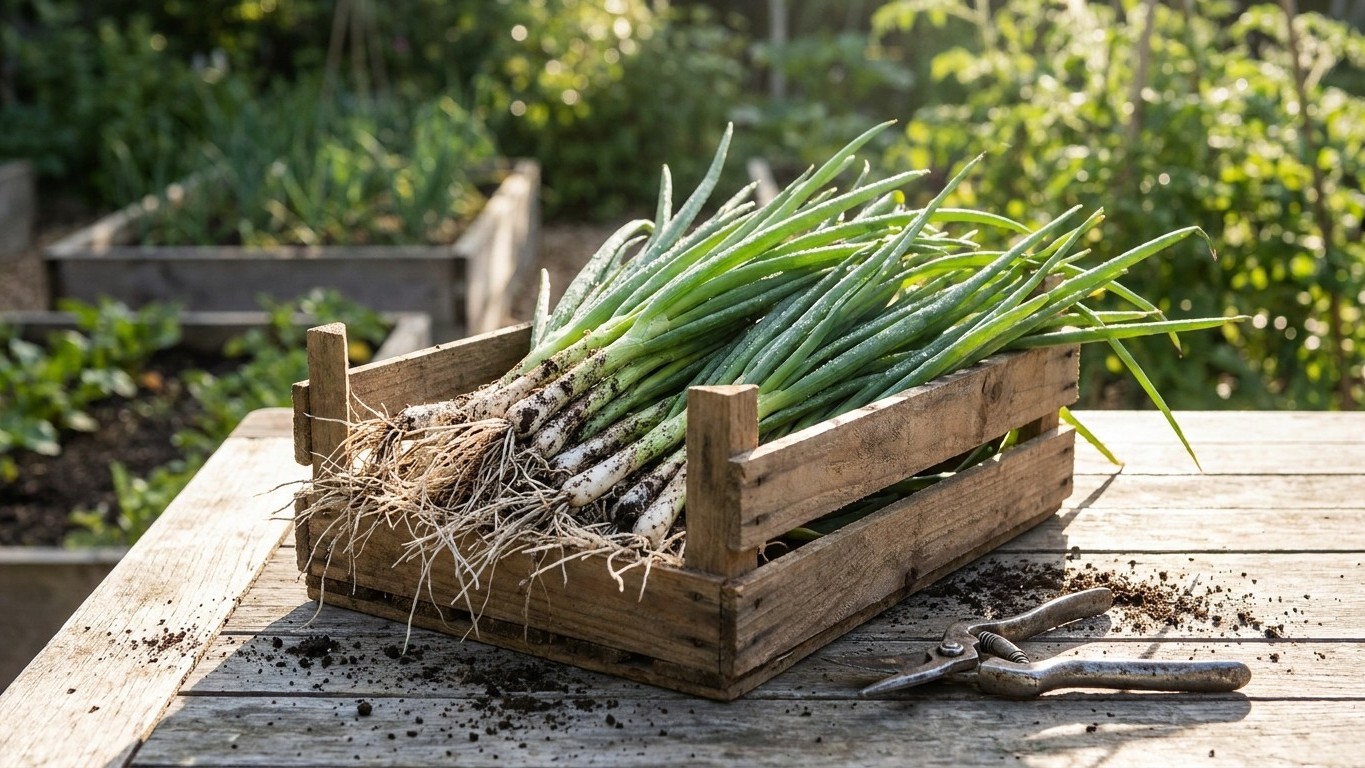

Scallions skip the bulbing stage entirely, and that single fact changes how you grow, harvest, and think about them compared to every other onion on this site. No day-length calculation, no curing shed, no storage math. Just a plant you can cut again and again through a long season, whether you’re in Minnesota or Georgia.
Growing Scallions

A scallion is not a young onion caught before it bulbs. That’s the mix-up that trips up most gardeners. Several distinct plants get sold under the “scallion” or “green onion” label, and they don’t all behave the same way. A true bunching onion never forms a bulb, at any point in its life, no matter what latitude you’re growing it at. You could grow one in a greenhouse in Alaska or a raised bed in Texas and it would do the exact same thing: stay slender, stay green, and keep pushing up new growth from the base.
This matters because day length is the single biggest variable governing bulbing onions. Short-day, long-day, day-neutral, that whole classification exists because bulbing onions respond to how many hours of light they get. Bunching onions ignore that mechanism completely. There’s no internal switch waiting for the right day length to trigger bulb formation, because that switch doesn’t exist in these plants. You’re not managing a countdown to bulbing. You’re managing a plant that just keeps growing.
The Other Way to Get a Green Onion
Here’s where the confusion usually starts. Any bulbing onion, the same kind you’d otherwise let mature into a storage onion, can also be pulled young and eaten as a green onion. Pull a short-day onion at four weeks and you’ve got something that looks and tastes a lot like a scallion. But it’s not the same plant category. It’s a bulbing onion interrupted before it does its main job.
That distinction isn’t just trivia. If you’re growing bulbing onions for storage and you accidentally treat the whole bed like scallions, pulling everything early, you lose your storage crop. And if you’re expecting a bunching onion to eventually swell into a bulb you can cure and keep through winter, you’ll wait forever. It’s not going to happen. The plant isn’t built that way.
Because there’s no bulb, there’s no curing process to worry about, no drying-down period, no decision about keeping quality versus sweetness. That whole set of trade-offs that governs storage onions (the ones where a sweeter variety sacrifices shelf life) simply doesn’t apply here. A bunching onion’s whole value proposition is different: harvest it fresh, use it fresh, repeat.
How to do it
Growing scallions well comes down to timing your plantings and knowing how to keep cutting without giving up on the plant. Here’s the order most gardeners actually work through, from seed to repeat harvest.
- Pick your starting point. Decide whether you’re direct-seeding true bunching onion seed or pulling young plants from a bulbing onion crop you already have going. Both routes get you a green onion, but only true bunching onion seed gets you a plant that keeps regrowing after you cut it.
- Prep loose, well-drained soil. Onions of any kind dislike compacted ground. Work the bed so it’s loose enough for the thin roots to spread without fighting clay or crust.
- Sow seed thickly in rows or a wide band. Bunching onions tolerate closer spacing than bulbing types since they’re not trying to swell outward. A dense planting is normal and expected here.
- Water consistently while seedlings establish. Onion seedlings are thin and shallow-rooted at first. Uneven moisture stresses them more than it does thicker-stemmed vegetables.
- Start harvesting once stems reach usable thickness. There’s no bulb signal to wait for, so harvest is really a judgment call based on size, not a calendar date tied to day length.
- Cut above the base instead of pulling the whole plant. This is the step that makes bunching onions worth growing over regular green onions. Leave an inch or two of the base and root system intact in the soil.
- Let the cut stems regrow and repeat. A true bunching onion will push up new growth from that base, giving you a second, third, sometimes fourth harvest off the same planting over a long season.
- Succession-sow every few weeks if you want continuous supply. Since there’s no bulbing clock to manage, staggered plantings are simple. Just tuck in new seed wherever there’s open row space.
What goes wrong
- You pulled the whole plant instead of cutting it. This looks like an empty spot in the row where a productive scallion used to be, and no regrowth coming. Once it’s happened, there’s no fixing that particular plant. Replant that spot and switch to cutting an inch above the base on everything else going forward.
- You planted a bulbing onion expecting scallion-style repeat harvests. This shows up as a plant that either bulbs on its own timeline or stops producing new green growth after one cut. Once you notice it’s bulbing, let it finish and harvest it as a regular onion instead of forcing it into a role it was never suited for.
- Stems came in thin and papery instead of thick and crisp. This usually traces back to crowding that went too far, or a dry stretch during establishment. If it’s already happened, thin out the row to give remaining plants more room, and water more consistently on the next planting.
- You waited for a “bulbing stage” that never arrived, assuming something was wrong. This is a true bunching onion doing exactly what it’s supposed to do: staying slender and green indefinitely. Nothing to fix here. Just start harvesting by cutting rather than waiting for a signal that isn’t coming.
- Growth slowed to a crawl mid-season. Onions in general are light feeders but not no feeders, and a stall in growth after repeated cutting often means the bed’s nutrients are drawn down from multiple harvests off the same soil. Once you spot the slowdown, work in a light feeding and keep watering on schedule for the next flush of growth.