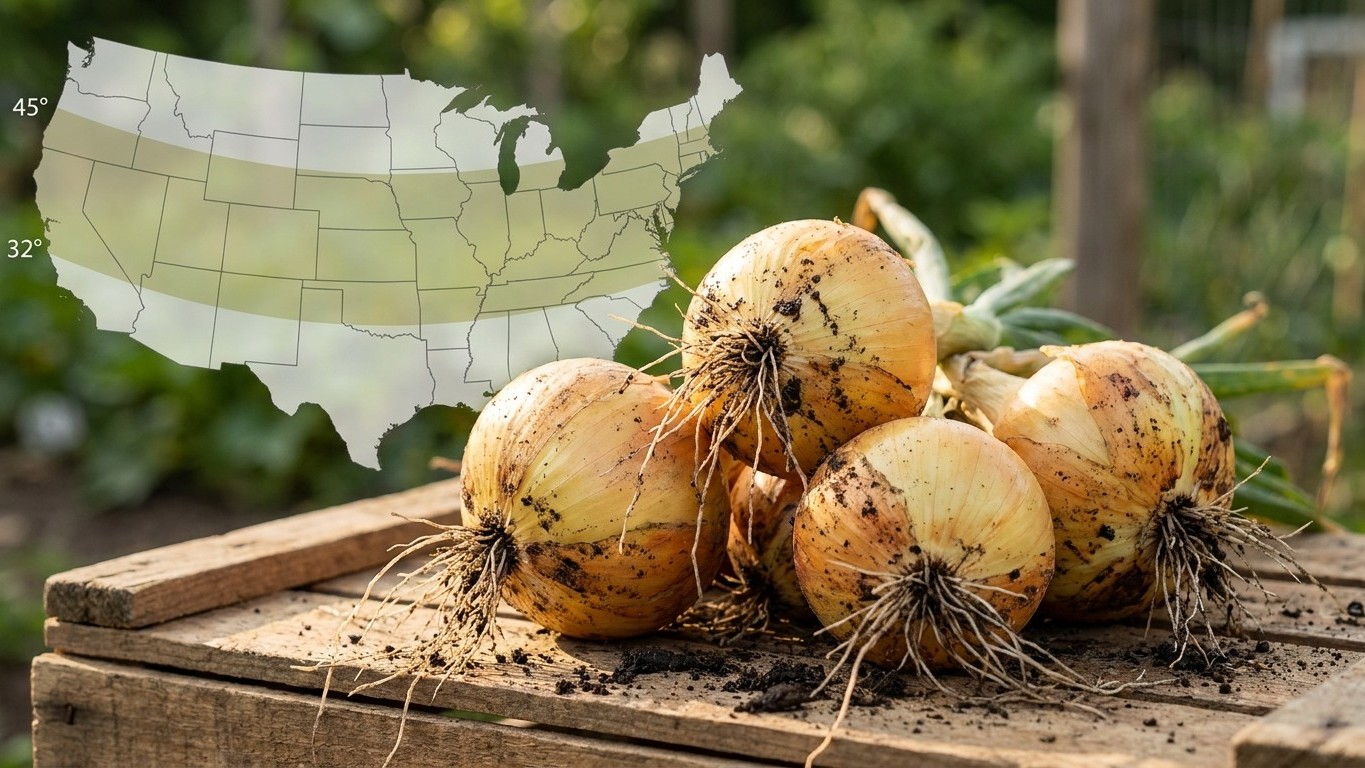

Elsye is an intermediate-day onion, which means it bulbs reliably between roughly 32 and 45 degrees north latitude, a band that covers much of the middle of the United States. Outside that range, the plant may never form a proper bulb at all. From transplant to maturity, Elsye needs about 105 days and produces a yellow bulb. No flavor rating and no storage-life figure have been published for this variety, and this guide won’t invent either.
Will Elsye bulb where you are

This is the question to answer before anything else, because nothing about growing Elsye matters if the plant can’t do the one thing it’s grown for. Elsye belongs to the intermediate-day group, and it bulbs correctly between 32 and 45 degrees north latitude. That band runs roughly from the Gulf Coast states up through the Ohio Valley and into the lower Great Lakes region.
Here’s the part that trips up a lot of gardeners: an onion decides when to bulb based on how many hours of daylight it’s getting, not on how warm the soil is. A stretch of 90-degree days in July does nothing to trigger bulbing if the daylight hours haven’t hit the threshold the plant needs. This is also why long-day onions are grown in the far north and short-day onions in the Deep South, even though the north has shorter growing seasons overall: in summer, the farther north you go, the longer each day stretches, sometimes past 15 hours near the Canadian border. Intermediate-day varieties like Elsye need less daylight to flip the switch, which is why they suit the middle latitudes instead of the extremes.
Plant Elsye well south of 32 degrees, say in central Florida or the Rio Grande Valley, and the daylight hours it needs may never arrive before the plant bolts or the season ends. The result isn’t a small onion. It’s leaf growth with no bulb underneath, or a bulb that starts too late and rots once it hits storage. Plant it well north of 45 degrees, up near the Canadian border or into much of Minnesota and North Dakota, and the opposite problem shows up: the plant may bulb too early, before the tops have grown large enough to feed a full-size bulb, leaving you with something small and disappointing.
If your garden sits near either edge, at 33 degrees north or 44 degrees north, treat that as a blurred zone rather than a guaranteed yes. These bounds describe a continuum, not a hard line, and local microclimate, planting date, and even the specific season’s daylight pattern can shift the outcome. A gardener in that zone is better served by checking with a regional Cooperative Extension office than by assuming the map settles it. The National Gardening Association’s day-length maps and local extension bulletins can help pin down where a specific address falls.
What Elsye is like
Once the bulbing question is settled, what a grower actually ends up with is straightforward on paper. The catalogue data for Elsye lists a handful of concrete traits, and they’re worth reading as a lookup, not a story:
- Color: Yellow
- Days to maturity: 105 days from transplant
- Day-length group: Intermediate-day
No published size, shape, flavor, or storage-life figure exists for this variety, so none is repeated here as if it did.
Flavor and shelf life deserve more than a shrug, though, because the same chemistry drives both. Onions build up sulfur compounds as they grow, and those compounds do two jobs at once: they give the bulb its bite when you slice into it, and they act as a natural preservative that slows decay in storage. A mild, sweet onion has less of that sulfur load, which is exactly why it tastes pleasant raw and exactly why it won’t survive a winter in a mesh bag. A sharp, pungent onion has more of it, which is why it bites your eyes and why it can sit in a cool pantry for months without going soft.
Day-length groups tend to track this trade-off loosely. Short-day onions, grown in warm climates with a short window before summer heat sets in, generally run sweeter and store for a shorter time. Long-day onions, grown where the season is longer and cooler, generally run sharper and keep longer. Intermediate-day types sit in between those two tendencies, but that’s a generalization about the category, not a fact about Elsye specifically. No flavor note and no storage rating have been published for this variety, and guessing at one wouldn’t help anybody standing in a kitchen wondering how long a bag of onions will last.
When to plant it
Planting time isn’t a fixed date on a seed packet. It shifts depending on which day-length group a variety belongs to and where the garden sits, and that surprises a lot of first-time onion growers who expect one universal answer. Short-day onions go into the ground in autumn across mild-winter regions like the Gulf Coast, overwinter as small plants, and get harvested in late spring. Long-day onions go in during late winter to early spring across northern states, where the ground is still cold but the days are lengthening fast.
Elsye, as an intermediate-day type grown across the 32-to-45-degree band, follows the pattern closer to the long-day side of that spectrum. Winters through much of that middle latitude range aren’t mild enough to support the autumn-planted, overwintering approach that works in the Deep South. Instead, Elsye is typically started as a transplant and set out in late winter to early spring, timed so the plant has weeks to build leaf mass before the lengthening days of early summer trigger bulbing.
The date on the calendar matters less than a different test: how big is the plant when day length reaches the trigger point. An onion bulb’s eventual size is set almost entirely by how much top growth the plant has built before it switches from growing leaves to growing a bulb. A transplant that goes in too late, or struggles through cold, wet soil early on, may still bulb right on schedule, on the calendar’s terms, but it bulbs small, because the tops never had time to get big first. Getting Elsye in the ground early enough to build real leaf mass before the trigger hits matters more than hitting any specific week.
Growing it well
Onions are shallow-rooted plants, and that single fact explains most of what goes wrong in a home onion patch. The root system sits mostly in the top few inches of soil, which makes onions poor competitors against weeds and poor at reaching for water once the top layer dries out. A weedy bed doesn’t just look messy, it directly steals the moisture and nutrients that would otherwise be building bulb size, and a patch that dries out between waterings produces smaller bulbs even if every other condition is right. Keeping the bed weeded and evenly moist through the growing season is less about tidiness and more about protecting the bulb that’s forming underground.
Bolting is the other issue worth watching for. A bolted onion is one that’s been stressed, often by a cold snap after transplanting or by uneven watering, into sending up a flower stalk instead of putting all its energy into the bulb. Once a plant bolts, the bulb it produces will not store well, even if it looks normal at harvest. The center often turns tough and the neck stays thick instead of drying down properly. Any bolted plants in the row are best pulled and used first, in the kitchen that week, rather than set aside for winter storage where they’ll be the first to spoil.
No specific spacing or fertilizer rate is published for Elsye, and this guide isn’t going to invent one. A regional Cooperative Extension office can supply spacing and feeding recommendations calibrated to local soil conditions, which will serve a specific garden better than a generic number pulled from nowhere.
Harvesting and keeping it
The signal that Elsye is ready has nothing to do with a date circled on a calendar. Onion tops fall over on their own when the bulb has finished forming, flopping down at the neck in a way that’s hard to miss once you’ve seen it happen. That collapse is the plant telling the grower the bulb is done, and it happens on the plant’s own schedule, which can run earlier or later than the 105-day maturity figure depending on the season’s weather.
Curing is the step that separates an onion that lasts through winter from one that turns to mush in a mesh bag within weeks, and it’s the step most home gardeners skip or rush. The process is simple to describe and easy to shortcut: the neck of the onion has to dry down until it’s papery and tight before the bulb goes into storage. Skip that drying window, and moisture trapped at the neck becomes the entry point for rot, often not visible until the onion’s already gone soft from the inside.
The sequence from field to pantry runs in order:
- Watch for the tops to fall over on their own, rather than pulling bulbs on a fixed date.
- Lift the bulbs gently once most of the tops have collapsed, taking care not to bruise the skins.
- Spread the bulbs in a single layer somewhere warm, dry, and out of direct sun, either outdoors under cover or in a shed or garage.
- Let them cure for one to three weeks, until the necks are dry and papery and the outer skins rustle when handled.
- Trim the dried tops and roots, then move the bulbs to a cool, dry, well-ventilated spot for storage.
No storage-life figure has been published for Elsye, so this guide won’t quote one. What’s useful to know instead is what that number would mean in practice, whichever way it lands. A variety that keeps six months carries a household through winter and into early spring on onions grown the summer before. A variety that keeps closer to three months is best treated as a fall-and-early-winter onion, eaten down before it has the chance to soften. Until a specific keeping time is published for Elsye, a reasonable approach is to store the crop as if it falls somewhere in the middle, checking the bin every few weeks and using any bulb that shows softness at the neck first.