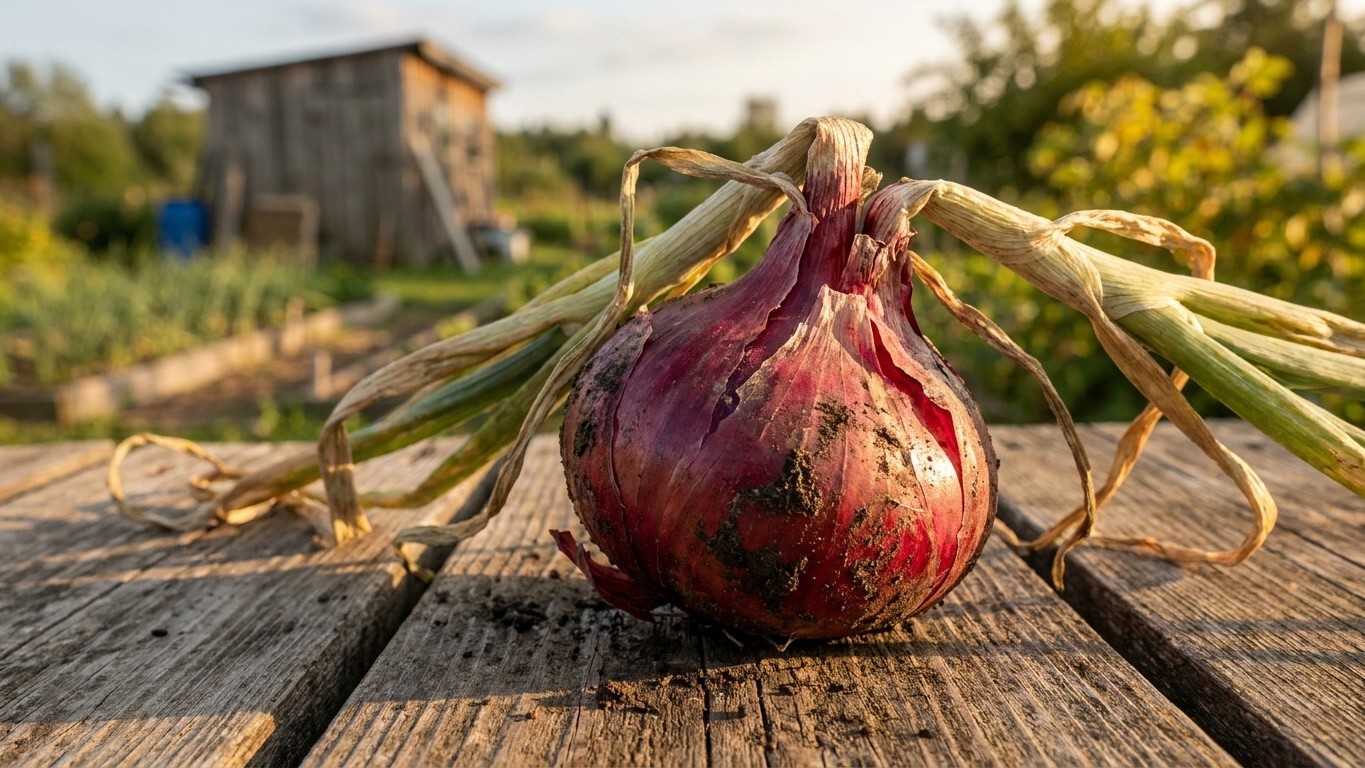

Redwing is a long-day onion, which means it only forms a bulb once summer daylight stretches past a certain threshold, roughly 14 to 16 hours. That single fact decides everything else about growing it: where it works, when to plant it, and whether the reader will be pulling red bulbs or just a patch of green tops come August.
Will Redwing bulb where you are

Redwing belongs to the long-day group, and it bulbs reliably between 43 and 65 degrees north latitude. That band covers the northern tier of the United States, most of Canada, and similar latitudes overseas. Below that range, roughly south of the mid-Atlantic and the lower Midwest, this onion runs into trouble it can’t recover from.
Here’s the mechanism, and it trips up a lot of gardeners because it runs against common sense: bulbing is triggered by day length, not by heat. An onion doesn’t “decide” to bulb because the weather turned warm. It bulbs when the number of daylight hours crosses a genetic threshold built into the variety. The far north actually receives more total daylight during the growing season than southern states do, thanks to those long summer evenings, which is exactly why long-day types like Redwing are bred for northern gardens and short-day types are bred for the Gulf Coast and the Deep South.
Plant Redwing south of its range and the day length never climbs high enough to flip the bulbing switch. The plant doesn’t respond by making a smaller bulb, the way it might if it were short on water or nitrogen. It just keeps growing leaves, season after season, until frost or rot ends the experiment. You end up with a fistful of green tops and, if you dig down, barely a swelling at the base. Store one of those and it turns to mush within weeks.
If you’re near the edge of the range
Latitude 43 isn’t a wall, it’s a fuzzy line. Gardeners in places like southern Ohio, central Kansas, or northern Virginia sit close to that boundary, and results there can go either way depending on the specific summer, cloud cover, and how early the sets or transplants went in. That’s not a green light and it’s not a red one either. It’s a genuine maybe, and the honest answer is to try a small test bed before committing a full row to Redwing, or to check with a local extension office for how long-day varieties have performed in your county.
What Redwing is like
Assuming the latitude checks out, here’s what actually shows up in the garden and on the cutting board. Redwing is a workhorse red onion built for storage rather than for eating raw off the vine, and its traits reflect that purpose from the ground up.
- Color: Red skin, typical of the red storage class
- Size and shape: A medium to large globe-shaped bulb, the standard storage-onion form
- Days to maturity: 118 days from transplant
- Flavor: Sharp, not mild or sweet
The 118-day window from transplant is long by onion standards, which is part of why the day-length trigger matters so much: this variety needs a full season to build enough leaf mass before it even starts bulbing, and a shortened or confused season leaves it caught mid-process.
The trade-off nobody mentions on the seed packet
Sharp and keeps for months. Sweet and mild and gone in weeks. That’s not a coincidence, it’s chemistry. The sulfur compounds responsible for an onion’s bite, the ones that make your eyes water when you slice it, are the same compounds that act as a natural preservative inside the bulb. A sweet, mild onion has fewer of those compounds, which is exactly why it tastes pleasant raw on a sandwich and exactly why it also breaks down in storage within a month or two. Redwing sits firmly on the sharp, storage-heavy end of that spectrum. Don’t expect it to eat like a sweet salad onion. It’s a pantry onion, meant to be cooked, and it holds its ground into spring precisely because it isn’t trying to be mild.
When to plant it
Planting timing for onions isn’t fixed on the calendar the way it is for tomatoes or beans. It follows the day-length group, and that’s the part that surprises a lot of first-time onion growers: the “right” planting month actually flips depending on where you live and which type of onion you’re growing.
Short-day onions get planted in autumn in mild-winter regions like the Gulf Coast, overwinter as small plants, and get harvested the following late spring. Long-day types like Redwing follow the opposite script. In northern gardens, Redwing goes in the ground late winter to early spring, as soon as soil can be worked, giving it the entire long summer to grow before the extended daylight of June and July triggers bulbing.
The size test that matters more than the date
A specific planting date matters less than a specific condition: the plant needs to already have a good amount of leafy top growth by the time day length crosses the bulbing threshold. Here’s why that detail is worth more attention than most gardeners give it. Onions bulb using the resources stored in their leaves at the moment the trigger fires. A small, stunted plant that hits the day-length threshold produces a small bulb, permanently, because the switch only flips once per season. Once bulbing starts, the plant stops investing in new leaf growth and starts investing in the bulb, using whatever leaf mass it already has. Plant Redwing too late, and it enters bulbing mode as a scrawny seedling with a few thin leaves, and the harvest reflects that no matter how well you water and feed it afterward.
Growing it well
Onions have a shallow, sparse root system, which makes them lousy competitors against anything else growing nearby. That single fact drives most of the practical care Redwing needs through the season.
Weeds are the biggest threat, and not because they look messy. A weedy patch pulls water and nutrients away from those thin onion roots before the bulb ever gets a chance to size up, and the effect shows up directly at harvest as smaller bulbs, not as some vague reduction in vigor. The same goes for inconsistent watering. Onions don’t have the root reach to hunt down moisture the way a squash vine or a tomato plant can, so a dry stretch during bulb formation translates directly into a smaller bulb, permanently, since there’s no catching up once that growth window closes.
Watch for bolting
Occasionally a Redwing plant will send up a flower stalk instead of focusing on the bulb, usually triggered by a cold snap early in the season followed by a warm spell. This is called bolting, and it changes the storage math entirely. A bolted onion redirects its energy into the flower and seed structure, and the bulb that results has a woody core and will not keep in storage no matter how well it’s cured. If you spot a flower stalk rising from the center of an onion, that’s not a plant to save for the pantry shelf. Pull it, use it in the kitchen right away, and let the rest of the row, the ones that stayed focused on bulbing, go the distance into storage.
Harvesting and keeping it
Redwing tells you when it’s ready, and the signal has nothing to do with a date circled on a calendar. The plant does the work itself.
- Watch the tops fall over on their own. As the bulb finishes sizing up, the leafy stalks weaken at the neck and flop over naturally. This is the plant’s own signal that bulb growth has stopped, and it’s far more reliable than counting days from transplant.
- Lift the bulbs once most of the tops have fallen. Loosen the soil gently and pull, rather than yanking, to avoid bruising the neck or skin.
- Cure the bulbs before storing them. Spread the onions in a single layer somewhere warm, dry, and airy, out of direct sun, and leave them for one to two weeks. The neck needs to dry down until it’s papery and tight, not soft or damp.
- Check the necks before boxing anything up. Any bulb with a neck that’s still thick or wet should get used first, not stored, since it’s the most likely one to rot.
- Store the fully cured bulbs somewhere cool, dry, and dark. A mesh bag or a slatted crate that allows airflow works better than a sealed container.
Skipping the curing step is the single most common reason home-stored onions turn to mush by midwinter, according to guidance from state extension services on onion storage. The neck is the entry point for rot, and a properly dried, papery neck seals that door.
Do it right, and Redwing earns its reputation as a pantry onion, keeping 6+ months. That’s a long enough shelf life to carry a household straight through winter and into the start of the next growing season, a very different outcome from a mild, sweet variety that needs to be eaten within a month or two of harvest before it starts breaking down on its own.