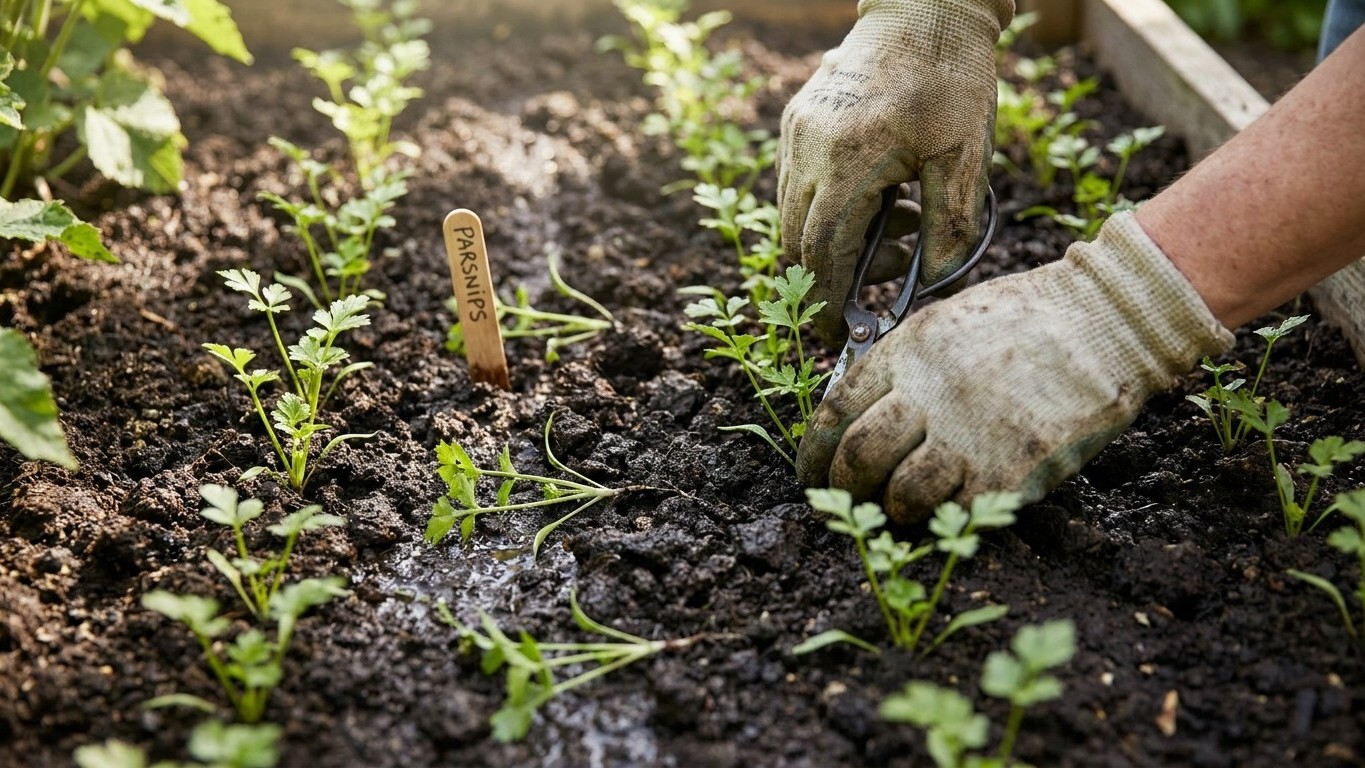

Thin parsnip seedlings down to one plant every three to six inches, with rows spaced twelve to eighteen inches apart, according to Utah State University Extension. That gap gives each root the room it needs to swell straight and thick by harvest, instead of crowding its neighbors into thin, twisted shapes.
The short answer
Utah State University Extension’s guidance on parsnips is specific for a reason: 3 to 6 inches between plants, 12 to 18 inches between rows. That’s not a suggestion with wiggle room built in for style. It’s the spacing a parsnip root needs underground to reach full size without fighting its neighbor for the same patch of soil.
Parsnips are sown directly in the garden bed where they’ll grow, not started indoors and transplanted, because the taproot doesn’t tolerate being moved once it starts forming. Seed goes into loosened soil, and then the waiting starts. Germination takes 14 to 21 days, which is slow compared to most garden vegetables and catches a lot of first-time growers off guard. If nothing has come up after a week, that’s normal. Give it the full three weeks before assuming the seed failed.
Once seedlings appear and develop their first true leaves, that’s the signal to thin. Pulling or snipping the extras down to that 3 to 6 inch spacing is what determines whether the remaining roots grow into something worth harvesting or stay skinny and stunted. The lower end of that range, closer to 3 inches, tends to work for gardeners after smaller roots for quicker cooking. The wider end, closer to 6 inches, gives roots more room to bulk up.
From the day of seeding, a parsnip crop needs 100 to 120 days to reach maturity. That’s a long season, longer than most root vegetables, and it means the thinning decision made early in spring shapes a harvest that won’t happen until well into fall. Get the spacing wrong at three inches tall, and there’s no fixing it three months later.
What actually decides it
Space and root size
A parsnip root grows in almost direct proportion to how much uncontested soil volume it has. Plant seedlings too close and the roots compete below ground the same way branches compete for light above it. The result is a row of thin, pale roots that never fill out, even after the full 100 to 120 days. Thinning isn’t cosmetic tidying. It’s the single adjustment that has the biggest effect on final root size, more than fertilizer timing or watering schedule.
Row spacing works the same way in a different direction. At 12 to 18 inches between rows, there’s enough width for roots to expand sideways without hitting the row next to them, and enough space for a gardener to walk between rows to weed or check on growth without disturbing developing roots.
Forked roots: two separate causes
Parsnip growers run into forked, split roots more than almost any other problem, and it traces back to two distinct causes that shouldn’t get lumped together.
The first is soil that’s heavy or full of stones. A taproot growing straight down hits a rock, a clay clump, or compacted subsoil, and it splits around the obstruction instead of pushing through it. This is a soil preparation issue, solved before seeding ever happens, not something thinning or watering can fix afterward.
The second cause is overwatering. A parsnip root that gets more moisture than it needs can fork even in loose, stone-free soil, because uneven or excessive water changes how the root develops as it grows. These are two different mechanisms with two different fixes, and treating them as one problem means half of forked-root cases never get solved.
How to do it
- Sow parsnip seed directly into the garden bed, in loosened, stone-free soil. Parsnips don’t transplant well, so this is the only planting method.
- Wait for germination. It takes 14 to 21 days, noticeably slower than most vegetable seed, so resist the urge to re-sow too early.
- Once seedlings show their first true leaves, thin them to one plant every 3 to 6 inches, keeping rows 12 to 18 inches apart.
- Water consistently through the growing season, aiming for 1 to 2 inches per week.
- Let the crop grow undisturbed for 100 to 120 days from the original seeding date.
- Leave mature roots in the ground through a stretch of frosty weather before harvesting. The sweetening in parsnips comes from that frost exposure, not simply from living in a comfortable climate zone.
- When lifting roots, wear gloves. Parsnip foliage and sap can irritate skin, and that’s worth knowing before hands ever touch the tops.
- For short-term storage, keep roots at 32 F and 95 percent relative humidity, where they’ll hold for two to four weeks. For longer storage, pack them in moist sand in a cool cellar, where they’ll keep for several months.
- According to NC State Extension, “the fleshy sweet taproot from first-year plants is edible, either raw or baked, boiled, pureed, roasted, fried, grilled, or steamed.” That phrase “from first-year plants” matters: a parsnip left to grow a second year sends up a flower stalk, and the root turns woody and unpalatable.
What goes wrong
- Forked roots from stony or heavy ground: the taproot splits around rocks or compacted clay. Fix it before planting by working the bed deep and clearing stones, not after the crop is already growing.
- Forked roots from overwatering: too much moisture distorts root development even in clean soil. Stick to the 1 to 2 inch per week guideline rather than watering on impulse.
- Parsnip fly maggots: this pest tunnels into roots and ruins them from the inside. Keeping rows properly spaced and monitoring plants through the season makes early damage easier to spot before it spreads.
- Leaf blights: fungal disease on the foliage spreads faster in crowded, damp conditions. Proper row spacing at 12 to 18 inches improves airflow and cuts down on the moisture blights need to take hold.
- Root rots: soggy, poorly drained soil rots roots before they mature. Well-drained beds and restrained watering are the main defense.
- Yellows: a leafhopper-borne disease that stunts and discolors plants. Since it spreads through leafhopper feeding, removing affected plants promptly limits how far it travels through the row.
- Woody, bitter roots: this happens when a parsnip is left to grow a second year instead of being harvested as a first-year root. Harvest on schedule rather than leaving roots in the ground past their first season.
Common questions
Can I start parsnip seed indoors and transplant it?
No. Parsnips are grown from seed sown directly where they’ll mature, because the taproot doesn’t handle being disturbed once it starts developing.
How do I know exactly when to thin?
Wait until seedlings have their first true leaves. Since germination itself takes 14 to 21 days, thinning typically happens a few weeks after that once seedlings are established enough to handle it.
Why did my parsnip roots split into two prongs?
It’s one of two things: the root hit stony or heavy, compacted soil and forked around the obstruction, or the plant received too much water during development. Rule out soil texture first, then check your watering habits.
Do I need a specific climate zone to get sweet parsnips?
No. Sweetness comes from the roots being exposed to a stretch of frosty weather before harvest, not from gardening in any particular hardiness zone. A mild climate without frost won’t produce the same flavor, regardless of the zone.