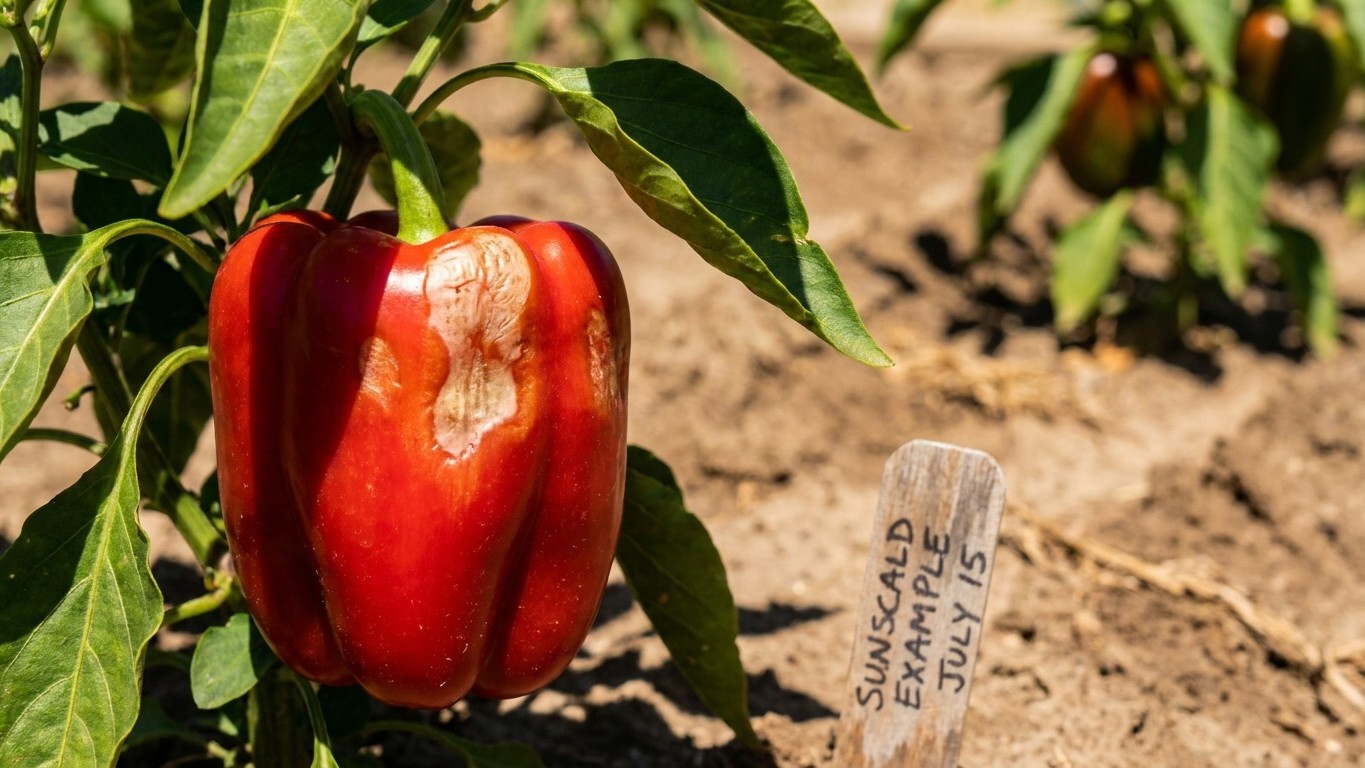

Sunscald on peppers is fixed by keeping leaves over the fruit, not by shading the whole garden bed. Utah State University Extension notes that sunscald happens when fruits are exposed to direct sunlight during hot, dry weather. The fruit isn’t damaged by sunlight in general, it’s damaged by the specific combination of bare skin, high heat, and low humidity that shows up once the canopy that normally shields it thins out.
The short answer
Utah State University Extension is the authority behind this one, and their explanation is narrower than most gardeners expect. Sunscald isn’t a fungus, a pest, or a nutrient problem. It’s a straightforward heat injury: peppers exposed to direct sun during hot, dry stretches develop pale, papery, sunken patches on the side of the fruit facing the light. The fix follows directly from the cause. If exposure to direct sun during heat is what damages the fruit, then leaf cover, the thing that normally stands between the fruit and that sun, is the fix.
This matters because gardeners often reach for the wrong tool first. A common instinct is to spray something on the fruit, add mulch, or increase watering across the board. None of that addresses the actual mechanism. Watering more won’t put leaves back over a fruit cluster that got exposed when a branch snapped in a storm or when three lower leaves were pruned off to “let air in.” The fruit needs shade from foliage, not moisture at the root, to avoid this particular injury.
Sunscald also tends to get confused with blossom-end rot, and the two look similar enough at a glance that people treat the wrong problem. Blossom-end rot shows up as a dark, sunken, often leathery spot at the blossom end of the fruit, and Utah State University Extension attributes it to a different set of conditions entirely: poor water management, excessive nitrogen, root pruning, and drought stress. That’s four separate causes, and only one of them touches water directly. Sunscald, by contrast, is purely about sun exposure landing on fruit during heat, and the remedy is canopy, not chemistry.
The practical takeaway is that the “leaf cover” answer isn’t a folk remedy or a workaround. It’s the direct inverse of the documented cause. Wherever a pepper plant loses its natural shade, whether from pruning, wind, disease, or just uneven growth, the fruit sitting in that gap becomes a candidate for sunscald the next time a hot, dry stretch rolls through.
What actually decides it
Sun and Heat Landing Directly on Fruit
The core mechanism is exposure, not ambient temperature alone. A pepper growing in full shade during a 95-degree day won’t scald. A pepper sitting in direct afternoon sun during that same hot, dry stretch will, because the fruit surface itself is absorbing radiant heat with nothing between it and the sky. Dry air makes this worse, since there’s less humidity buffering the heat load on the fruit’s skin.
Leaf Loss Is the Variable That Changes Everything
Plants don’t start the season exposed. They lose their protective canopy through specific events: aggressive pruning aimed at airflow or disease control, wind or hail stripping leaves, foliar disease causing leaf drop, or simply uneven growth that leaves gaps over a fruit cluster. Any of these can turn a well-shaded pepper into an exposed one almost overnight. The timing is what makes it dangerous. Leaf loss that happens right before or during a hot, dry stretch is far riskier than leaf loss during mild weather, because the plant doesn’t have time to regrow foliage before the fruit is sitting bare in direct sun.
Blossom-End Rot Runs on a Completely Different Track
It’s worth separating this mechanism clearly, because the two disorders get lumped together far too often. Blossom-end rot traces back to four distinct causes according to Utah State University Extension: poor water management, excessive nitrogen, root pruning, and drought stress. None of those four involve direct sun hitting the fruit. A pepper can develop blossom-end rot in full shade if its roots are stressed or its nitrogen is too high. Treating it like sunscald, by adding leaf cover, does nothing, just as treating sunscald like blossom-end rot, by adjusting fertilizer, does nothing. The fix has to match the actual mechanism at work.
How to do it
- Check the canopy after any leaf-thinning event. After a storm, a round of pruning, or a disease outbreak that caused leaf drop, walk the row and look specifically for fruit clusters that are now sitting in direct light where they weren’t before.
- Hold off on pruning during hot, dry stretches. If airflow or disease management calls for removing leaves, do it before a heat wave is forecast, not in the middle of one, so the plant has time to compensate before fruit is exposed.
- Leave the leaves nearest the fruit clusters alone. When thinning foliage, prioritize removing leaves low on the plant or deep in the interior over the ones directly shading developing fruit.
- Watch the south and west sides of the plant. Afternoon sun is more intense than morning sun, so gaps in the canopy on the side that faces the afternoon light are the highest-risk spots for scald.
- Add temporary shade over exposed clusters. If a storm or disease event has already stripped leaves and a hot, dry stretch is coming, cover the exposed fruit directly rather than trying to shade the entire plant.
- Let the plant regrow before removing more foliage. Once a canopy has thinned, give the plant time to put out new leaves over the exposed fruit before doing any further pruning nearby.
What goes wrong
- Pruning for airflow strips the exact leaves shielding fruit. Gardeners aiming to reduce fungal disease often remove leaves indiscriminately, including the ones draped over fruit clusters. The remedy is to prune selectively, targeting interior and lower leaves that don’t provide direct fruit cover, and leaving the ones closest to developing peppers in place.
- Disease-driven leaf drop leaves fruit bare right when it’s most vulnerable. A fungal or bacterial infection that causes leaves to yellow and fall can expose fruit at the same time a hot, dry spell arrives. The remedy is to address the disease early and, in the meantime, add temporary shade over any fruit that’s lost its natural cover until new foliage fills back in.
- Sunscald gets misdiagnosed as blossom-end rot, or the reverse. Both show up as damaged patches on the fruit, but sunscald appears on the sun-facing side as a pale, papery patch, while blossom-end rot appears at the blossom end as a dark, sunken spot. The remedy is to check the fruit’s blossom end and sun-facing side, and to match the fix to the right diagnosis, since blossom-end rot involves four separate causes (poor water management, excessive nitrogen, root pruning, and drought stress), not sun exposure at all.
- Storm damage strips leaves right before a heat wave. Wind or hail can defoliate a section of the plant in minutes, and if hot, dry weather follows immediately, the newly exposed fruit has no protection. The remedy is temporary shade cloth or row cover placed directly over the affected section until the plant regrows its canopy.
- Staking or caging opens up the plant to direct sun. Some support methods pull branches outward and upward, spreading the canopy thin and exposing fruit that would otherwise sit under a natural drape of leaves. The remedy is to check how the support structure is positioning the foliage and adjust ties or cage spacing so leaves still fall over the fruit-bearing branches.
Common questions
Can sunscald damage be reversed once it appears on a pepper? No. The pale, sunken patch is permanent tissue damage. The fruit is often still edible if the affected area is cut away, but the injury itself doesn’t heal. Prevention through leaf cover is the only real intervention.
Is sunscald the same problem as blossom-end rot? No, and Utah State University Extension treats them as separate issues with separate causes. Sunscald comes from direct sun exposure during hot, dry weather. Blossom-end rot comes from poor water management, excessive nitrogen, root pruning, or drought stress, none of which involve sunlight hitting the fruit directly.
Does artificial shade cloth work as a substitute for leaf cover? It can serve the same function in a pinch, since the mechanism that matters is blocking direct sun exposure to the fruit during hot, dry weather. The most reliable approach is still keeping the plant’s own canopy intact over developing fruit whenever possible.
Which fruit on the plant is most likely to develop sunscald? Fruit sitting on the side of the plant that faces the afternoon sun, typically the south or west side, is at the highest risk, especially if that side has lost leaves to pruning, wind, or disease.