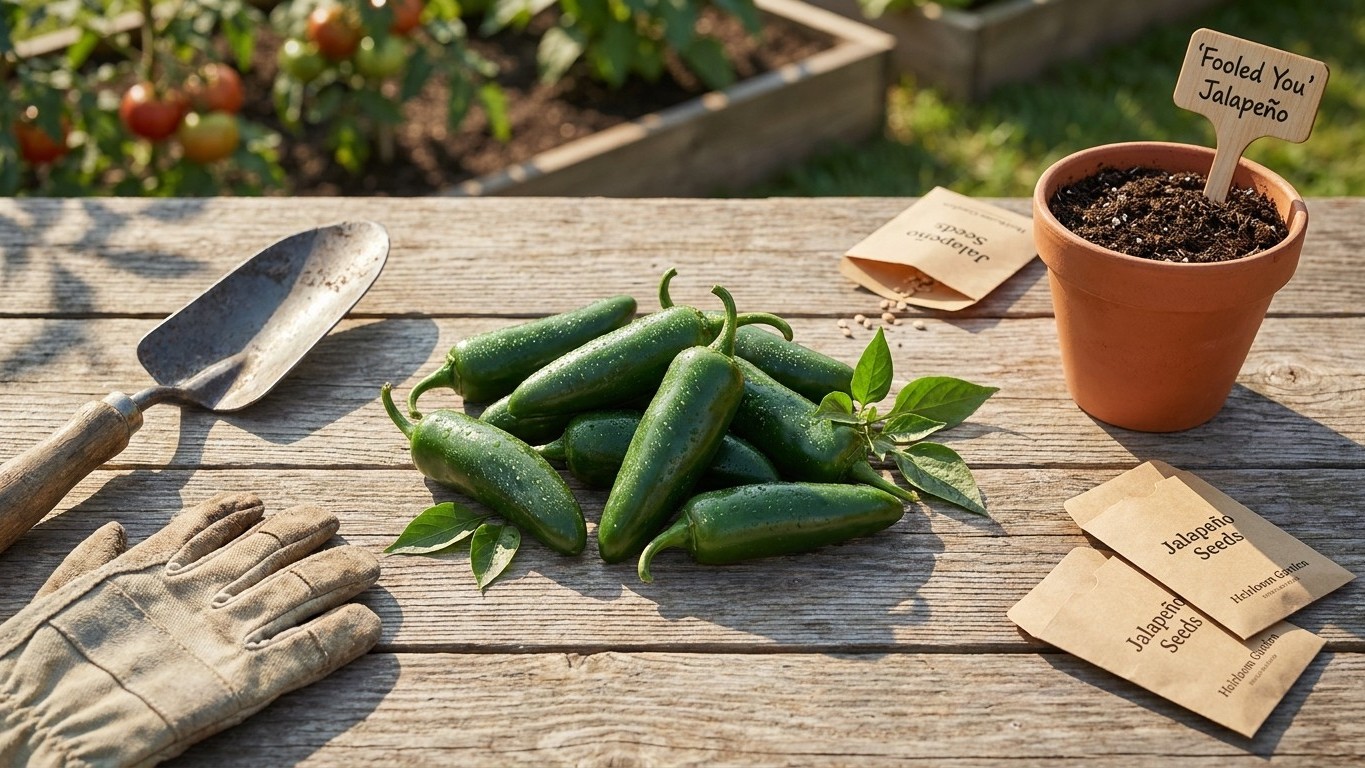

Fooled You is a jalapeño-type pepper on Clemson Cooperative Extension’s list of recommended garden varieties. That single fact settles the biggest questions before you even plant a seed: expect jalapeño-style heat, jalapeño-style fruit, and jalapeño-style care. What Clemson and NC State Extension do not publish for this specific cultivar matters just as much, and it’s worth knowing upfront so you don’t plant based on numbers nobody has actually measured.
What Kind of Pepper Is ‘Fooled You’?
The name suggests a trick, and in a way it is one: ‘Fooled You’ looks like it should carry real heat, but its classification tells a different story. Clemson Cooperative Extension lists it among recommended garden cultivars, identifying its type simply as jalapeño. That single word does more work than the cultivar name itself, because it tells you the fruit shape, the general size range, and the ballpark heat level before you read another line.
What the extension listing does not include is a days-to-maturity figure, a fruit size in inches, or a per-plant yield estimate. That’s not an oversight worth worrying about. Many cultivars on university recommendation lists get a name, a type, and little else, because the list exists to flag which varieties perform reliably in regional trials, not to replace the seed packet’s own agronomic data. A grower who knows that gap exists is better off than one who assumes a confident number that was never published.
One distinction is worth making plainly here. Ornamental pepper plants, the kind sold in fall for colorful foliage and tiny upright fruit on garden center shelves, are a different category entirely and are often not meant to be eaten. ‘Fooled You’ is not one of those. It’s an edible jalapeño-type cultivar grown for the kitchen, not for decoration, and that distinction matters every time you’re comparing pepper plants at a nursery.
How Hot Is the Fooled You Pepper, Really?
Heat is the first question most gardeners ask, and here the type answers most of it. Jalapeños sit in the moderate range of the pepper world, nowhere near a habanero and nowhere near the extremes bred for competitive heat. As a type, jalapeños run 2,500 to 8,000 Scoville units, a range wide enough to cover a mild grocery-store jalapeño and a noticeably sharper one grown in a hot, dry backyard.
No Scoville figure specific to ‘Fooled You’ has been published by either extension source, and that’s worth saying outright rather than papering over. Giving a precise number for this cultivar would suggest lab-tested data that simply doesn’t exist. What does exist, and what NC State Extension repeats for pepper cultivars generally, is a caution that applies here too: fruits are edible “but spiciness is unpredictable in intensity.”
That unpredictability isn’t random. It comes down to plant stress. Capsaicin, the compound responsible for pepper heat, tends to concentrate when a plant is pushed by drought, high heat, or uneven watering. A jalapeño-type plant coasting through a mild, well-watered summer often produces milder fruit than the same variety grown through a scorching, dry stretch with irrigation on a tight schedule. Two gardeners growing ‘Fooled You’ three states apart, in two different summers, could reasonably end up with two different heat experiences from the same seed packet.
For comparison, the far end of the pepper heat spectrum belongs to cultivars like the Carolina Reaper, which averages 1.64 million Scoville units, over 200 times hotter than the top of the jalapeño range. ‘Fooled You’ isn’t competing in that category, and nothing in the source material suggests it should be treated as anything hotter than a standard jalapeño.
Growing Fooled You Peppers: What This Variety Needs
What the extension sources confirm
Beyond its jalapeño classification and its spot on Clemson’s recommended list, the published record on ‘Fooled You’ is thin. No days-to-maturity figure is listed for this cultivar in the source material, and no note on compact growth habit, container suitability, or disease resistance is attached to it either. That’s a narrower profile than some named cultivars get, and rather than guess at numbers based on “jalapeños typically take X days,” the more honest answer is that the count isn’t published for this specific variety.
Where to actually find your timeline
The seed packet in your hand is the figure that will apply to you. Days-to-maturity varies by seed source and by the specific breeding line even within a single named cultivar, so the number printed on your packet, not a general jalapeño average pulled from elsewhere, is the one worth circling on your calendar.
One rule holds true for every pepper, ‘Fooled You’ included: this is a warm-soil crop from root to leaf. Peppers stall, sometimes for weeks, when transplanted into soil that’s still cold from spring. Soil temperature matters more than the calendar date on the wall. If you’re timing your transplant, our guide on transplanting peppers into the garden covers the soil-temperature thresholds that actually matter, and if you’re starting from seed indoors, the seed-starting guide walks through the germination window that gets plants ready before that transplant date arrives.
The Taste and Best Uses for Fooled You Peppers
Taste, like heat, follows the type here. Jalapeños are grown for fresh, bright flavor with a moderate kick, not the sweet mildness of a bell pepper or the smoky depth of a dried cayenne. That profile makes them the standard choice for fresh salsa, for stuffed and baked poppers, and for quick-pickled rings that hold their crunch in a jar for weeks in the refrigerator.
Neither Clemson Cooperative Extension nor NC State Extension attaches a cultivar-specific tasting note to ‘Fooled You’, the way some other named peppers get described with phrases like “sugary sweet flavor” or “no heat but the prolific production of a habanero pepper.” Without that kind of direct quote on record for this variety, the honest description is the type description: a jalapeño-style pepper suited to fresh eating and pickling, with the moderate, sometimes unpredictable heat that comes with the category.
That’s not a limitation so much as a useful boundary. Inventing a specific flavor note for a cultivar that hasn’t been described that way in the published record would be the kind of detail a careful reader, or a future harvest, could easily contradict.
Common questions
Is Fooled You pepper the same as a regular jalapeño?
It’s classified as a jalapeño-type cultivar by Clemson Cooperative Extension, so it shares the general fruit shape, size range, and moderate heat level associated with jalapeños as a category. No separate heat or size measurement specific to the cultivar has been published.
Why does my Fooled You pepper taste hotter some years than others?
Heat in jalapeño-type peppers responds to plant stress. Drought, high heat, and inconsistent watering all tend to concentrate capsaicin in the fruit, which is why NC State Extension describes pepper spiciness broadly as unpredictable rather than fixed.
How many days until Fooled You peppers are ready to pick?
No days-to-maturity figure for this specific cultivar appears in the extension sources. Check the seed packet you’re planting from, since that number reflects the specific seed line you have.
Can I grow Fooled You peppers in a container?
Neither source notes a compact or container-specific growth habit for this cultivar, so treat it like a standard jalapeño-type plant and size your container accordingly, with attention to warm soil temperature before transplanting.