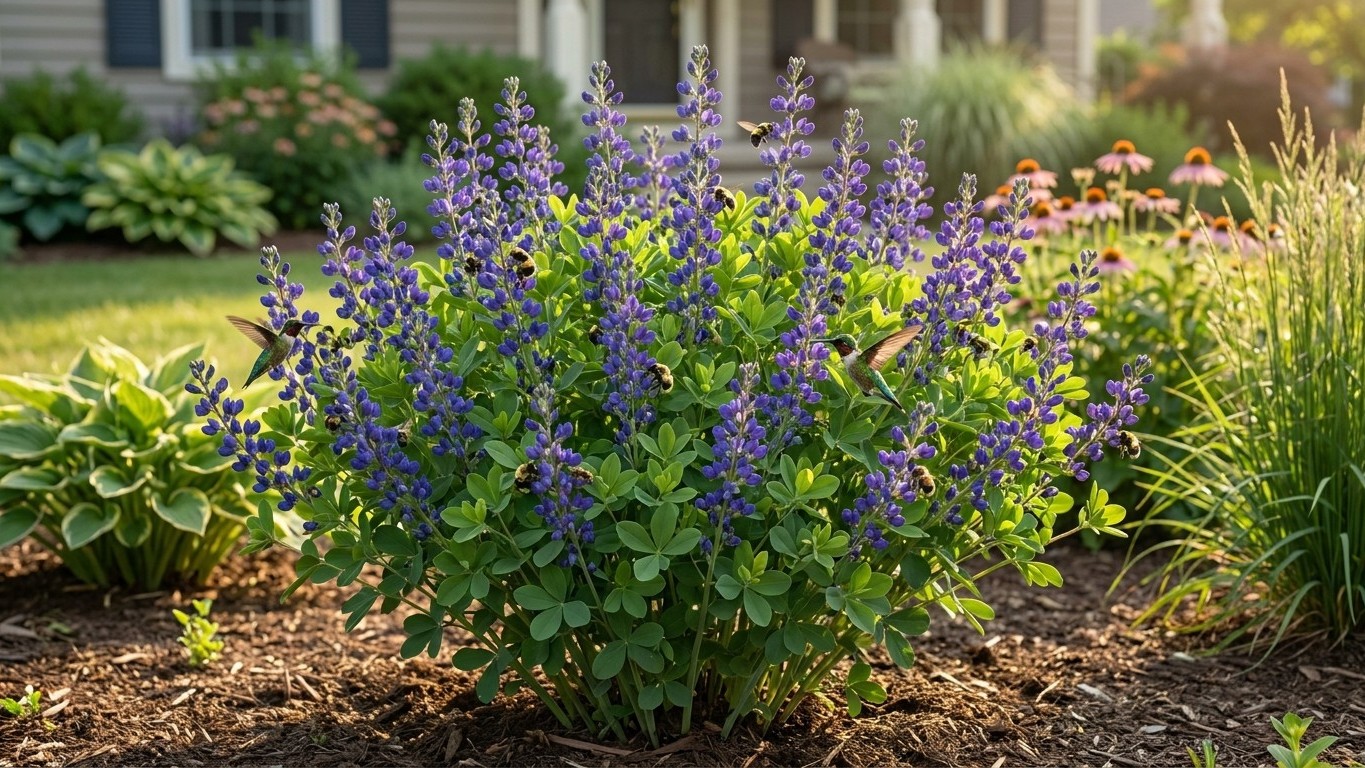

Baptisia australis survives across USDA zones 3a through 9b, holds its ground in clay soil as long as water drains away rather than sitting, and blooms through spring into summer with spikes that draw bees and hummingbirds. It asks for almost nothing once Established, but the space it needs at maturity, up to 6 feet across, is where most planting plans go wrong. Also sold as Blue False Indigo, Blue Wild Indigo, False Indigo, or Wild Indigo, it resents being moved once its taproot is down.
Where it will and will not survive

The USDA hardiness range for Baptisia australis runs from zone 3a to zone 9b. That is a wide band, but the number that matters most to a reader is what falls outside it. Below the bottom of this range, winters run too cold and too long for the plant’s root system to come back reliably in spring. Above the top of it, summer heat and the length of the warm season work against a plant that was never bred or tested to shrug them off. A range like this describes survival, not comfort, and the distinction matters: a Baptisia rated for zone 9b will likely live there, but “likely to live” and “thrives without extra fuss” are two different promises. The same caution applies at the cold end. A gardener sitting right at zone 3a should expect a plant that survives, not necessarily one that puts on the same full flush of blue spikes a milder zone would produce.
None of this is a reason to guess. Hardiness zones are assigned county by county, and two towns fifty miles apart can sit in different zones depending on elevation, wind exposure, or how close they sit to a large body of water. Rather than assuming a zone based on a state name, check the hardiness zone guide on this site for the specific number tied to your location, then compare it against the 3a-9b range above. If your zone falls inside that range, the plant is a candidate. If it falls outside, no amount of mulch or siting will reliably fix that.
The data behind this hardiness figure comes from the North Carolina Extension Gardener Plant Toolbox, and it is worth being precise about what that source does and does not cover. The USDA zone range is a national standard, built for use anywhere in the country, and it is the number cited above. But that same extension record also carries regional notes specific to North Carolina’s own growing regions, the kind of guidance that assumes a Piedmont clay soil or a Coastal Plain water table. That regional detail does not travel. A reader in a different part of the country should rely on the universal hardiness figure and their own local zone, not on advice written for a single state’s geography.
Light, soil and drainage
The growing conditions recorded for Baptisia australis break down cleanly into a handful of tolerances, and they are easiest to read side by side.
| Condition | What the plant tolerates |
|---|---|
| Light | Full sun (6+ hours direct) or partial shade (2-6 hours direct) |
| Soil texture | Clay |
| Soil pH | Acid, below 6.0 |
| Drainage | Good drainage; also tolerates occasionally wet soil |
That last row deserves more attention than it usually gets. For a perennial that is expected to live in the same spot for years, winter drainage decides survival more often than winter cold does. A plant rated hardy to zone 3a can still die in a zone 6 backyard if its crown sits in saturated soil through a thaw-freeze cycle in January. Cold alone rarely kills an established root system this size; standing water around that same root system, repeated over several winters, does. The good news here is that Baptisia’s tolerance for occasionally wet soil gives it more margin than many perennials get, but “occasionally wet” is not the same as a low spot that stays soggy for weeks after every rain.
There is a simple way to check before planting. Dig a hole about a foot deep in the spot you’re considering, fill it with water, and come back in an hour. If the water is gone, drainage is workable. If it’s still standing after several hours, that location is a poor match regardless of how sunny it is or how well the clay soil otherwise fits the plant’s texture tolerance. Acidic soil below pH 6.0 is the other box to check, and a basic soil test, available through most state extension offices, will tell you where you stand without guesswork.
When it flowers and how long
Bloom time for Baptisia australis runs from spring into summer, rather than a single fixed month. Exactly when the spikes open in your yard depends on latitude and elevation as much as on the calendar, so treat this as a season-long window rather than a date to circle. The flower spikes themselves rise well above the foliage, and that height is part of what makes the plant useful as a backdrop for shorter perennials that bloom later in the season.
Deadheading has limited effect on Baptisia compared to plants bred for repeat flowering. Once the main bloom period ends, cutting spent spikes will tidy the plant’s appearance but will not push out a second flush. What it does change is the seed pod display: removing spent flowers early means fewer of the puffy, inflated pods that follow. Those pods are worth leaving on the plant for most gardeners. They fill with seeds, ripen to a deep black, grow up to 2.5 inches long, and hold real ornamental interest into late summer, whether left standing in the garden or cut with stem attached for a dried arrangement.
Out of flower, which is most of the year, Baptisia reads as a rounded shrub of blue-green, clover-like foliage, dense enough to hold its shape without staking. That foliage is the reason the plant earns a spot in a perennial border even in the months it isn’t blooming, and it’s worth planning around rather than treating the plant as decorative only during its flowering window. The bees, butterflies, hummingbirds, and other pollinators the flowers attract are drawn by the bloom itself, and that traffic drops off once the spikes fade for the season, whatever else the plant is doing at the time.
Planting, and dividing it later
Getting Baptisia into the ground correctly matters more than usual, since a mature clump does not transplant easily once its taproot has developed.
- Plant in spring or fall, when temperatures are mild and rainfall is more dependable than in the heat of summer.
- Space plants according to their mature size, 12 inches to 3 feet for the smaller end of the range and 3 feet to 6 feet for plants given full room to spread; crowding here is the single most common and most expensive planting mistake.
- Set the crown, where roots meet stem, level with the surrounding soil grade, not buried under an inch of extra soil or mulch.
- Water consistently through the first growing season while the root system establishes; after that, established plants need far less supplemental water.
- Mulch around the base to conserve moisture and suppress weeds, but keep mulch pulled back from direct contact with the crown itself.
What separates a perennial like this from a shrub or tree is that it will eventually need dividing, and the plant tells you when rather than working on a fixed schedule. Watch for a clump that has developed a bare, unproductive center while growth continues only around the outer edge, a noticeable drop in the number of flower spikes compared to previous years, or a footprint that has simply outgrown the space it was given. Any one of those is a sign it’s time, regardless of how many years have passed since planting.
- Dig around the entire clump generously, since Baptisia develops a substantial taproot that does not tolerate rough handling.
- Lift the whole root mass rather than trying to work sections out from the side.
- Use a sharp spade to divide the clump into sections, each with healthy roots and visible growth points attached.
- Replant divisions promptly, at the same depth as the original crown, before the exposed roots dry out.
- Water the new divisions in thoroughly and keep them consistently moist Through Their First season, just as with new plantings.
What it resists, and what it does not
Resistance in a plant record means a tendency, not a guarantee. A plant listed as resistant to a given pressure will usually be left alone or shrug off damage more readily than a susceptible species, but “resistant” is never the same promise as “immune,” and drought resistance in particular applies to plants that are already established, not to something planted a few months earlier.
For Baptisia australis, the North Carolina Extension source lists a full set of resistance categories, but it does not assign a specific rating to any of them for this species. That is worth stating plainly rather than glossing over.
| Category | Rating in the source record |
|---|---|
| Deer | Not specified |
| Fire | Not specified |
| Drought | Not specified |
| Erosion | Not specified |
| Rabbits | Not specified |
| Diseases | Not specified |
| Dry Soil | Not specified |
| Poor Soil | Not specified |
| Insect Pests | Not specified |
The two categories that usually matter most to a homeowner planting perennials, deer and wet soil, deserve a direct answer here rather than a guess dressed up as one. Deer resistance is not specified in this record, so it should not be assumed either way; a gardener in an area with heavy deer pressure should treat this as an open question rather than a settled advantage. Wet soil is better documented: the growing conditions listed above confirm the plant tolerates occasionally wet ground in addition to well-drained soil, which is a real and useful piece of information, distinct from the unspecified resistance categories in the table.
Maintenance is rated low, and in practical terms that means one seasonal cutback rather than ongoing attention. Low maintenance does not mean no maintenance: expect to cut the plant back once its foliage fades for the season, and to divide it eventually as the signs above indicate, but not much beyond that in a typical year.
Common questions
Can Baptisia australis be moved once it’s established?
It’s possible but harder than with most perennials, because of the deep taproot it develops over time. Digging generously around the entire root mass and moving it promptly, without letting roots dry out, gives the best chance of success.
Does Baptisia australis need staking?
The foliage forms a dense, rounded shrub shape sturdy enough to hold itself upright without support in most conditions, which is part of why it works well as a structural element in a perennial bed.
Why didn’t my Baptisia flower this year?
A drop in flowering is one of the signs a clump has outgrown its space or developed a bare center, both indications that it’s due for division rather than a sign of a care mistake.
Is the term “wild indigo” specific to this plant?
It’s one of several common names in use, alongside Blue False Indigo, Blue Wild Indigo, and False Indigo. None of these names is officially primary, and common names can overlap across different species, so the botanical name Baptisia australis is the reliable identifier.