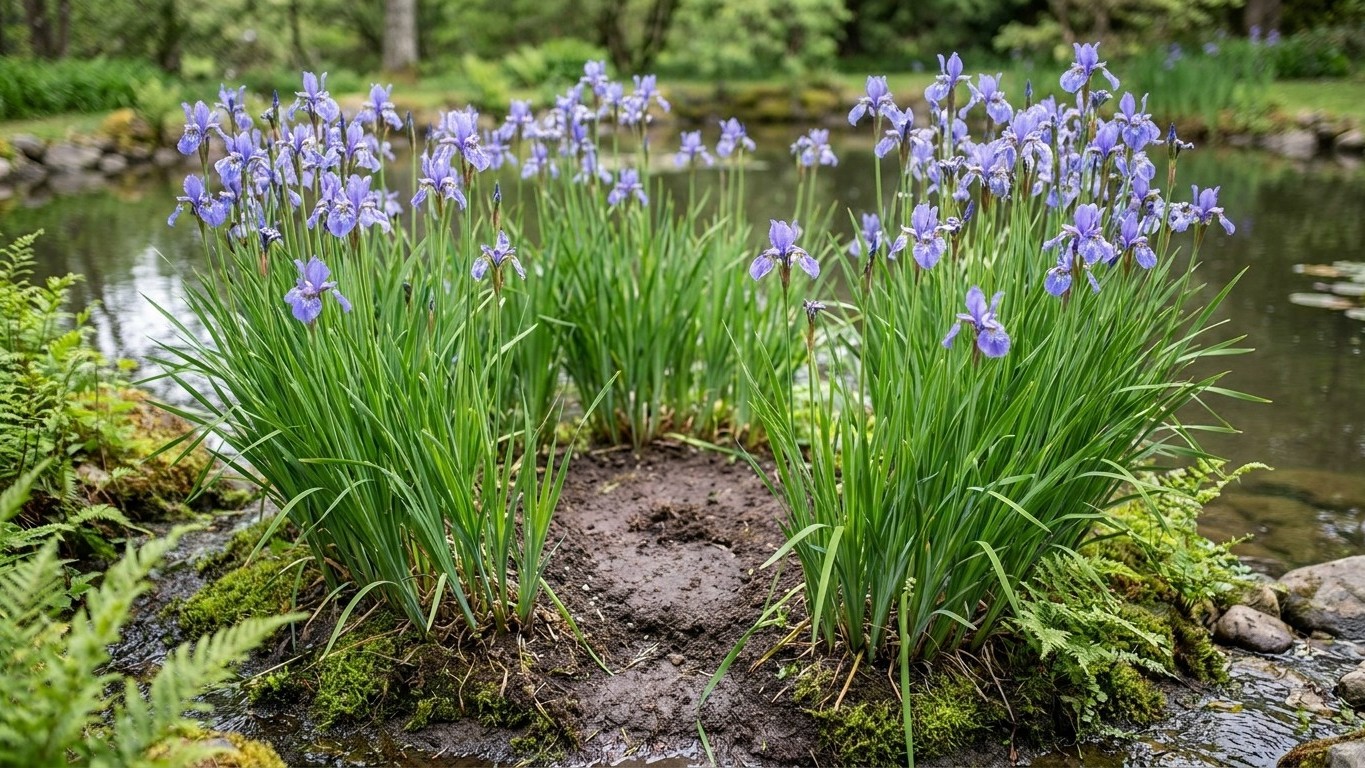

Siberian iris survives across USDA zones 3a through 8b, tolerates clay and occasionally wet ground, and needs dividing only when the clump develops a bare, flowerless center, not on a fixed yearly schedule. It’s a clumping, arching perennial that comes back reliably from a rhizome (not a true bulb, despite one label the source uses), blooms in spring into summer, and asks for little beyond an annual cutback. That combination of cold tolerance and wet-soil tolerance is unusual among perennials, which is why it shows up so often near ponds and low spots where other plants rot out.
Where it will and will not survive

The plant most people call Siberian iris, and some call Siberian Flag, is rated hardy across USDA zones 3a through 8b. That’s a wide range as perennials go, but it still draws a hard line. Below the bottom of that range, a Siberian iris planted in the ground has no reliable protection against winter kill, no matter how good the drainage or how thick the mulch. Above the top of it, the plant may survive the winter without trouble but struggle through a long hot season it wasn’t built for.
That second point matters more than most plant tags let on. A hardiness range describes survival, not comfort. A Siberian iris rated to the warm edge of its range, zone 8b, isn’t necessarily happy there through a full summer, it will likely persist, but bloom and vigor can lag behind what the same plant does in a cooler zone closer to the middle of its range. Treat the upper number as a ceiling for survival, not a promise of good performance.
Don’t guess at your own zone from a regional label or a neighbor’s experience. Zones shift by county, and sometimes by elevation within the same county. Check your specific zone against a current map before deciding whether this plant belongs in your yard; our hardiness zone guide breaks the ranges down by state so you can confirm where you fall rather than assume it.
One more note on sourcing here matters. The hardiness range itself, 3a through 8b, is the universal USDA figure, it applies wherever you garden. Any regional planting advice tied specifically to North Carolina’s coastal plain, piedmont, or mountains is not part of that universal figure and shouldn’t be read as advice for a different state. The zone number travels. The regional commentary doesn’t.
Light, soil and drainage
Siberian iris is flexible on light and soil texture but has real preferences on moisture, and that’s the detail worth reading closely before you pick a spot.
| Condition | Tolerance |
|---|---|
| Light | Full sun (6+ hours direct) or partial shade (2-6 hours direct) |
| Soil texture | Clay, high organic matter, loam (silt), or sand |
| Soil pH | Acid (below 6.0) or neutral (6.0-8.0) |
| Drainage | Good drainage, moist, or occasionally wet |
Notice that drainage tolerance stretches from good drainage all the way to occasionally wet, which is broader than most perennials get. For a plant like this, winter drainage decides survival more often than cold does. A Siberian iris rated hardy to zone 3a can still rot out in a spot that stays saturated and cold through a long winter, well before the cold itself becomes the problem. Standing water at the crown in December and January is a far more common cause of death than a hard freeze.
Before you plant, run a simple check on your own soil. Dig a hole about a foot deep and a foot wide, fill it with water, and time how long it takes to drain. A spot that clears in a few hours is fine for the “good drainage” end of this plant’s range. A spot that’s still holding water after half a day is closer to “occasionally wet,” which this iris can handle, but it’s worth confirming that’s actually the tolerance you’re planting into rather than a guess. If the hole barely drains at all after a full day, you’re looking at standing water rather than occasional wetness, and that’s a different situation than the plant is rated for.
Soil texture is genuinely not a limiting factor here. Clay, sand, loam, and soil high in organic matter are all listed as acceptable, which takes one variable off the table for most home landscapes. pH is similarly forgiving across the acid-to-neutral range most yards fall into. Drainage is the one condition worth actually testing rather than assuming.
When it flowers and how long
Siberian iris blooms in spring into summer, with the exact timing shifting depending on your latitude and elevation rather than falling on a fixed calendar date. Gardeners at lower latitudes or lower elevations tend to see bloom start earlier in the season; those further north or higher up see it arrive later. There’s no single month to circle on a calendar nationwide.
Deadheading spent flower stalks keeps the clump looking tidy but doesn’t meaningfully extend the bloom window on this plant the way it does on some repeat-blooming perennials. What it does help with is appearance: removing the spent stalks stops the plant from putting energy into seed production and keeps the clump from looking ragged while the foliage carries on for the rest of the season.
Cutting back is a separate task from deadheading, and it matters more for how the plant looks the other ten or eleven months of the year. The foliage is deciduous, arching, and clumping, forming an erect grassy mound that holds its shape well after the flowers are gone. Most gardeners leave that foliage standing through fall and into winter for structure, then cut it back close to the ground in late winter or early spring before new growth starts. Out of flower, this is a foliage plant, and a fairly attractive one, which is worth remembering since flowering is a small fraction of the year compared to the months of just the grassy clump.
The flowers themselves attract bees, butterflies, and pollinators generally, according to the source data. That’s a property of the bloom specifically, not the plant year-round. Once flowering ends for the season, so does that pollinator traffic, even though the clump itself keeps its structure and green color for months afterward.
Planting, and dividing it later
Getting a Siberian iris established correctly upfront saves work later. The steps in order:
- Plant in spring or fall, when temperatures are moderate and the plant isn’t stressed by heat or hard freezes.
- Space plants based on mature size, which runs from 12 inches to 3 feet depending on conditions, so allow enough room for a full clump rather than a single spring stem.
- Set the crown at grade, level with the surrounding soil, rather than burying it deep or leaving it exposed above the soil line.
- Water regularly through the first growing season while roots establish, then rely on natural rainfall and the plant’s own drainage tolerance afterward.
- Mulch around the clump to conserve moisture, keeping mulch pulled back from the crown itself so it doesn’t stay wet and encourage rot.
One classification note worth flagging: the source lists this plant under several overlapping labels, including “Bulb” alongside “Herbaceous Perennial” and “Perennial.” Siberian iris actually grows from a rhizome, a thickened underground stem, rather than a true bulb. That’s a small contradiction in how the source categorizes it, and it’s worth knowing rather than assuming the “bulb” label is literal.
Growth rate is listed as rapid, and that rapid clumping habit is exactly why division eventually becomes necessary. Unlike a shrub, this plant doesn’t just sit in place year after year, it spreads outward from the center, and that center is where trouble starts. Watch for these signs that a clump needs dividing:
- A bare, hollow-looking center with green growth only around the outer edge of the clump.
- Noticeably fewer flowers than in previous seasons, even though the clump looks larger overall.
- A clump that has physically outgrown its space, crowding neighboring plants or spilling past its bed line.
When any of those signs show up, dig the entire clump in early spring or fall, split it into sections with a sharp spade or knife so each division has healthy roots and at least a few growing points, and replant the divisions at the same depth as before, spaced according to the same 12-inch to 3-foot guideline used for new plantings.
What it resists, and what it does not
Resistance, on any plant tag, means a tendency to be left alone or to bounce back, not a guarantee of immunity. A “deer resistant” plant can still get nibbled, especially by a hungry or inexperienced animal, and a “drought resistant” plant means an established one with a developed root system, not a plant still settling in during its first season.
For Siberian iris specifically, the source data doesn’t assign a resistance rating one way or the other for the traits usually listed on a plant profile:
| Trait | Rating in the source |
|---|---|
| Deer | Unspecified |
| Rabbits | Unspecified |
| Drought | Unspecified |
| Wet soil | Unspecified |
| Poor soil | Unspecified |
| Diseases | Unspecified |
| Insect pests | Unspecified |
| Black walnut | Unspecified |
That’s a meaningful gap, not a data entry error, and worth being upfront about rather than glossing over. An unspecified rating isn’t the same as a documented “no” for resistance, but it also isn’t a confirmed “yes.” The two traits that matter most for a perennial in most yards, deer browsing and tolerance of wet soil, simply aren’t rated here one way or the other by this particular source, even though the growing conditions data separately confirms this plant tolerates occasionally wet ground.
Maintenance is listed as low, which in practical terms means the plant doesn’t need staking, frequent feeding, or pest treatments as a matter of routine. It still needs an annual cutback of old foliage, occasional division once the clump shows the signs described above, and a first season of regular watering while it establishes. Low maintenance describes the yearly time commitment relative to other perennials, not zero effort.
One more note that doesn’t fit neatly into resistance but matters if pets or kids are around the bed: the source states plainly that the rhizomes are not edible.
Common questions
Is Siberian iris the same as bearded iris? No. They’re different iris species with different growth habits and different tolerances for wet soil; this article covers Siberian iris specifically, not bearded types.
Can Siberian iris grow in a pot? The growing conditions data here describes garden bed conditions, not container culture, so container performance isn’t addressed by this source.
Does it need staking? The habit is described as arching, clumping, and erect, and maintenance is rated low, which suggests the plant holds its own structure without support under normal conditions.
Will it spread aggressively into lawn or beds nearby? Growth rate is listed as rapid and the plant clumps outward from the center, which is exactly why it eventually needs dividing rather than being left indefinitely in the same spot.