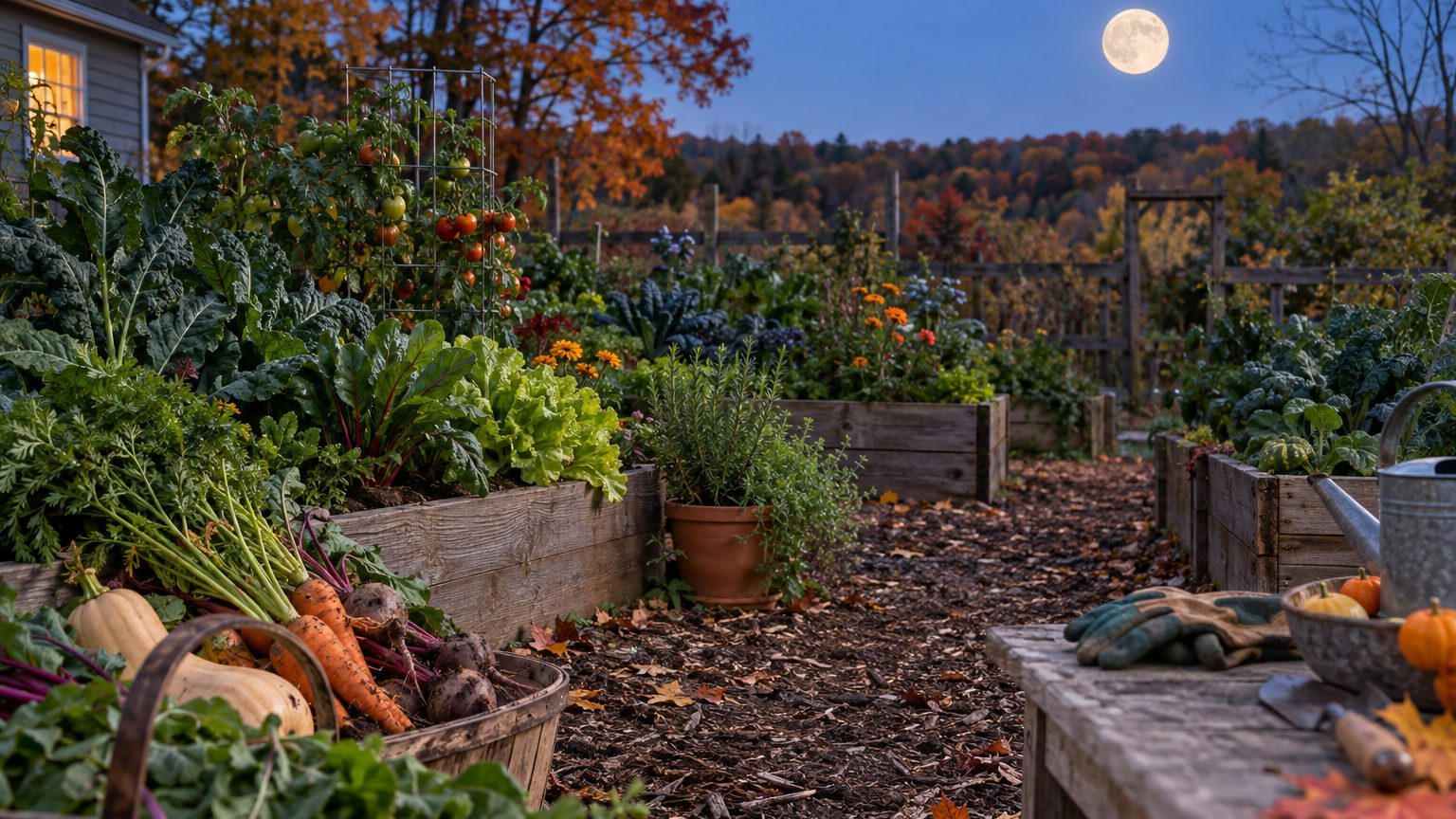

Planting by the Moon in 2026 follows an old almanac practice. Gardeners match each task to the Moon’s phase and, in some almanacs, to the zodiac sign the Moon is passing through. Thirteen full moons fall in 2026, including a Blue Moon on May 31, and every phase below is in Eastern time. The rules attached to those phases are tradition, so read the dates as a calendar, not a forecast.
Planting by the moon in 2026: the year at a glance
This is the 2026 overview. It lists every new moon, first quarter, full moon and last quarter of the year in Eastern time (ET), the traditional name of each full moon, and a way into the day-by-day calendar for October 2026. Later sections cover the full moons, a three-step way to use the calendar, and a short FAQ.
The quarter rule
According to almanac tradition, the lunar cycle is cut into four quarters, and each quarter has its own kind of garden task. In the first quarter (new moon to first quarter), the tradition names leafy crops that bear above ground, such as lettuce, spinach, cabbage, broccoli and celery. The second quarter (first quarter to full moon) belongs to above-ground crops that bear seed inside the fruit: tomatoes, peppers, beans, squash and corn. The third (full moon to last quarter) is for root crops, bulbs and perennials, meaning potatoes, carrots, garlic, onions and beets. The fourth (last quarter to new moon) is a rest period for weeding, pruning, turning the soil and composting.
All four phases, month by month
Every date and time below is Eastern time. Months are listed in calendar order, and within a row the phases are sorted by type, not by date.
| Month | New moon | First quarter | Full moon | Last quarter |
|---|---|---|---|---|
| January | Jan 18, 2:51 p.m. | Jan 25, 11:47 p.m. | Jan 3, 5:02 a.m. | Jan 10, 10:48 a.m. |
| February | Feb 17, 7:01 a.m. | Feb 24, 7:27 a.m. | Feb 1, 5:09 p.m. | Feb 9, 7:43 a.m. |
| March | Mar 18, 9:23 p.m. | Mar 25, 3:17 p.m. | Mar 3, 6:37 a.m. | Mar 11, 5:38 a.m. |
| April | Apr 17, 7:51 a.m. | Apr 23, 10:31 p.m. | Apr 1, 10:11 p.m. | Apr 10, 12:51 a.m. |
| May | May 16, 4:01 p.m. | May 23, 7:10 a.m. | May 1, 1:23 p.m. and May 31, 4:45 a.m. | May 9, 5:10 p.m. |
| June | Jun 14, 10:54 p.m. | Jun 21, 5:55 p.m. | Jun 29, 7:56 p.m. | Jun 8, 6:00 a.m. |
| July | Jul 14, 5:43 a.m. | Jul 21, 7:05 a.m. | Jul 29, 10:35 a.m. | Jul 7, 3:28 p.m. |
| August | Aug 12, 1:36 p.m. | Aug 19, 10:46 p.m. | Aug 28, 12:18 a.m. | Aug 5, 10:21 p.m. |
| September | Sep 10, 11:26 p.m. | Sep 18, 4:43 p.m. | Sep 26, 12:49 p.m. | Sep 4, 3:51 a.m. |
| October | Oct 10, 11:50 a.m. | Oct 18, 12:12 p.m. | Oct 26, 12:11 a.m. | Oct 3, 9:25 a.m. |
| November | Nov 9, 2:02 a.m. | Nov 17, 6:47 a.m. | Nov 24, 9:53 a.m. | Nov 1, 3:28 p.m. |
| December | Dec 8, 7:51 p.m. | Dec 17, 12:42 a.m. | Dec 23, 8:28 p.m. | Dec 1, 1:08 a.m. and Dec 30, 1:59 p.m. |
Read each row against the quarter rule. In January, the full moon on January 3 opens the third quarter, which runs to the last quarter on January 10. The fourth quarter then runs to the new moon on January 18, and the first quarter starts there. Two cells hold a pair of dates. May has full moons on May 1 and May 31, and December has last quarters on December 1 and December 30.
The sign layer
Some almanacs add a second filter, the sign the Moon occupies. This convention labels Cancer, Scorpio and Pisces fruitful. It labels Taurus, Libra and Capricorn semi-fruitful, and Aries, Gemini, Leo, Virgo, Sagittarius and Aquarius barren, although sources differ on Virgo, Sagittarius and Aquarius. These labels are the almanac’s own vocabulary. The table above covers phases only and does not give the sign for any day.
Biodynamic gardening, following Maria Thun, sorts the same signs into four day types instead:
- Root days: Taurus, Virgo, Capricorn
- Flower days: Gemini, Libra, Aquarius
- Leaf days: Cancer, Scorpio, Pisces
- Fruit days: Aries, Leo, Sagittarius
The full moons of 2026
Thirteen full moons fall in 2026, one more than the twelve months suggest. The extra one comes in May, and the table gives each with its traditional name.
| Month | Date and time (ET) | Traditional name |
|---|---|---|
| January | January 3, 5:02 a.m. ET | Wolf Moon |
| February | February 1, 5:09 p.m. ET | Snow Moon |
| March | March 3, 6:37 a.m. ET | Worm Moon |
| April | April 1, 10:11 p.m. ET | Pink Moon |
| May | May 1, 1:23 p.m. ET | Flower Moon |
| May | May 31, 4:45 a.m. ET | Flower Moon (Blue Moon) |
| June | June 29, 7:56 p.m. ET | Strawberry Moon |
| July | July 29, 10:35 a.m. ET | Buck Moon |
| August | August 28, 12:18 a.m. ET | Sturgeon Moon |
| September | September 26, 12:49 p.m. ET | Harvest Moon |
| October | October 26, 12:11 a.m. ET | Hunter’s Moon |
| November | November 24, 9:53 a.m. ET | Beaver Moon |
| December | December 23, 8:28 p.m. ET | Cold Moon |
The Harvest Moon is the full moon nearest the September equinox. In 2026 the equinox arrives on September 22 at 8:05 p.m. ET, so the Harvest Moon is the September 26 full moon at 12:49 p.m. ET. The other seasonal markers sit alongside the phases: the March equinox on March 20 at 10:45 a.m. ET, the June solstice on June 21 at 4:24 a.m. ET and the December solstice on December 21 at 3:50 p.m. ET.
The May 31 full moon earns its Blue Moon label because it is the second full moon in one calendar month. It keeps the Flower Moon name. For the origin of each name and how the names are assigned, see the full moon names guide. A fuller version of this list, with its own focus on the lunar dates, lives in the full moon calendar 2026.
How to use this calendar
The Moon comes last in the planning order, not first. Three steps keep the sequence straight:
- Check your state’s planting calendar first. Look up the planting season for the crop where you live, including the frost dates and soil temperature guidance in your state’s own guide. The Moon never overrides the calendar of the place. If your state’s guide says a crop is not ready to go in, no phase changes that. If you follow the Moon at all, it only chooses among days that are already open.
- Pick the days inside that season that match the tradition for your crop type. Leafy crops belong to the first quarter, above-ground crops that bear seed inside the fruit to the second, and root crops, bulbs and perennials to the third. The fourth quarter is kept for weeding, pruning, turning soil and composting. Gardeners who also follow signs narrow the choice further, for instance a third-quarter day that Maria Thun’s system calls a root day.
- Keep a note. Write down the date, the crop, the quarter, the sign if you use one, and what the weather did. After a season or two you have your own record to compare against the calendar.
One caution belongs here, and it applies to every rule on this page. No effect of the Moon’s phase or sign on germination or yield has been established. Planting by the Moon is a custom that many gardeners keep for its rhythm, and nobody should expect a guaranteed result from it.
The wider guide to planting by the moon covers the practice in general. Day-by-day pages hold the detail for individual months, and the next section links to them.
Month by month
Each monthly page is a day-by-day calendar for one month of 2026. The one currently linked is below, with the phase that opens and closes the month.
- October 2026: opens with the last quarter on October 3, 9:25 a.m. ET, and closes with the Hunter’s Moon on October 26, 12:11 a.m. ET.
October shows how the quarters line up inside a single month. From the last quarter on October 3 to the new moon on October 10 at 11:50 a.m. ET, tradition places the rest period. The first quarter then runs from the new moon to October 18 at 12:12 p.m. ET. The second quarter ends at the full moon on October 26, and the third quarter starts there.
Other months follow the same arc but start and stop on different phases. January opens with a full moon on January 3 and closes with the first quarter on January 25. May opens with a full moon on May 1 and closes with the Blue Moon on May 31. December opens with the last quarter on December 1 at 1:08 a.m. ET and closes with another last quarter on December 30 at 1:59 p.m. ET. The overview table above gives the exact times for every month.
Looking ahead, the 2027 calendar carries the same layout into next year.
Questions about the 2026 calendar
When is the first full moon of 2026?
The first full moon of 2026 falls on January 3 at 5:02 a.m. ET, and it is the Wolf Moon. The Snow Moon follows on February 1 at 5:09 p.m. ET.
Which month has two full moons?
May does. The first full moon arrives on May 1 at 1:23 p.m. ET and the second on May 31 at 4:45 a.m. ET. Both carry the Flower Moon name, and the second is the Blue Moon, the name for a second full moon within one calendar month.
Do the dates change by time zone?
They do, because every time on this page is Eastern time. A reader in the Pacific zone subtracts three hours. The October 26 full moon at 12:11 a.m. ET becomes October 25 at 9:11 p.m. Pacific, so it lands on the previous calendar day. Readers in other zones adjust by their own difference from Eastern time. Dates can shift by a day near midnight, which matters if a tradition tied to one date is part of your plan.