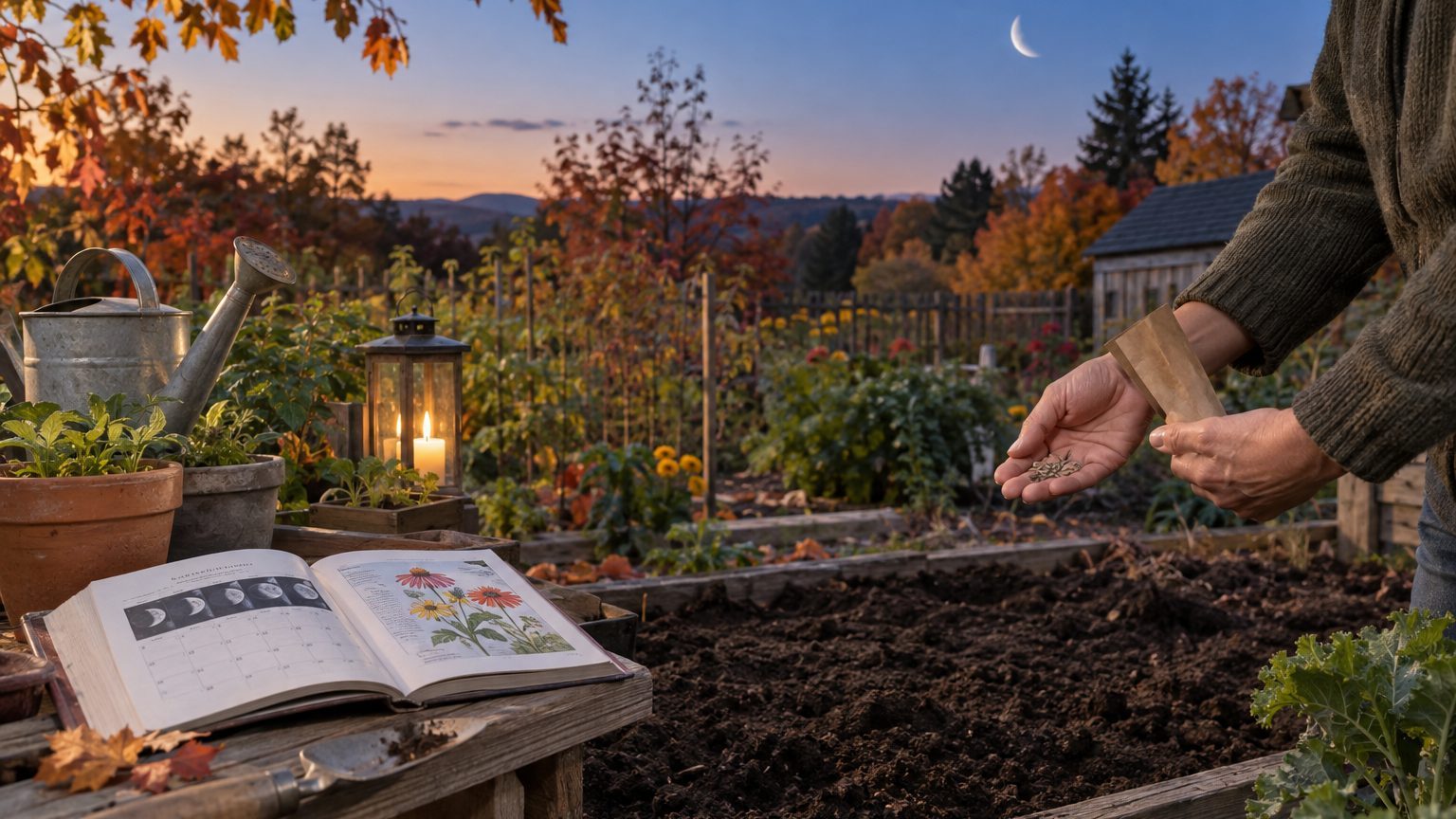

Planting when the Moon is in Aquarius falls, according to almanac tradition, on a barren day. Almanacs that follow moon sign gardening label Aquarius barren, and the biodynamic calendar calls it a flower day. Neither label is proven to affect a crop. The next time the Moon enters Aquarius is October 18, 9:39 p.m. ET.
What the tradition says about the Moon in Aquarius
The almanac label: barren
Moon-sign almanacs sort the twelve signs into classes. This convention labels Cancer, Scorpio and Pisces fruitful, and Taurus, Libra and Capricorn semi-fruitful. Aries, Gemini, Leo, Virgo, Sagittarius and Aquarius are labeled barren. Sources disagree on Virgo, Sagittarius and Aquarius, so one almanac may class Aquarius differently from another. Check which convention yours follows before you compare dates with a friend’s.
“Barren” is a label in a table, not a property of the sign. It says nothing about the sky itself. It is simply the word the convention attaches to six of the twelve signs.
The biodynamic label: flower day
The biodynamic calendar associated with Maria Thun uses a different grouping. It sorts the signs into four types of day, three signs each:
- Root days: Taurus, Virgo, Capricorn
- Flower days: Gemini, Libra, Aquarius
- Leaf days: Cancer, Scorpio, Pisces
- Fruit days: Aries, Leo, Sagittarius
The two systems do not line up. Libra is semi-fruitful in the almanac convention but a flower day in the biodynamic one. Aquarius is barren in one and a flower day in the other, which is why the same date can read as “hold back” in one calendar and “flowers” in the other.
Jobs and crops the tradition gives this sign
Under the barren label, the almanac custom is to steer sowing toward other signs and to give the day to upkeep. That means weeding, pruning, turning the soil and composting, the same jobs almanacs attach to the fourth quarter of the lunar cycle. Gardeners who plant by the Moon often treat a barren day as a day for clearing and tidying rather than for putting seed in the ground.
Under the flower-day label, the biodynamic tradition points the day toward flowers. In that tradition, Aquarius is a traditional day for sowing and tending ornamental flowers. Food crops are not what this label is about.
A gardener who uses both systems will notice the pull in two directions. One says to hold back on sowing, the other says to work with flowers. Practitioners resolve this in different ways, and no rule settles it for everyone.
The effect of the Moon’s sign on germination or yield is not proven. Everything above is a custom passed down through almanacs, and you are free to use it, adapt it or ignore it.
When the Moon is in Aquarius next
The Moon moves through all twelve signs in a bit under a month, so it returns to Aquarius about once a month. These are the next three entries:
| Date | Moon enters Aquarius (ET) |
|---|---|
| October 18 | 9:39 p.m. ET |
| November 15 | 4:24 a.m. ET |
| December 12 | 11:05 a.m. ET |
The Moon stays in a sign for about two and a half days. Each Aquarius window therefore opens at the time listed and runs a little over two days past it. Because the entries fall at different hours, the October window begins late in the evening, while the November and December windows begin in the morning. Anyone in a Western time zone should subtract the right number of hours, since every time here is Eastern.
One point deserves plain words. The Moon never overrides the calendar of your place. Frost dates and soil temperature decide whether a crop can go in the ground at all. If you follow the Moon, it only picks among days that your local conditions already allow. Your state’s planting guide is where those dates live, and nothing on this page replaces it.
The sign and the phase together
Almanacs rarely use the sign alone. The usual structure has two layers. The phase sets the type of crop, and the sign refines the choice of day. According to almanac tradition, the four quarters break down like this:
- First quarter (new moon to first quarter): leafy crops that bear above ground, such as lettuce, spinach, cabbage, broccoli and celery
- Second quarter (first quarter to full moon): above-ground crops that bear seed inside the fruit, such as tomatoes, peppers, beans, squash and corn
- Third quarter (full moon to last quarter): root crops, bulbs and perennials, such as potatoes, carrots, garlic, onions and beets
- Fourth quarter (last quarter to new moon): rest, meaning weeding, pruning, turning the soil and composting
The sign then acts as a second filter. The almanac rule for a root crop, for example, is the third quarter and a fruitful or semi-fruitful sign. A third-quarter day that falls in Aquarius meets the first condition and fails the second, since this convention labels Aquarius barren.
Almanacs differ on what happens in that conflict. Many treat the phase as the main rule and the sign as a refinement, so the advice is to move to another day inside the same quarter. The Moon in Capricorn offers a comparison, because Capricorn comes just before Aquarius in the Moon’s path and this convention labels it semi-fruitful. A conflicting day may therefore sit right next to a qualifying one.
For the full framework, the guide to planting by the moon covers the phases and the reasoning behind them. To see how signs and quarters line up on specific dates, the October 2026 calendar lays them out day by day.
Questions
Is Aquarius a planting sign or a resting sign?
According to almanac tradition, it is a resting sign, since this convention labels it barren. The biodynamic tradition instead calls it a flower day. The two systems disagree, and no evidence settles which one to follow.
Does a flower day mean the tradition favors flowers?
Yes, in the biodynamic calendar that is what the label means. Flower days are the traditional window for sowing and tending flowers. The calendar does not say anything about when frost has passed or when the soil is ready, so those still come from your local guidance.
What if an Aquarius window overlaps a phase I want?
Almanacs split on this. Many let the phase lead and move the job to a neighboring day in the same quarter. Others skip the job until the Moon enters a sign they label fruitful or semi-fruitful. Pick one approach and apply it the same way each time.