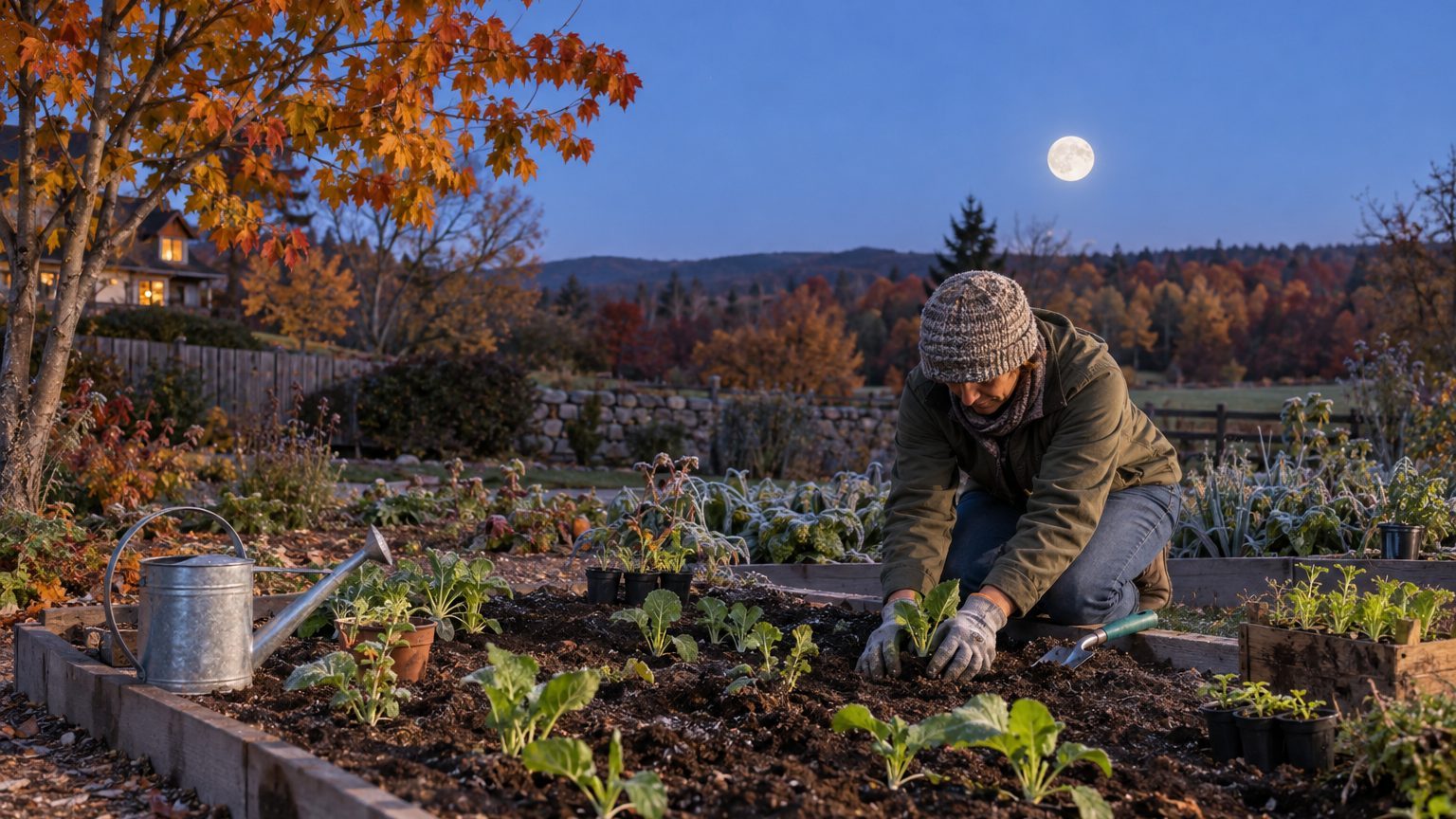

Twelve full moons fall in 2027, from the Wolf Moon on January 22 to the Cold Moon on December 13, and no month holds two of them. Gardeners who plant by the Moon sort their days by four phases and by the Moon’s zodiac sign. This page lists every phase date in Eastern time (ET). It follows almanac tradition, and the calendar of your own location still comes first.
Planting by the moon in 2027: the year at a glance
Everything below runs on Eastern time. The table gives the four principal phases of each month, the next section lists the twelve full moons with their traditional names, and the full moon calendar 2027 goes through the year day by day.
The quarter rule is the backbone of the tradition. According to almanac tradition, the lunar cycle splits into four quarters, and each quarter has its own kind of work. From new moon to first quarter, the almanac rule is leafy crops that bear above ground, such as lettuce, spinach, cabbage, broccoli and celery. From first quarter to full moon, it is above-ground crops that bear seed inside the fruit, such as tomatoes, peppers, beans, squash and corn. From full moon to last quarter, it is root crops, bulbs and perennials, such as potatoes, carrots, garlic, onions and beets. From last quarter to the next new moon, the almanac calls for rest: weeding, pruning, turning the soil and composting.
One limit applies to every date on this page. Frost dates and soil temperature decide whether a crop can go in the ground at all. The Moon, for those who follow it, only chooses among days that the local calendar already allows. Your state’s planting guide sets that calendar, and nothing here replaces it.
| Month | New moon | First quarter | Full moon | Last quarter |
|---|---|---|---|---|
| January | January 7, 3:24 p.m. | January 15, 3:34 p.m. | January 22, 7:17 a.m. | January 29, 5:55 a.m. |
| February | February 6, 10:56 a.m. | February 14, 2:58 a.m. | February 20, 6:23 p.m. | February 28, 12:16 a.m. |
| March | March 8, 4:29 a.m. | March 15, 12:25 p.m. | March 22, 6:43 a.m. | March 29, 8:53 p.m. |
| April | April 6, 7:51 p.m. | April 13, 6:56 p.m. | April 20, 6:27 p.m. | April 28, 4:17 p.m. |
| May | May 6, 6:58 a.m. | May 13, 12:43 a.m. | May 20, 6:59 a.m. | May 28, 9:57 a.m. |
| June | June 4, 3:40 p.m. | June 11, 6:56 a.m. | June 18, 8:44 p.m. | June 27, 12:54 a.m. |
| July | July 3, 11:02 p.m. | July 10, 2:39 p.m. | July 18, 11:44 a.m. | July 26, 12:54 p.m. |
| August | August 2, 6:05 a.m. and August 31, 1:41 p.m. | August 9, 12:54 a.m. | August 17, 3:28 a.m. | August 24, 10:27 p.m. |
| September | September 29, 10:36 p.m. | September 7, 2:31 p.m. | September 15, 7:03 p.m. | September 23, 6:20 a.m. |
| October | October 29, 9:36 a.m. | October 7, 7:47 a.m. | October 15, 9:47 a.m. | October 22, 1:29 p.m. |
| November | November 27, 10:24 p.m. | November 6, 4:00 a.m. | November 13, 10:25 p.m. | November 20, 7:48 p.m. |
| December | December 27, 3:12 p.m. | December 6, 12:22 a.m. | December 13, 11:08 a.m. | December 20, 4:10 a.m. |
Read the table with two details in mind. August holds two new moons, one at each end of the month. From September through December, the new moon listed falls at the end of the month, after the last quarter.
The season markers for 2027 are also in Eastern time: the March equinox on March 20 at 4:24 p.m., the June solstice on June 21 at 10:10 a.m., the September equinox on September 23 at 2:01 a.m. and the December solstice on December 21 at 9:42 p.m.
The full moons of 2027
The year’s full moons run from the Wolf Moon on January 22 to the Cold Moon on December 13. Each month has exactly one, so 2027 has no Blue Moon. The names are the traditional ones printed in almanacs.
| Month | Full moon (ET) | Traditional name |
|---|---|---|
| January | January 22, 7:17 a.m. | Wolf Moon |
| February | February 20, 6:23 p.m. | Snow Moon |
| March | March 22, 6:43 a.m. | Worm Moon |
| April | April 20, 6:27 p.m. | Pink Moon |
| May | May 20, 6:59 a.m. | Flower Moon |
| June | June 18, 8:44 p.m. | Strawberry Moon |
| July | July 18, 11:44 a.m. | Buck Moon |
| August | August 17, 3:28 a.m. | Sturgeon Moon |
| September | September 15, 7:03 p.m. | Harvest Moon |
| October | October 15, 9:47 a.m. | Hunter’s Moon |
| November | November 13, 10:25 p.m. | Beaver Moon |
| December | December 13, 11:08 a.m. | Cold Moon |
The Harvest Moon is the full moon nearest the September equinox. In 2027 the equinox arrives on September 23 at 2:01 a.m. ET, and the full moon that carries the Harvest Moon name falls on September 15 at 7:03 p.m. ET.
In the planting-by-the-moon tradition, the full moon is a turning point. It closes the second quarter, the one tied to above-ground crops that bear seed inside the fruit, and it opens the third, the one tied to root crops, bulbs and perennials. The names themselves are seasonal labels and carry no planting instruction. The full moon names guide goes through each one.
How to use this calendar
- Check your state’s planting calendar first. Look up the frost dates and the soil temperature your crop needs in your state’s planting guide. Those set the season, and the Moon does not move them.
- Pick days inside that season that match the tradition for your crop type. If you sow lettuce or cabbage, look at the stretch from a new moon to the next first quarter. If you sow tomatoes or beans, look at the stretch from first quarter to full moon. Potatoes and onions belong, by the almanac rule, between a full moon and the last quarter. The table in the first section gives every one of those boundaries in Eastern time.
- Keep a note. Write down the date, the crop, the phase and the local weather, then record what you see weeks later. A single season settles nothing, but several seasons of notes let you compare plantings made by the Moon with plantings made on other days.
The effect of the Moon on crops is not proven. Treat this calendar as a tradition you can follow or set aside, and never as a promise of a result.
The sign layer is a second, separate convention. Many moon-sign almanacs label Cancer, Scorpio and Pisces fruitful, Taurus, Libra and Capricorn semi-fruitful, and Aries, Gemini, Leo, Virgo, Sagittarius and Aquarius barren, although sources differ on Virgo, Sagittarius and Aquarius. The biodynamic system associated with Maria Thun groups the signs differently, into four kinds of day. Root days are Taurus, Virgo and Capricorn. Flower days are Gemini, Libra and Aquarius. Leaf days are Cancer, Scorpio and Pisces. Fruit days are Aries, Leo and Sagittarius. This overview sticks to the phases, so the sign day tables are a separate layer.
The full guide to planting by the moon explains the method in more depth, and the month-by-month list below summarizes where each month’s phases fall.
Month by month
Each line names the first and the last phase listed for the month, in Eastern time. The exact times are in the table above.
- January: opens with the new moon on January 7 and closes with the last quarter on January 29.
- February: opens with the new moon on February 6 and closes with the last quarter on February 28.
- March: opens with the new moon on March 8 and closes with the last quarter on March 29.
- April: opens with the new moon on April 6 and closes with the last quarter on April 28.
- May: opens with the new moon on May 6 and closes with the last quarter on May 28.
- June: opens with the new moon on June 4 and closes with the last quarter on June 27.
- July: opens with the new moon on July 3 and closes with the last quarter on July 26.
- August: opens with the new moon on August 2 and closes with a second new moon on August 31.
- September: opens with the first quarter on September 7 and closes with the new moon on September 29.
- October: opens with the first quarter on October 7 and closes with the new moon on October 29.
- November: opens with the first quarter on November 6 and closes with the new moon on November 27.
- December: opens with the first quarter on December 6 and closes with the new moon on December 27.
For the months still ahead this year, use the 2026 calendar.
Questions about the 2027 calendar
When is the first full moon of 2027?
The Wolf Moon on January 22 at 7:17 a.m. ET. It follows the new moon of January 7 at 3:24 p.m. ET and the first quarter of January 15 at 3:34 p.m. ET. The Snow Moon comes next, on February 20 at 6:23 p.m. ET.
When is the last full moon of 2027?
The Cold Moon on December 13 at 11:08 a.m. ET. The last quarter follows on December 20 at 4:10 a.m. ET, and the new moon on December 27 at 3:12 p.m. ET. That stretch, from last quarter to new moon, is the one the almanac tradition sets aside for rest.
Do the dates change by time zone?
Yes. Every time on this page is Eastern time. A reader on Pacific time subtracts three hours. The January 22 full moon at 7:17 a.m. ET becomes 4:17 a.m. Pacific. Near midnight, the calendar date itself can slip back a day. The first quarter on February 14 at 2:58 a.m. ET falls on February 13 at 11:58 p.m. Pacific.