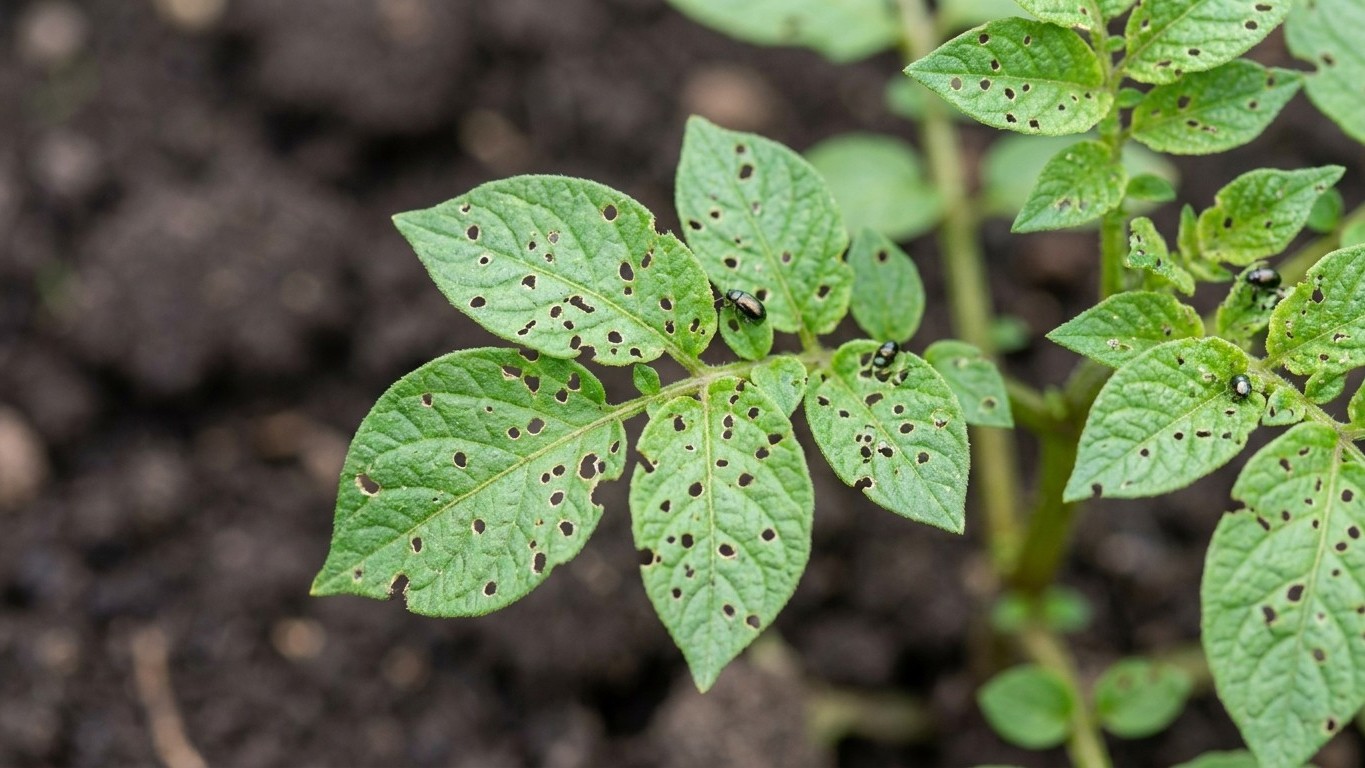

Those tiny, ragged holes scattered across young potato leaves aren’t random damage. Utah State University Extension identifies this pattern as flea beetle feeding: adults chew small holes in the leaves of young plants, and that feeding reduces plant vigor and decreases yield. The cost isn’t cosmetic. A weakened plant early in the season means a smaller harvest later, even if the foliage eventually grows past the worst of it.
The short answer
Shot-hole damage on potato leaves, the kind that looks like someone took a hole punch to the foliage, is the signature of flea beetle feeding. Utah State University Extension describes the symptom plainly: adults chew tiny holes in leaves of young plants. The holes themselves are small, often just a millimeter or two across, but they show up in clusters because flea beetles feed in groups and move fast when disturbed. If you brush a leaf and see small dark insects jump away like fleas, that confirms what you’re looking at before you even count the holes.
The financial and practical cost is where this stops being a minor annoyance. According to the same source, beetle feeding reduces plant vigor and decreases yield. That’s the real stake for anyone growing potatoes in a home garden or small plot: it’s not just leaf appearance, it’s tuber production later in the season. Young plants take the worst of it because they have less leaf surface to spare. A plant with four true leaves that loses a meaningful share of that tissue to feeding has less capacity to photosynthesize and build the below-ground reserves that become your harvest.
This matters most in the weeks right after emergence, when seedlings are tender and flea beetles are most active. A garden with a heavy flea beetle population in early spring can show visible stunting compared to unaffected plants by the time tubers start forming. The damage compounds because a stressed plant is also more vulnerable to other pressures, whether that’s drought stress, competition from weeds, or secondary pest and disease issues that a vigorous plant would otherwise shrug off.
None of this means every hole in a potato leaf spells disaster. Light, scattered feeding on mature plants with plenty of established foliage is a different situation than heavy feeding on seedlings just breaking through the soil. Utah State University Extension’s guidance centers on that early window, when plants are most vulnerable and control decisions matter most. The takeaway from the short answer is simple: shot holes are the sign, reduced vigor and yield are the cost, and timing your response to the seedling stage is what separates a manageable problem from a lost portion of your crop.
What actually decides it
Flea beetles are small, and that size is part of what makes them easy to misdiagnose. They’re typically dark, sometimes with a slight shine, and they get their common name from their jumping behavior. Disturb a leaf and they spring away instantly, which is a useful field test: aphids crawl, caterpillars inch along or drop on silk, but flea beetles vanish in a hop. That single behavioral clue does more to confirm identification than the appearance of the holes themselves.
The holes matter because of how they’re made. Adult flea beetles chew through leaf tissue in small circular or irregular patches, leaving the surrounding leaf intact. This creates the shot-hole look, dozens of tiny perforations rather than large ragged bites or skeletonized leaves. The pattern tends to concentrate on younger leaves first, because those tissues are more tender and more attractive to feeding adults. As the season progresses and plants gain more mature foliage, the same population of beetles can be present without causing proportionally as much visible damage, simply because there’s more leaf area to absorb the feeding.
What actually decides whether this becomes a yield problem isn’t just the presence of beetles, it’s the timing relative to plant growth stage. Utah State University Extension’s framing, focused on young plants, points to this directly. A seedling with two or three leaves that takes heavy shot-hole damage has far less capacity to recover than an established plant with a full canopy taking the same intensity of feeding. That’s why the same insect, doing the same kind of chewing, can be a background nuisance in July and a real threat in the two or three weeks right after plants emerge.
Weather and soil conditions around planting also play into beetle activity, though the specific thresholds aren’t part of the published guidance referenced here. What is clear is that the mechanism is adult beetles feeding on foliage, not a soil-borne issue, not a fungal spread pattern, and not a vascular disease working through the plant. The damage stays visible, external, and traceable to chewing, which is the detail that should guide how you scout: look at the leaves, look for the jumping insects, and don’t assume every leaf problem in a potato patch has the same origin.
What to do about it
- Confirm the identification first. Before treating anything, check for the actual insects: small, dark, quick to jump when disturbed. Matching that behavior to the shot-hole pattern on the leaves rules out other causes and prevents wasted effort on the wrong problem.
- Time your scouting to seedling emergence. Since young plants carry the highest cost from feeding, start checking foliage as soon as seedlings break the soil surface, not weeks later once damage is already extensive.
- Control beetles with appropriate insecticides at planting or after seedlings have emerged. This is the published recommendation from Utah State University Extension, and it specifies two windows: at planting, or once seedlings are up. Choosing an appropriate product for the situation matters more than reaching for whatever is on hand, since not every insecticide is labeled or effective for flea beetles on potatoes.
- Reassess as plants mature. Once potato plants have built a fuller canopy, the same level of beetle activity causes proportionally less damage. Continued monitoring helps determine whether further treatment is warranted or whether the plants have outgrown the most vulnerable stage.
Identification has to come first because flea beetle damage can resemble other leaf issues, and treating the wrong problem wastes time while the actual cause keeps feeding. Confirming the insect and the pattern before acting is what makes the rest of the sequence effective rather than guesswork.
What goes wrong
- Mistaking shot holes for early blight or other fungal spotting. Fungal leaf diseases typically produce discolored lesions with defined borders, often with concentric rings, rather than clean punched-through holes. Flea beetle damage leaves the surrounding tissue green and intact around each hole; a fungal lesion usually shows browning or yellowing tissue at the site itself.
- Confusing flea beetle feeding with hail or mechanical damage. Hail can tear irregular holes across a broader area of the plant all at once, often with torn or shredded edges, while flea beetle holes are more uniformly small and appear gradually as adults continue feeding over days.
- Overlooking the insect itself and treating only the symptom. Because flea beetles jump away so quickly when a plant is disturbed, gardeners sometimes see the holes, assume a disease, and never actually spot the insect responsible. Checking leaves gently, and looking at the soil surface near the base of plants where beetles can also be found, helps confirm the cause before choosing a treatment.
- Assuming all leaf damage on young potatoes has equal impact. Not every hole-riddled leaf translates to the same yield loss. The Extension guidance ties the cost specifically to feeding on young plants; damage that shows up later, once plants are well established, doesn’t carry the same risk to vigor and yield.
Common questions
Do flea beetles affect potato tubers directly, or only the leaves?
The published guidance from Utah State University Extension describes adults chewing holes in leaves, with the cost expressed as reduced plant vigor and decreased yield rather than direct feeding on tubers themselves.
How soon after planting should I start checking for flea beetle damage?
Since the guidance centers on young plants, checking foliage as soon as seedlings emerge from the soil is the practical window, rather than waiting until plants are further along.
Is one insecticide application usually enough?
The published recommendation covers two possible timings, at planting or after seedlings emerge, but doesn’t specify a number of applications; that detail isn’t part of the source guidance referenced here.
Can established, mature potato plants still be harmed by flea beetles?
The Extension source ties the yield and vigor cost specifically to feeding on young plants, so the same level of beetle activity on more mature foliage isn’t described as carrying the same risk.