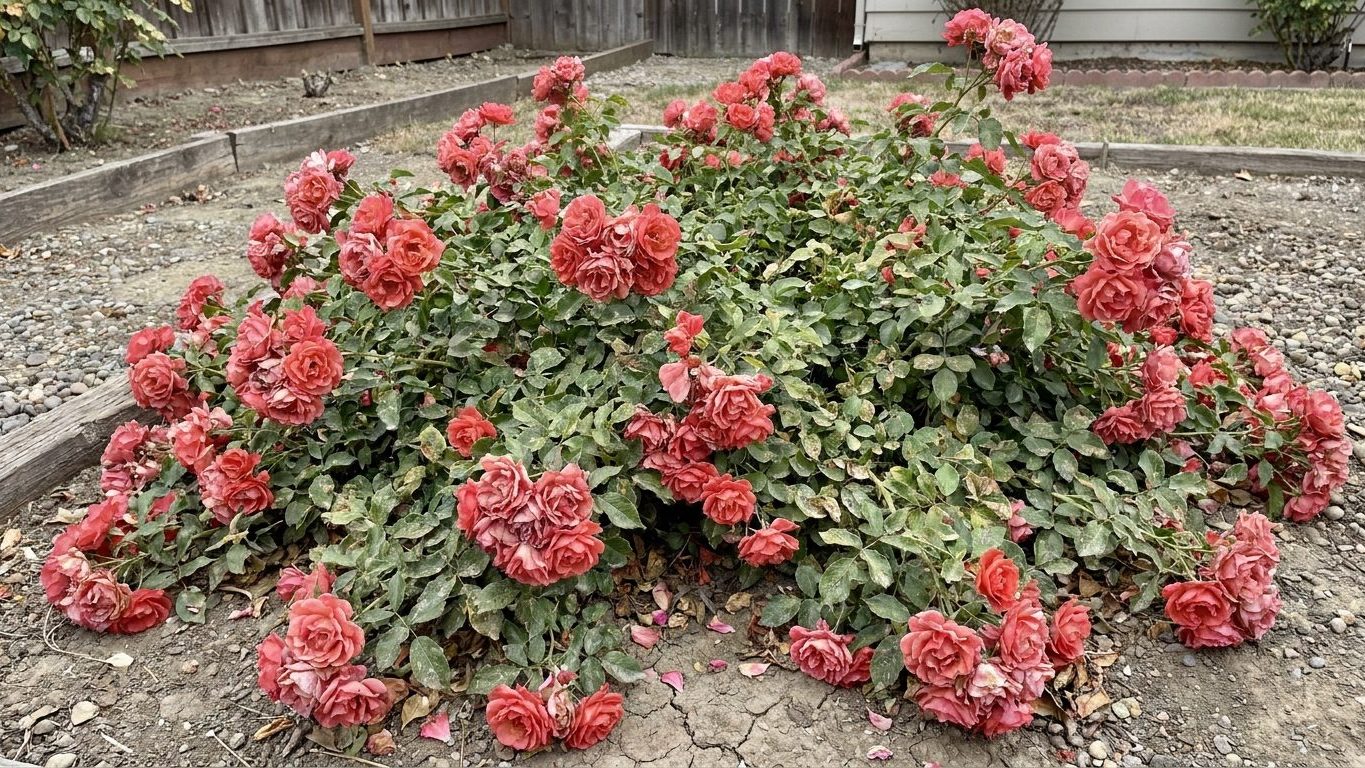

Flower Carpet is a ground cover rose bred to spread low and wide rather than climb or stand upright, and it flowers on new wood, which means the plant needs shearing rather than cane-by-cane pruning. It’s rated for USDA zones 5a through 11b, tolerates clay or loam soil from acid to neutral pH, and needs full sun. That’s the plant on paper. What it means in a real yard depends on your zone, your soil chemistry, and how much of the “high maintenance” rating you’re willing to sign up for.
What Flower Carpet actually is
Flower Carpet belongs to the Ground Cover group, one of several rose groups covered on this site, and its defining trait is where it flowers from: new wood, not old. That single fact decides how it gets pruned. A rambler that blooms on old wood gets pruned right after flowering, because cutting it back in late winter would remove the wood that was about to bloom. Flower Carpet works the other way: since flowers come from wood grown this season, it gets sheared rather than trimmed cane by cane, and the exact timing depends on your zone, which is a question for the state-specific page rather than this one.
On size, the only figure documented at the genus level is 1 to 8 feet tall and 1 to 6 feet wide, “depending on cultivar,” according to the North Carolina Extension Gardener Plant Toolbox. Ground cover types like this one typically sit toward the low, spreading end of that range, but no exact mature spread is published for Flower Carpet specifically, so check the nursery tag before deciding how far apart to plant it.
Growth rate is rated medium and maintenance is rated high, which is worth sitting with before you buy: this isn’t a plant-it-and-forget-it shrub, even though it’s marketed as tough. It wants full sun, six or more hours of direct light a day, and soil that runs from acid (below pH 6.0) to neutral (6.0 to 8.0). Outside that pH window, particularly on the alkaline side, trouble starts, covered below.
What Flower Carpet is good for
The source description credits this cultivar with resistance to drought, heat, and de-icing salt. That’s a narrow but useful set of tolerances, pointing to a specific job: hard sites where a lawn or a delicate perennial would struggle. Think a sloped bank that erodes in rain, a strip along a driveway that gets salted every winter, a parking-lot island baked by reflected heat off asphalt. The mechanism behind “drought and heat tolerant” is a low, spreading habit that shades its own root zone and needs less supplemental water than an upright shrub exposed on all sides.
Salt tolerance matters for a specific reason: plants along walkways and driveways in cold climates absorb runoff loaded with sodium chloride every winter, and most ornamentals show scorched leaf margins or dieback from it by spring. A cultivar bred to shrug that off is genuinely useful along a northern driveway.
What Flower Carpet is not documented for is fragrance. The genus Rosa is grouped into five fragrance categories, old rose, fruity, tea, myrrh, and musk, but no fragrance note is published for this specific cultivar, so don’t expect a scented hedge; treat any fragrance as a bonus. The same goes for cut-flower use: nothing in the source ties this cultivar to vase performance, and ground cover roses in general are grown for mass landscape display, not cutting.
The hips are worth mentioning separately. Rose hips are an accessory fruit holding the plant’s achenes, they’re edible, and they turn from green to red in fall. That’s a genus-wide fact rather than something specific to Flower Carpet, but it’s a real bonus for anyone who wants a landscape plant that also feeds birds through the colder months.
Where it ripens in time, and where it is a gamble
Flower Carpet’s hardiness range, USDA zones 5a through 11b, is unusually wide for a rose. USDA plant hardiness zones are defined by average annual minimum winter temperature, and zone 5a marks roughly the cold edge of where this cultivar is documented to survive without extra protection, a band running through parts of the upper Midwest and interior New England. Zone 11b sits at the opposite extreme, covering the far southern tip of Florida and the Keys, where frost essentially doesn’t happen. Between those edges lies most of the continental United States, which is why this variety shows up in so many regional landscape lists.
What that zone range doesn’t tell you is how the plant performs once it’s alive. A gardener in zone 5a and one in zone 10b are both inside the documented range, but they’re managing completely different plants in practice: one is fighting to get wood to ripen before a hard freeze, the other never sees real dormancy at all. Neither condition is captured by the zone number alone.
The practical way to use the 5a-to-11b figure is as a filter, not a guarantee. If your zone falls outside that range, the plant isn’t documented to survive there without intervention. If it falls inside, the zone number tells you the plant can survive winter where you live; it says nothing about your soil pH, sun exposure, or how much shearing and feeding you’re prepared to do, all of which matter more day to day than the zone rating.
Spacing is the other place zone range gets misread. Because mature width for the genus runs 1 to 6 feet, and this ground cover selection likely lands toward the wider end rather than the narrow one, planting several specimens close together on the assumption that “ground cover” means compact is a common way this variety disappoints gardeners expecting a tidy border. Space for the eventual width, not the nursery-pot width, and confirm mature spread on the plant tag before committing to a spacing pattern.
The two ways a season goes wrong
A wide hardiness range doesn’t mean a trouble-free one. Two separate limits sit outside what the zone number shows, and they fail a Flower Carpet planting in opposite ways.
On the cold end, zone 5a is the documented floor. Below that, winter survival isn’t described in the source data at all, which means planting this cultivar in a colder zone is a gamble the label doesn’t cover, not a documented risk with a known outcome.
On the soil end, the risk is chemistry rather than temperature. The documented pH range runs from acid, below 6.0, to neutral, between 6.0 and 8.0. Push past roughly 7.5 into strongly alkaline soil, common near concrete foundations, driveways, and freshly poured walkways, and iron chlorosis becomes a real risk: leaves yellow between the veins because the plant can’t take up iron efficiently in that chemistry, even though the soil itself looks fine.
For this cultivar, the alkaline-soil risk is probably the more common failure point day to day. Flower Carpet is marketed for hard sites, exactly the kind of spot, next to a salted driveway or a concrete parking strip, where soil pH tends to run high from lime leaching out of concrete over years. A gardener who buys this rose specifically for a tough urban spot may be walking it straight into the soil condition it handles worst. A simple pH test before planting, rather than after the leaves start yellowing, is the cheap way to avoid that outcome.
What it resists, and what it does not
The pests and diseases documented for Rosa by the North Carolina Extension Gardener Plant Toolbox aren’t graded per cultivar; they’re listed at the genus level, and no specific disease-resistance rating is published for Flower Carpet beyond its drought, heat, and salt tolerance. Treat the following as risks to watch for, not something this rose is certified to shrug off.
- Pests: Fuller rose beetle, Japanese beetle, rose chafer, rose thrips, southern red mite, two-spotted mite
- Diseases: botrytis, blights, powdery mildew, leaf spots, anthracnose
Two of those names deserve a correction. The southern red mite and two-spotted mite are arachnids, not insects, so an insecticide labeled for beetles or thrips won’t necessarily touch them; they need treatment as mites specifically.
Among the leaf spot diseases, black spot is the one gardeners run into most, and it overwinters both in fallen leaves and in lesions on the canes themselves. Raking up litter every fall helps, but doesn’t end the problem if infected canes stay on the plant. Powdery mildew is the opposite case: it overwinters in dormant buds and stem tissue, not leaf litter, so sanitation around the base does nothing for it. Different disease, different hiding place, different cleanup.
Growing it without the usual mistakes
Because Flower Carpet flowers on new wood, the pruning approach is shearing rather than selective cane removal, more like cutting back a shrub hedge than trimming individual canes on a hybrid tea. The exact month depends on your zone and local last-frost timing, which is why that date belongs on the page for your state rather than here.
Check the plant tag for whether your specimen is grafted or own-root before winter. Many landscape shrub roses sold today, including several ground cover types, are own-root rather than budded onto a rootstock, and that changes what you’re protecting: a budded rose needs the graft union insulated through winter, while an own-root plant needs the crown protected instead. The tag, or the nursery receipt, is the fastest way to know which situation you’re in.
Stop deadheading before the season winds down in your zone. Every deadheading cut pushes the plant to produce a new shoot, and shoots produced too close to your first frost date often stay too soft to ripen in time. Letting the last flush of spent blooms sit unpruned in late season, rather than continuing to cut them for tidiness, is a small change that reduces winter dieback.
At cleanup time, resist cutting every dead stem to the ground. Trim dead wood back to 12 to 24 inches and leave those stubs standing rather than removing them entirely; stem-nesting native bees use that hollow, cut wood over winter, and a fully shorn bed offers them nothing.
Common questions
Is Flower Carpet a climbing rose or a ground cover?
It’s a Ground Cover type, bred to spread low and wide rather than climb, which is why it’s used on slopes, banks, and roadside strips rather than trellises.
Are rose thorns dangerous on this variety?
What look like thorns are prickles, outgrowths of the stem’s outer skin rather than true woody thorns, which is why they snap off sideways instead of breaking like a modified stem would.
Does Flower Carpet need feeding all season?
The source rates its maintenance as high and its growth rate as medium, but no specific feeding schedule is published; general guidance is to taper feeding as your local season winds down so new growth has time to ripen before frost.
Can I grow Flower Carpet in partial shade?
No margin is documented for reduced light. The requirement given is full sun, six or more hours of direct sunlight daily; less than that isn’t covered by the source data, so treat shade planting as unsupported rather than merely suboptimal.