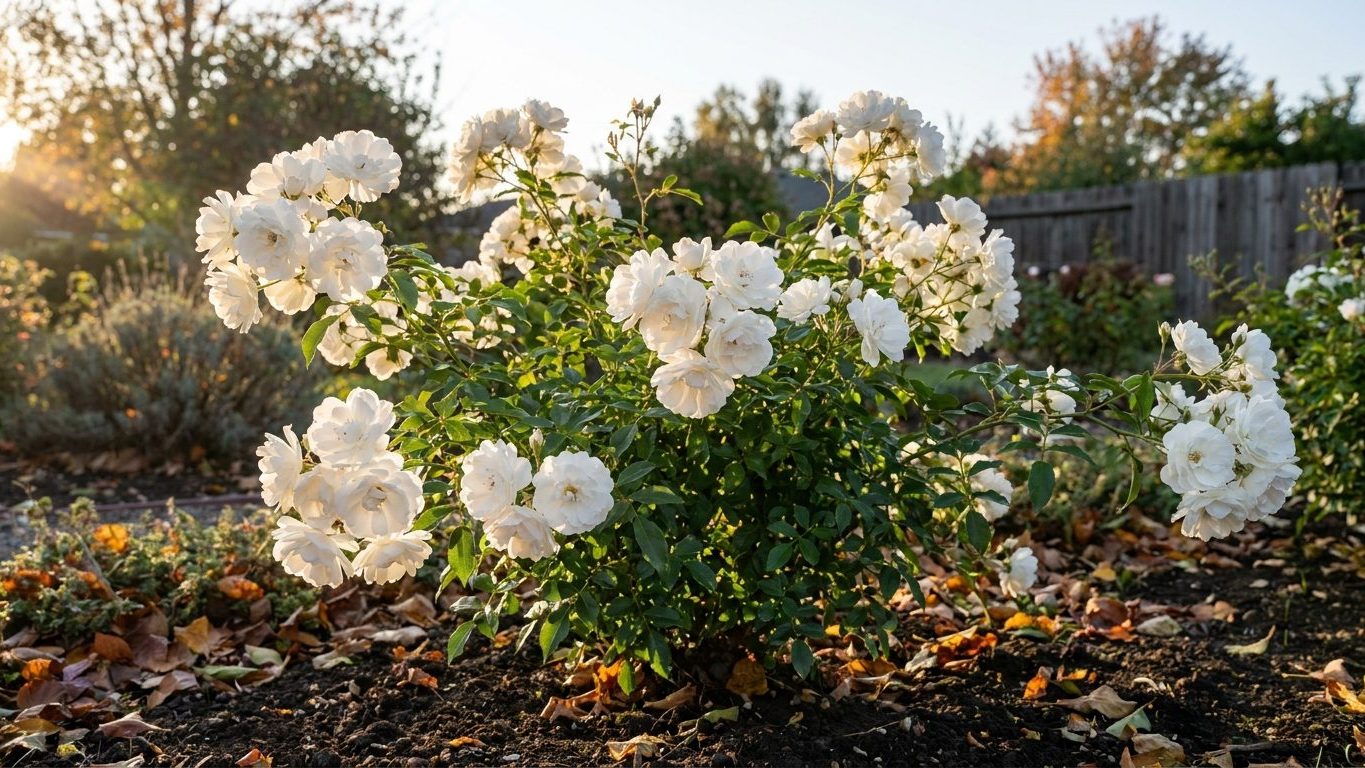

Iceberg is a Floribunda rose grown for clusters of simple white flowers, lightly scented, that keep opening from spring into fall almost anywhere winters don’t drop past USDA zone 5a. It’s rated hardy from zone 5a through 11b, needs six or more hours of direct sun, and flowers on new wood each year, which is the single detail that decides how you cut it back. A climbing sport, ‘Schneewittchen’ (KORbin), carries the same bloom on a taller frame.
What Iceberg actually is
The genus range from NC State Extension puts roses anywhere from 1 to 8 feet tall and 1 to 6 feet wide, and that spread exists because a bush Floribunda and a climbing sport of the same cultivar are not the same plant to plant. Iceberg’s own footprint, and the exact size difference between the shrub form and ‘Schneewittchen’, is a cultivar-level figure you’ll find on the variety comparison page, not in the genus-wide range.
What the source does confirm for the genus, and what applies here, is full sun of six or more hours, and soil that runs clay or loam with a pH anywhere from acid (below 6.0) to neutral (6.0-8.0). Growth rate is medium, but maintenance is rated HIGH, and that rating matters for a Floribunda whose flowers form in clusters that need deadheading to keep coming.
The fact that changes everything downstream is the wood. Iceberg blooms on new wood grown that same season, not on wood left over from last year. A rambler that flowers on old wood gets pruned lightly, after bloom, to spare the cane that will flower next spring. Iceberg gets no such mercy: the yearly late-winter pruning that NC State recommends for most roses is, on this cultivar, a hard cutback, because the new wood that follows is what carries every flower cluster that season.
What Iceberg is good for
A simple, five-to-few-petaled white bloom that opens flat and repeats through the season is built for two jobs: mass color in a bed or hedge, and cut stems for the house. The flower’s structure explains why it works for both. Flower parts across the genus come in multiples of five, and a simple form near the low end of that count opens fast and wide rather than staying tight like a many-petaled hybrid tea, so a bed of Iceberg reads as a solid drift of white rather than individual show blooms.
For the vase, timing the cut matters more with a simple flower than with a dense one, because it opens quickly once cut. The cultivar’s own bloom description confirms only that the flowers are simple and lightly fragrant, nothing stronger, so cut it once the sepals have folded back and the first one or two petals are unfurling. Wait for a fully open bloom and it won’t last once indoors.
If a reader wants heavier scent and a single classic bloom instead of a repeat-flowering white cluster, a hybrid tea like Mr. Lincoln answers that brief instead. If the priority is the lowest possible maintenance rather than a cutting garden, an own-root shrub bred specifically for resistance, such as Oso Easy, trades some of Iceberg’s flower count for less spray and less watching.
Left undeadheaded late in the season, Iceberg’s spent blooms will set hips, the accessory fruit that holds the true seed (the achenes) and that turns from green to red in fall. Hips are edible and decorative, but forming them means fewer new flushes, so it’s a trade-off between more bloom now or hips later, not a defect either way.
Where it ripens in time, and where it is a gamble
Iceberg’s rated range of USDA zones 5a through 11b covers most of the continental country, but “hardy” doesn’t mean “identical performance” at both ends. What actually changes as you move through that range is how much winter damage the new wood takes before spring growth starts, and how long the bloom season runs before summer heat slows it.
What changes across the range
| Zone band | What it means for Iceberg | Practical consequence |
|---|---|---|
| 5a-6b (cold winters) | New wood can die back hard over winter, sometimes to the crown or bud union | Winter protection matters, and spring growth starts later, delaying the first flush |
| 7-9 (temperate) | Little to no winter dieback, a long uninterrupted bloom season | Regular deadheading keeps flushes coming from spring through fall |
| 10-11b (subtropical/tropical) | Essentially no winter rest for the plant | Bloom can run nearly year-round, but midsummer heat still slows flower quality |
At the cold end, the practical question isn’t whether Iceberg survives (it’s rated hardy to 5a) but whether the wood that survives is enough to carry a full first flush without a long delay. That’s a rootstock question as much as a climate one: a grafted plant protects the bud union, an own-root plant protects the crown, and the tag tells you which you have. Neither NC State’s genus page nor Iceberg’s own cultivar description gives a specific mounding depth or a calendar date for either zone, because that figure is set at the state level, not for the genus.
At the warm end, the range extends to 11b, which covers South Florida and similar near-tropical conditions, and there the limiting factor stops being cold entirely. Full sun and six-plus hours of direct light are still required, but soil pH management (keeping it out of the strongly alkaline range above roughly 7.5, where iron chlorosis shows up) becomes the more common maintenance issue than winter survival ever is.
The two ways a season goes wrong
A wide hardiness range on a plant tag can hide two separate failure modes that don’t show up in that single number. In the coldest part of Iceberg’s range, the plant itself survives winter, but the new wood it needs for flowers doesn’t always survive intact, so the first bloom flush can run weeks behind a warmer-zone garden even though both gardens are technically “in range.”
In the hottest part of its range, the opposite problem shows up: nothing kills the plant, but sustained high heat through the middle of summer stresses bud formation and fades petal color on white blooms especially, so growers in the warmest zones often see a strong spring flush, a quieter midsummer stretch, and a second strong flush once nights cool in fall rather than one even season.
For a cultivar rated from 5a through 11b, the cold-end risk is the more consequential one, simply because it delays or reduces the first flush of the year rather than just softening flower quality for a few weeks. That’s also the reason the wood question from the first section matters so much here: a plant that loses more new wood over winter is a plant with less to bloom on come spring, regardless of what the calendar says about the last frost.
What it resists, and what it does not
NC State’s Rosa page names the pests and diseases documented for the genus, and none of them are rated per cultivar on that source, so nothing here should be read as an Iceberg-specific resistance claim. The pests named are Fuller rose beetle, Japanese beetle, rose chafer, rose thrips, and two arachnids, southern red mite and two-spotted mite, grouped correctly as pests and mites rather than lumped under insects.
The diseases named are botrytis, blights, powdery mildew, leaf spots, and anthracnose. Iceberg’s flower clusters, typical of Floribundas, hold moisture between tightly packed buds after rain, which is the mechanical reason botrytis shows up on cluster-flowered roses more than on single-bloom types, not a resistance failure specific to this cultivar.
Two of those diseases overwinter differently, and treating them the same is a common mistake. Black spot survives both in fallen leaves and in lesions on the canes themselves, while powdery mildew overwinters in dormant buds and on stems, not in leaf litter at all. Raking up fallen leaves in fall helps against black spot but does nothing against mildew, so a cleanup routine built around one disease can leave the plant exposed to the other. Nothing in the source rates Iceberg as resistant to any of these, so treat the list as what to watch for, not what’s been bred out.
Growing it without the usual mistakes
Because Iceberg flowers on new wood, the yearly pruning it needs isn’t the light shaping a rambler gets after bloom. It’s a hard cutback done while the plant is dormant, sized to the reader’s own zone rather than a fixed date, since a zone 6 garden and a zone 9 garden aren’t dormant at the same time of year.
Space it for the six-plus hours of full sun the genus requires, and leave enough air movement between plants to work against the botrytis risk clustered flowers carry in humid weather. Stop deadheading late in the season rather than pushing one more flush: every cut sends up a new shoot, and a shoot pushed too late won’t ripen its wood before the first hard cold, leaving soft growth that dies back regardless of the zone rating on the tag.
Check the plant tag before deciding how to protect it over winter. Grafted plants (common on many Floribundas and hybrid teas) need the bud union protected, while own-root plants have no union at all and need the crown covered instead. Guessing wrong wastes the effort either way.
Quick check before you cut: the sharp structures on rose stems are prickles, not true thorns, growing from the stem’s outer skin rather than from woody tissue underneath, which is why they snap off sideways instead of splintering. It changes nothing about how you handle the plant, but it explains why a rubbed cane can lose its prickles while a true thorn never would.
Come winter cleanup, cut dead stems back to 12 to 24 inches rather than to the ground, and leave them standing. Those hollow stems are nest sites for native stem-nesting bees, and removing every last inch of dead wood costs the garden that habitat for no gain in plant health.
Common questions
Does Iceberg need winter protection?
It depends on zone and rootstock. In the coldest part of its 5a-11b range, protect whichever structure carries the plant’s future growth, the bud union on a grafted plant or the crown on an own-root one. Check the tag to know which applies.
Is Iceberg strongly fragrant?
The cultivar description notes the flowers as lightly scented, not strongly fragrant. Readers wanting heavier scent are better served by a fragrant hybrid tea such as Mr. Lincoln.
What’s the difference between Iceberg and its climbing form?
‘Schneewittchen’ (KORbin) is a climbing sport of the same cultivar, carrying the same simple white flower on a taller, trainable frame rather than a bush habit.
Are the thorns on Iceberg dangerous?
They’re prickles, not true thorns. They grow from the stem’s outer skin, which is why they can be rubbed off, unlike a true thorn, which is woody to the core.