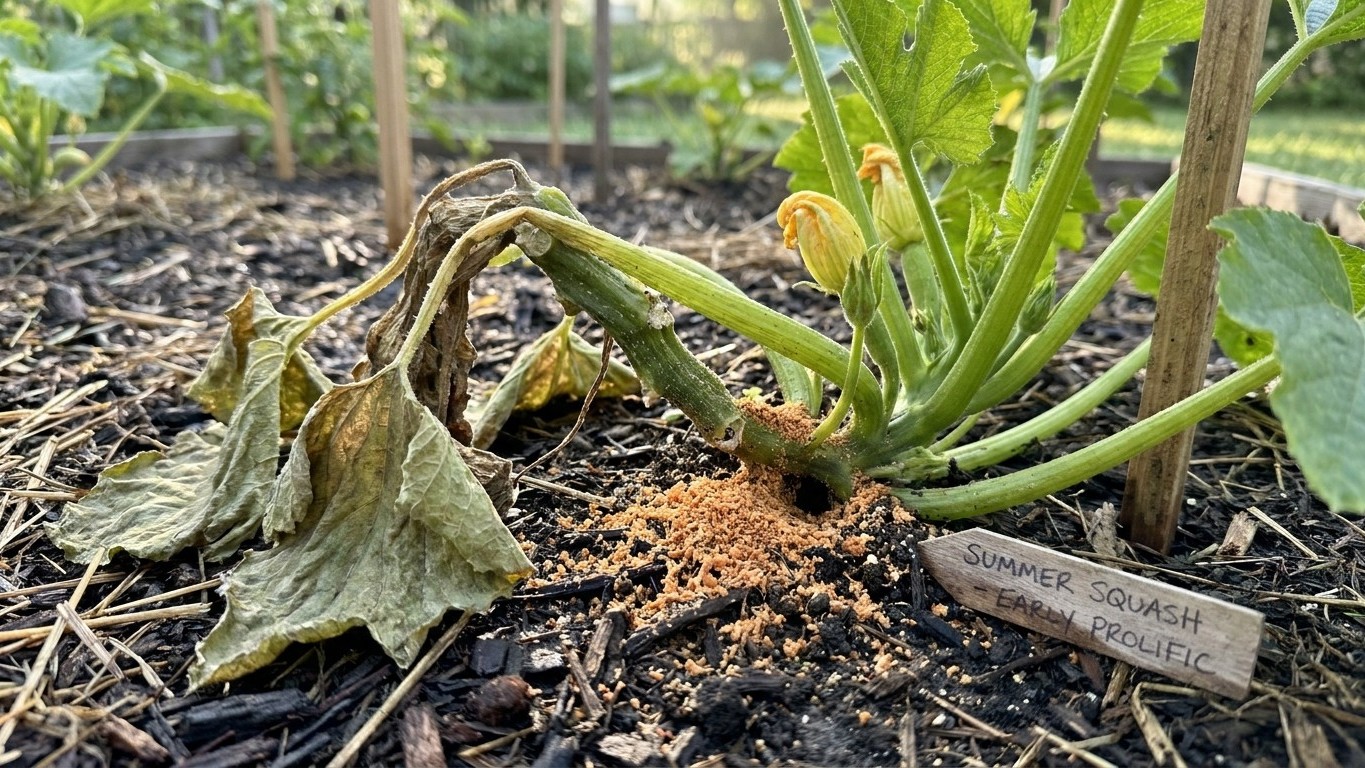

A summer squash plant that looks fine one evening and lies flat the next morning is almost never a watering problem. It’s usually squash vine borer damage, and by the time the whole plant is down, the larva responsible has already been feeding inside the stem for weeks. The plant didn’t collapse overnight. It just ran out of water overnight, because the pipe carrying it had been chewed hollow from the inside.
What is actually going on

The culprit is the larva of a moth that looks almost nothing like a moth. It’s day-flying, with an orange-and-black body that makes it easy to mistake for a wasp, and it lays its eggs individually at the base of the plant, right at soil level, usually in early to midsummer. Each egg hatches within a week to ten days, and the young larva does something a caterpillar shouldn’t be able to do: it bores straight into the stem and disappears from view.
Once inside, it feeds for four to six weeks, tunneling through the pith that carries water and nutrients up from the roots. That’s the part gardeners never see. The only outward evidence is a small pile of moist, sawdust-like frass sitting at the base of the plant, pushed out through the entry hole like debris from a construction site. Most people walk right past it, because it doesn’t look like damage. It looks like dirt.
As the tunnel widens, the stem’s internal plumbing gets cut off in sections. A plant can wilt on one side while the other side still looks healthy, because only part of the vascular system has been severed. That partial wilting is often the first real sign, and it can persist for days before the whole plant finally gives out. Once enough of the stem is hollowed, there isn’t enough intact tissue left to hold water pressure, and the collapse that follows can genuinely happen within twenty-four hours.
Not every squash plant is equally at risk. Types in the summer squash and zucchini family tend to have thinner, more hollow stems, which makes them easier targets and more vulnerable to total collapse once a larva gets inside. Squash types with denser, more solid vines, the kind often grown for fall storage, tend to tolerate a tunneling larva longer before showing serious symptoms. This is a difference in stem anatomy across squash types, not a reason to chase a specific variety name, since resistance varies by region and by the particular seed lines available locally. A state extension service can point to what performs best in that climate.
It’s also worth knowing that a single stem can have more than one entry hole. Larvae don’t share tunnels particularly well, and a heavily infested plant may be hollowed out from two or three separate points along the same vine, which is part of why collapse can look so sudden and so total.
In the garden
Finding the problem early is almost entirely about knowing where to look and how often. The entry hole is nearly always within the first few inches of the main stem, right where it meets the soil, and the frass around it is the single most reliable early warning sign available. Checking that spot once a week during the egg-laying window matters more than almost anything else a gardener can do.
| Sign or action | What it means | What to do | What happens if it’s missed |
|---|---|---|---|
| Sawdust-like frass at stem base | A larva has already entered and is actively feeding | Slit the stem lengthwise near the hole, remove the larva by hand, then mound moist soil over the wound | The tunnel keeps widening and the plant loses vascular tissue it can’t replace |
| Partial wilting on one side of the plant | Part of the water supply has already been cut off | Check the base immediately for frass rather than assuming drought | Watering more heavily does nothing and can even encourage stem rot at the wound |
| Vine touching soil at leaf nodes | The plant can root at these points, creating a backup water supply | Mound soil over one or two nodes early in the season, before symptoms appear | The plant has only one entry point for water, so a single larva can take down the whole vine |
| Sudden total collapse overnight | The main stem has been hollowed past the point of holding water pressure | Cut and remove the plant to stop larvae from maturing and overwintering in the debris | Larvae finish their cycle in the soil and the same bed sees the problem again next season |
The slit-and-remove technique works, but only within a narrow window. Once the tunnel runs more than a few inches inside the stem, or once it’s split across multiple entry points, cutting the vine open does more damage than the larva already caused. At that stage, the more realistic goal is protecting the rest of the patch rather than saving that particular plant.
Timing matters just as much as technique. Egg-laying happens over a period of several weeks, not all at once, so a single inspection early in the season isn’t enough. A plant that looked clean two weeks ago can have a fresh entry hole today. Gardeners who treat this as a one-time check, rather than a weekly habit through the vulnerable stretch of the season, tend to be the ones surprised by a plant that “collapsed overnight.”
What it depends on where you are
How much of this risk actually applies, and when, depends heavily on climate, and that part of the picture is genuinely local. Squash vine borer moths emerge once soil and air temperatures warm up enough in spring, and that timing shifts by weeks between a short-season northern garden and a long, hot southern one. In shorter growing seasons, there’s typically a single generation of moths per year, which narrows the risk window. In regions with a long, warm summer, a second generation can emerge later, which means the danger period stretches much further into the season than a gardener further north would expect.
Summer heat and rainfall patterns also influence how fast larvae develop once they’re inside the stem, and how much stress the plant is already under from other factors. A vine growing in a drought-stressed garden has less reserve capacity to survive a partial vascular injury than one growing in consistently moist soil, so the same level of tunneling damage can look far more severe in one climate than another.
None of this is something a single national article can pin down responsibly. Squash vine borer emergence dates, the number of generations per year, and the length of the vulnerable window are tracked locally by state agricultural extension programs, which monitor actual moth activity through the season rather than relying on a generic calendar. Checking with the cooperative extension service for a specific state or county is the most reliable way to know when the local risk window opens and how long it typically stays open.
The broader guides on this site covering summer squash growing conditions and pest timing can help frame the general pattern, but the specific dates always belong to local extension data, not to a national article.
The mistake that costs the most
The single costliest mistake is treating the first sign of wilting as a watering problem and responding by watering more. It’s an understandable reaction. Wilting looks exactly like drought stress, and the instinct to reach for a hose is immediate. But by the time a summer squash plant is visibly wilting from vine borer damage, the larva has typically already been feeding inside the stem for one to two weeks, and extra water at that point does nothing to restore the vascular tissue that’s already been hollowed out.
What that mistake actually costs is time, and time is the one resource that matters most here. Every day spent watering a plant that’s actually losing an internal battle with a larva is a day not spent checking the stem base for frass, not spent slitting the stem to remove the larva while it’s still small, and not spent mounding soil over healthy nodes on neighboring plants to give them a backup rooting point. The plant that could have been saved with a five-minute inspection ends up collapsing entirely, and worse, the larva inside often survives to pupate in the soil regardless of what happens to the plant above ground.
The fix is simple to describe even if it takes discipline to practice: whenever a summer squash plant shows any wilting, check the base of the stem before doing anything else. Look for frass, look for a visible hole, and only reach for the watering can once vine borer has been ruled out. That single habit, repeated weekly through the vulnerable part of the season, prevents more losses than any other single practice available to a home gardener growing squash types in the more hollow-stemmed, vine borer-prone family.