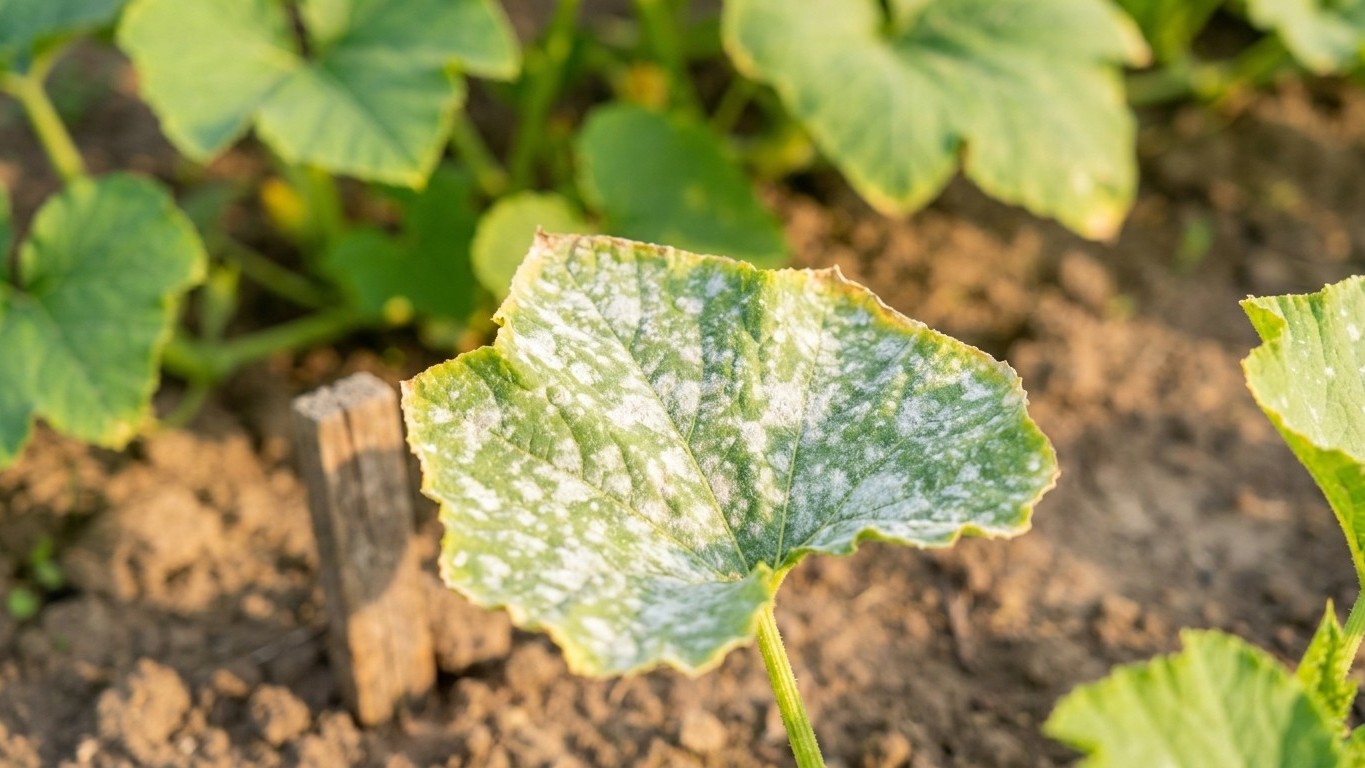

That white, flour-like coating on squash leaves is powdery mildew, a fungal disease that spreads fast in warm, humid air but rarely kills the plant outright. It weakens leaves, cuts down photosynthesis, and shortens how long the plant keeps producing. Caught early and managed with airflow, sanitation, and timing, most squash plants can push through a full harvest season despite it.
What is actually going on

The thing to understand here is that this mildew needs humid air but not wet leaves, so it thrives in dry warm spells with high humidity overnight and no rain to wash spores away. That’s the opposite of what most gardeners assume. Downy mildew and other leaf diseases need standing water on foliage to infect a plant. Powdery mildew spores can germinate on a dry leaf surface as long as the surrounding air holds enough moisture, which is exactly the pattern of late summer in much of the country: hot days, cool humid nights, and long dry stretches between rain events.
The fungus behind it survives on plant debris and can also blow in on wind currents from other infected plants, sometimes from miles away. Once a spore lands on a leaf, it doesn’t need a wound or a wet surface to get started, just the right humidity band and a leaf that’s aging past its most vigorous growth. That’s why the disease shows up first on older, lower leaves and works its way up and inward toward younger growth. A plant stressed by drought, crowding, or nitrogen shortage is more vulnerable, because stressed tissue has thinner cuticles and slower defensive responses.
Visually, it starts as small white or gray circular spots, almost like someone dusted the leaf with flour. Left alone, those spots merge into a solid white coating across the whole leaf surface, then the tissue underneath yellows and turns brittle. Squash plants can lose a surprising share of their leaf canopy to this before fruit production actually drops off, because the plant keeps redirecting resources to whatever green tissue remains. That’s the deceptive part: the leaves look terrible well before yield takes a real hit, which leads a lot of gardeners to either panic and pull healthy plants too soon, or ignore it too long and lose the whole canopy at once.
State extension services differ on which squash types show the most resistance in regional trials, so rather than naming a cultivar here, the practical move is to check the vegetable disease resistance ratings published by the land-grant university extension office in your state before you buy seed next season. Resistance ratings vary by growing region because local mildew strains differ, and a variety bred resistant in one climate zone can still show symptoms in another.
In the garden
What you do once you spot the white coating depends on how far it has spread and how much growing season is left. The table below breaks down the common responses and, just as important, what happens when each one is skipped or done too late.
| Situation | What to do | What happens if you don’t |
|---|---|---|
| First white spots on a few lower leaves | Remove those leaves by hand, dispose of them away from the compost pile, and improve air circulation by thinning nearby foliage | Spores spread upward and outward within days, and by the time it’s visible on new growth the infection is already established across the plant |
| Mildew covering a third or more of the plant | Cut back the most affected foliage, prioritize keeping leaves shading developing fruit, and begin a fungicidal treatment rotation appropriate for edible crops per your local extension guidance | Photosynthesis drops sharply, fruit production slows, and the plant becomes more vulnerable to secondary rot and insect damage on exposed stems |
| Late-season infection with harvest nearly done | Let the plant finish its remaining fruit, then pull and discard all plant material rather than composting it | Leftover infected debris left in the garden becomes a source of spores that can survive through mild winters and reinfect next year’s planting |
| Planning next year’s layout | Increase spacing between plants, choose a site with morning sun to dry dew quickly, and rotate squash out of that bed for a season or two | Tight spacing traps humid air around the foliage overnight, recreating the exact conditions the fungus needs, so the same bed tends to show symptoms earlier each year |
Watering habits matter more than most gardeners expect. Overhead watering in the evening keeps foliage wet into the night, which sounds like it should discourage a fungus that supposedly likes dry leaves, but in practice it just adds another stress factor without slowing the mildew down, since the disease is driven by air humidity rather than leaf wetness. Watering at the base of the plant in the morning is the better habit, because it keeps soil moisture up without adding extra humidity to the canopy during the vulnerable overnight hours.
Feeding also plays a role. Excess nitrogen pushes out a flush of soft, fast-growing leaf tissue that’s more susceptible to infection than steadily hardened growth. A balanced feeding approach, checked against your state extension’s fertility recommendations for squash, keeps growth steady rather than surging, which gives the plant’s natural leaf defenses time to develop.
What it depends on where you are
Some of this is universal: the fungus behaves the same way in a garden in the Pacific Northwest as it does in the Gulf Coast, because the biology of the pathogen doesn’t change by region. But how often it shows up, how early in the season, and how aggressively it spreads depends heavily on local season length, summer heat, and summer rainfall patterns.
A region with long dry summers and big day-to-night temperature swings will typically see earlier and more persistent mildew pressure than a region with frequent summer rain, because rainfall physically knocks spores off leaves and interrupts the humidity buildup the fungus depends on. That doesn’t mean rainy regions are in the clear. Humid climates with warm, still air can produce just as much pressure, just through a different mechanism, since the fungus responds to relative humidity in the air around the leaf rather than to rainfall itself.
Season length changes the calculation too. In areas with a short growing window, an infection that shows up late in the season may barely matter because harvest is nearly finished anyway. In areas where squash can be grown for many months, the same infection arriving early can mean months of managing a declining plant rather than replacing it with a fresh planting.
This is exactly the kind of variable that a state-level guide can address and a general page cannot. Local extension offices track which mildew strains are active in a given state, which resistant varieties performed well in regional trials, and what timing windows tend to correspond with the highest infection pressure in that climate. Checking the summer squash guides for your specific state on this site, alongside your state extension service’s current bulletins, will get you a more accurate answer than any general rule can offer.
The mistake that costs the most
The single costliest mistake is waiting to act until the mildew has already spread across most of the plant, on the assumption that a little white powder on a few leaves isn’t worth the effort yet. By the time the coating is obvious on the upper canopy, the fungus has already been established for a week or more on the lower leaves where it started, quietly building spore populations the whole time. Acting at the first sign, removing the earliest affected leaves and adjusting airflow and watering immediately, is far more effective than any treatment applied after the infection has taken hold across the plant.
The reasoning comes back to how the disease spreads. Each infected leaf becomes a spore factory, and those spores travel easily on air currents to every other leaf on the plant and to neighboring plants in the same bed. A gardener who removes two or three early spotted leaves in the first week has removed a meaningful share of the spore source before it multiplies. A gardener who waits until the whole plant looks dusted with flour is trying to treat an infection that’s already had multiple generations to spread, and at that point even a good treatment routine mostly slows the decline rather than reversing it.
The fix is simply attention early in the season, before symptoms feel serious enough to justify action. Walk the planting every few days once the weather turns warm and humid, check the undersides and lower leaves specifically since that’s where it starts, and remove anything suspicious immediately rather than waiting to see if it spreads. Pair that habit with the spacing and site choices your state extension recommends for squash types trialled in your region, and the disease becomes a manageable seasonal nuisance rather than the reason a planting ends early.