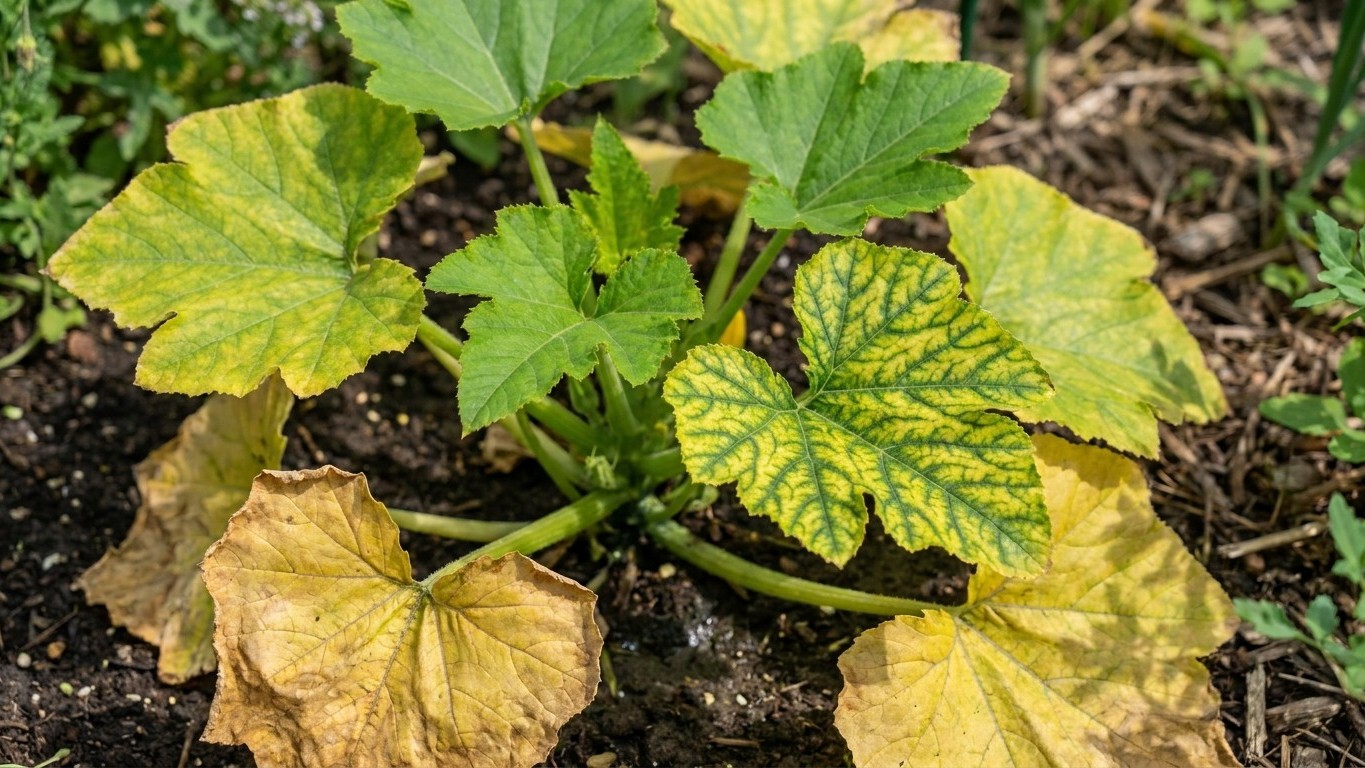

Yellow leaves on summer squash mean something different depending on which leaves turn yellow first. Oldest leaves at the base yellowing and dying back as the season winds down is normal aging. Newest growth turning pale, or yellow spreading between green veins, points to a nutrient or water problem. Yellow with spots or a fuzzy coating signals disease. The location of the yellow, not just its presence, is the diagnosis.
What is actually going on
The reason location matters so much comes down to how a plant moves its own nutrients around. Nitrogen, phosphorus, and potassium are mobile inside a squash plant. When the roots can’t pull in enough from the soil, the plant cannibalizes what it already has stored in older leaves and ships it to the new growth at the tips, where photosynthesis and fruit production matter more. That’s why a classic nitrogen shortage always shows up first on the oldest, lowest leaves, the ones closest to the soil line, while the crown stays green.
Nutrient movement inside the plant
Iron and manganese work the opposite way. They’re immobile, meaning the plant can’t relocate them once they’re built into a leaf’s tissue. So when the roots can’t take up enough of either one, usually because the soil pH is too high or the roots are sitting in waterlogged, oxygen-poor soil, the deficiency shows up on the newest leaves instead. The pattern looks distinct too: the veins stay dark green while the tissue between them turns yellow, almost like a green net laid over a yellow leaf. Gardeners on the West Coast and in parts of the Southwest run into this more than most, since alkaline soils there tie up iron even when there’s plenty in the ground.
When the whole leaf goes, not just the color
Not every yellow leaf is a nutrient story. Overwatering suffocates roots the same way a compacted, poorly drained bed does, and a plant with damaged roots can’t take up nitrogen even if the soil is full of it, so the leaves yellow uniformly across the whole plant. Fungal diseases like downy mildew produce yellow patches that are boxed in by leaf veins, almost like stained-glass panels, often with a gray or purple fuzz on the underside in humid mornings. Viral infections carried by aphids or cucumber beetles cause a mottled, blotchy yellow-green pattern paired with leaf curling or puckering. And insects that damage the stem or root system, like squash vine borer larvae tunneling inside the main stem, cut off the plant’s plumbing entirely, so the leaves yellow and wilt even though the soil underneath is perfectly moist. Reading the pattern means asking three questions in order: which leaves, is it the whole leaf or the tissue between veins, and is there wilting or spotting alongside the color change.
In the garden
Once the pattern is identified, the next step is knowing what happens if it’s ignored. Some yellowing is cosmetic and self-correcting. Some costs the whole plant within a week. The table below lays out the most common patterns gardeners report, what usually causes each one, and what happens if nothing is done.
| Pattern observed | Likely cause | What happens if ignored |
|---|---|---|
| Oldest, lowest leaves yellow first; upper canopy stays green | Natural late-season senescence or nitrogen shortage | Leaf surface shrinks early, cutting into flower and fruit production for the rest of the season |
| Yellow between green veins, concentrated on new growth | Iron or manganese deficiency, often tied to high soil pH or soggy roots | New growth stays stunted and pale, limiting the plant’s ability to feed developing fruit |
| Whole leaves pale yellow-green across the entire plant | Nitrogen shortage or root stress from overwatering | Growth stalls, flowering slows, and the plant becomes more vulnerable to secondary stress |
| Yellow patches bounded by veins, fuzzy underside in humid mornings | Downy mildew | Spreads across the canopy within days and can defoliate the plant before fruit finishes sizing |
| Blotchy yellow mottling with leaf curling or distortion | Viral infection spread by aphids or cucumber beetles | No cure exists once infected; the plant declines and can spread the virus to neighboring plants |
| Sudden wilting of a single leaf or vine, sawdust-like debris at the stem base | Squash vine borer larva tunneling inside the stem | Act today. The larva is already inside; delay means losing that vine entirely |
| Whole plant wilts rapidly, leaves yellow then collapse despite moist soil | Bacterial wilt, spread by cucumber beetles | Act today. Once systemic there is no reversing it, and the plant is usually dead within one to two weeks |
The two patterns worth dropping other garden chores for are the last two rows. A single wilted vine with debris at the base means a borer is already feeding inside the stem, and every day of delay is tissue that can’t be saved. A whole plant collapsing despite damp soil is the signature of bacterial wilt, which has no treatment once it takes hold. Everything else on the table rewards patience and a correct diagnosis more than urgency.
What it depends on where you are
Some of this is universal biology. A leaf that runs out of mobile nitrogen yellows from the bottom up no matter what state it’s growing in. But how often each cause shows up, and how fast it moves, is largely local, and this page has no way of knowing which garden is reading it.
Season length changes the math. In regions with a short, cool growing season, squash plants often run out of steam before disease pressure builds, so nutrient-related yellowing is the more common culprit. In long, hot, humid regions, downy mildew and bacterial wilt have more weeks to establish and spread, and cucumber beetle populations, which carry bacterial wilt, tend to be heavier and more persistent. Soil chemistry is regional too: alkaline soils common in parts of the West and Southwest tie up iron and manganese regardless of how much fertilizer goes down, while naturally acidic soils in parts of the Southeast rarely see that particular pattern at all.
Rainfall patterns matter just as much as heat. A wet spring followed by a dry summer stresses roots differently than steady rainfall all season, and overwatering-related yellowing shows up far more in regions with heavy clay soils that drain slowly. Disease forecasting networks that track cucurbit downy mildew across the country, such as the Cucurbit Downy Mildew monitoring network, show the disease moving northward through the growing season as spores travel on weather systems, which means the same yellow-patch pattern can show up in June in the Gulf states and not reach the upper Midwest until August. Checking a state extension service’s current pest and disease alerts, alongside the state-specific pages on this site, gives a far more accurate read on which cause is likely right now than any national guide can.
The mistake that costs the most
The single most expensive mistake is treating every yellow leaf as a nitrogen problem and reaching for fertilizer before confirming the pattern. It’s an understandable reflex. Yellow leaves look like hunger, and feeding the plant feels like the responsible response. But if the real cause is waterlogged roots, iron lockout from high soil pH, or an early-stage disease, extra nitrogen doesn’t fix anything and often makes it worse. Excess nitrogen pushes soft, lush leaf growth that’s more attractive to aphids and more susceptible to fungal infection, right at the moment the plant can least afford it. It also does nothing for a root system that’s already struggling to breathe in saturated soil, and it does absolutely nothing for a plant with bacterial wilt or a vine borer already inside the stem.
The better habit is a thirty-second check before any fertilizer goes down: which leaves are yellow, is the color loss uniform or between the veins, and is there wilting, spotting, or debris nearby. That short inspection separates a genuine nutrient shortage, which does respond to feeding, from a root, water, or pest problem that fertilizer can’t touch. A gardener who reaches for the trowel to check soil moisture and root color before reaching for fertilizer will diagnose the real cause faster, waste less material, and catch the two urgent patterns, borer damage and bacterial wilt, while there’s still a vine left to save. Local extension offices can also run a soil test that settles the nitrogen question for good, rather than guessing season after season.